The global search for clean energy is shifting focus toward a molecule that has been part of our lives for over a century: ammonia. Traditionally used in fertilizers, ammonia is now emerging as a powerhouse for the maritime and power sectors. Unlike fossil fuels, ammonia does not release carbon dioxide when burned, making it a critical tool for reducing greenhouse gas emissions. As India works toward net-zero goals, ammonia fuel offers a practical way to store and transport energy over long distances. Avaada is a part of this transition, integrating green fuels into a broader ecosystem of sustainable solutions to ensure a reliable and clean energy supply for the nation.
What is Ammonia Fuel?
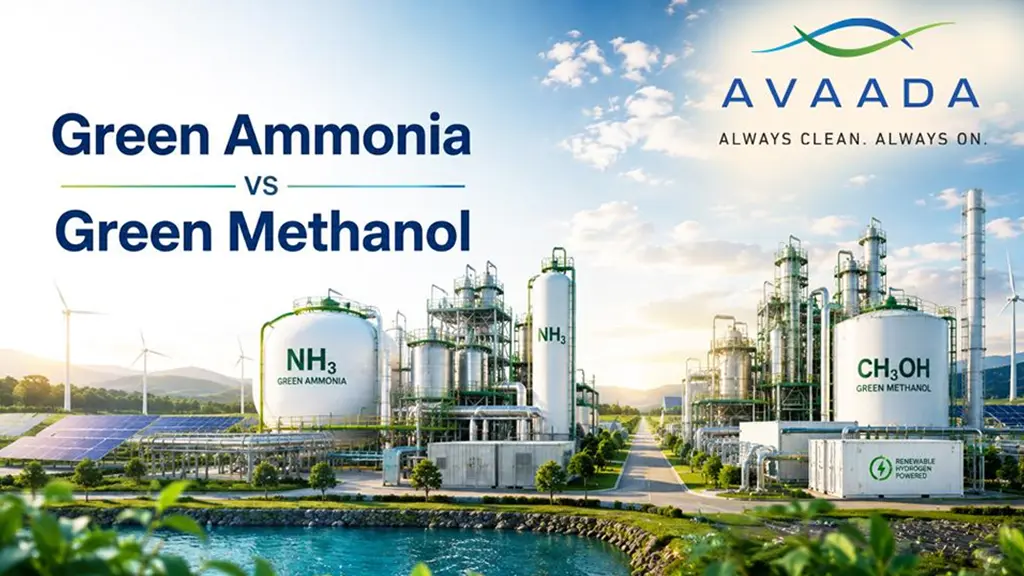
Ammonia is a chemical compound made of one nitrogen atom and three hydrogen atoms (NH3). While it is famous for its role in agriculture, its high energy density and lack of carbon make it an ideal fuel option. To understand its role in clean energy, it is important to look at how it is produced. “Grey” ammonia is made from natural gas, while “blue” ammonia involves capturing the resulting carbon emissions. The most sustainable version is green ammonia, which is produced using renewable energy to split water into hydrogen via electrolysis, then combine it with nitrogen from the air.
This carbon-free liquid can be burned directly in internal combustion engines or used in an ammonia fuel cell to generate electricity. Because ammonia stays liquid at much milder temperatures than hydrogen, it is easier to handle and transport using existing global infrastructure.
Advantages and Disadvantages of Ammonia Fuel
Every energy source has its trade-offs. Understanding the ammonia fuel advantages and disadvantages is essential for industries planning to switch from diesel or heavy fuel oil.
Advantages:
- Zero Carbon Emissions: When burned or used in a fuel cell, ammonia does not produce CO2.
- High Energy Density: It carries more energy per unit volume than liquid hydrogen, making it better suited for long-distance shipping.
- Existing Infrastructure: There are already 120 ports worldwide equipped with ammonia terminal facilities, which simplifies the transition for the maritime sector.
- Storage Ease: Ammonia liquefies at -33°C, whereas hydrogen requires -253°C, significantly reducing cooling costs and energy loss.
Disadvantages:
- Toxicity: Ammonia is hazardous to human health and marine life if a leak occurs, requiring strict safety protocols.
- NOx Emissions: Burning ammonia can produce nitrogen oxides, which are potent greenhouse gases, unless specialized catalysts are used.
- Corrosivity: It can corrode certain metals and elastomers, necessitating the use of specific materials for engine parts and storage tanks.
Must Read:- Green Ammonia in Reducing Emissions
Understanding Ammonia Fuel Cells
An ammonia fuel cell converts chemical energy directly into electricity via a chemical reaction. This process is often more efficient than combustion because it avoids the thermal losses associated with burning fuel. There are two main types being developed: Solid Oxide Fuel Cells (SOFC) and Proton Exchange Membrane (PEM) fuel cells that “crack” ammonia back into hydrogen before use.
Several ammonia fuel cell companies are currently testing these systems on large vessels. These companies are working to prove that ammonia can provide the steady, high-output power needed for cargo ships. Avaada supports this movement toward “Round-the-Clock” (RTC) clean power by developing integrated solutions that include green fuels and storage, ensuring that the energy supply remains stable.
Ammonia Fuel Cell Efficiency: Current Status and Innovations
Efficiency is a major factor in determining which clean fuel wins the race. Ammonia fuel cell efficiency currently ranges from 50% to 60% with Solid Oxide technology. This is significantly higher than traditional marine diesel engines, which usually operate at around 30% to 40% efficiency.
Technology Type | Estimated Efficiency | Primary Benefit |
Marine Diesel Engine | 35-42% | Established but high carbon |
Ammonia Combustion | 38-45% | Low carbon, needs NOx control |
Ammonia Fuel Cell (SOFC) | 50-60% | Zero emission, very quiet |
Recent innovations focus on catalysts that allow fuel cells to operate at lower temperatures, reducing the “warm-up” time and improving the overall lifespan of the system.
Green Ammonia and Its Role in Sustainable Aviation Fuel
While shipping is the primary target for ammonia, the aviation industry is also exploring its potential. Green ammonia can serve as a raw material for creating sustainable aviation fuel (SAF). Because liquid ammonia is too heavy for most airplane wings, it is often used as a “carrier” for hydrogen or processed into synthetic kerosene.
The ability to produce green ammonia at scale is a game-changer for decarbonizing “hard-to-abate” sectors like aviation. By using renewable energy from wind and solar plants, such as those operated by Avaada in states like Rajasthan, Uttar Pradesh, Gujarat, Madhya Pradesh and Maharashtra, producers can ensure the entire lifecycle of the fuel remains carbon-neutral.
Policy Tailwinds and Regulatory Frameworks Driving Green Ammonia
Global regulations are serving as the primary catalyst for the rapid adoption of green ammonia in maritime transport.
- IMO GHG Strategy: The International Maritime Organization has set a rigorous target of 70–80% emission reductions by 2040, positioning ammonia as a frontrunner for zero-emission long-haul shipping.
- FuelEU Maritime: This regulation imposes strict penalties on high-carbon intensity fuels, creating a direct financial incentive for shipowners to switch to Renewable Fuels of Non-Biological Origin (RFNBOs) like ammonia.
- RED III Directive: By setting binding renewable energy targets for the transport sector, this EU directive ensures a guaranteed market and stable demand for green ammonia derivatives through 2030 and beyond.
Safety and Regulatory Considerations for Ammonia Fuel Use
Safety is the top priority when handling ammonia. Because it is toxic and has a pungent odor, industry regulations are being updated to require specific “leak detection” systems and double-walled piping on ships.
In India, agencies are looking to international standards, such as the IGF Code, to ensure crew members are trained to handle ammonia safely. Regulatory bodies are also setting limits on nitrogen oxide emissions to ensure that the shift to ammonia doesn’t replace one environmental problem with another. Avaada follows strict global certifications (including IEC and ISO) to maintain the highest levels of reliability and safety across all its energy projects.
Final Thoughts
Ammonia is a bridge to a carbon-free future for our oceans and skies. By combining high energy density with the ability to be produced from 100% renewable sources, it addresses the most difficult challenges of the energy transition. Avaada remains committed to this path, delivering the innovation and integrated manufacturing needed to power a cleaner India.
Would you like to learn how Avaada’s green fuel solutions can support your organization’s sustainability goals? Contact our team today to explore our end-to-end clean energy solutions.
FAQs
What makes ammonia fuel a sustainable energy source?
Ammonia is sustainable because it does not release CO2 during combustion. When produced as green ammonia using renewable electricity, the entire process is carbon-neutral.
How safe is ammonia fuel compared to conventional marine fuels?
Ammonia is more toxic than diesel and requires specialized handling, including double-walled tanks. However, its strong odor makes leaks easy to detect quickly, and it is less flammable than many traditional fuels.
Can ammonia fuel cells replace diesel engines in maritime vessels?
Ammonia fuel cells can replace diesel engines, especially for long-haul shipping. They offer higher efficiency and zero-emission operation, though the technology is currently in the advanced testing and pilot phase.
What are the main challenges in scaling green ammonia production in India?
The main challenges in scaling green ammonia production in India include the high initial cost of electrolyzers and the need for vast amounts of renewable energy. Avaada is addressing this by scaling integrated manufacturing and large-scale solar-wind hybrid projects.
How does green ammonia contribute to sustainable aviation fuel?
Green ammonia acts as a hydrogen carrier or a chemical building block for synthetic fuels. It enables renewable energy to be converted into a liquid form suitable for high-energy aviation needs.