
Homeowners in India often face a choice between rooftop solar systems and traditional solar panels when seeking clean energy. Both deliver solar energy to cut electricity bills and support sustainability. Solar rooftop vs solar panels comes down to integration, cost, and home design needs. Avaada provides reliable solutions tailored for Indian homes, from standard installations to fully integrated setups. This comparison covers key aspects to help decide what fits best.
Understanding Solar Solutions: Solar Rooftops and Solar Panels
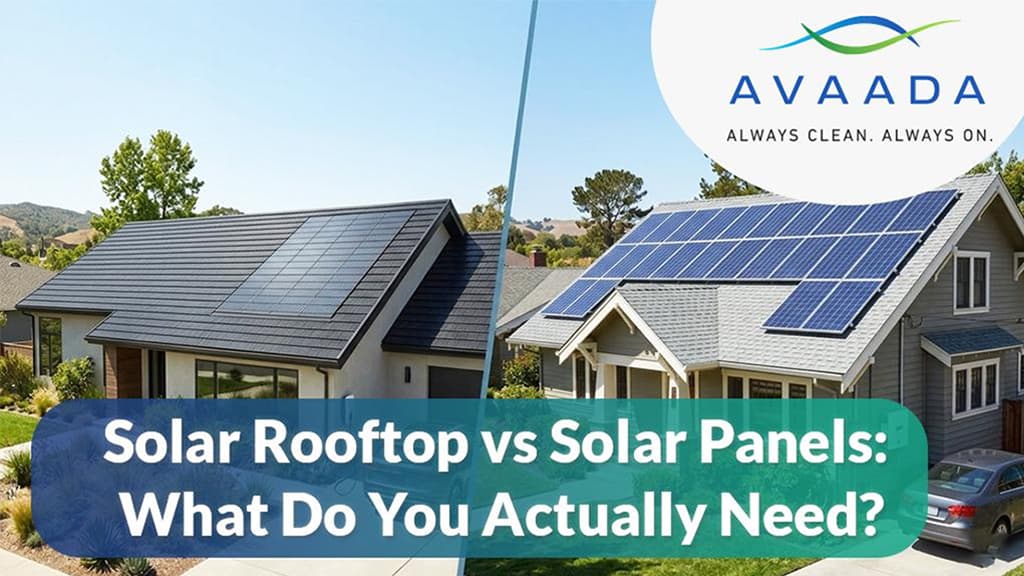
Solar rooftop vs solar panels represents two approaches to harnessing solar energy at home. Solar panels mount on existing roofs as modular units, while solar rooftops replace or integrate with roofing materials for a seamless look. Both convert sunlight into electricity using photovoltaic cells, but their designs and applications differ. In India, where sunlight abounds, these systems meet rising power demands, with per capita electricity use at 1,460 kWh in 2024-25, up 52.6% from 2013-14. Avaada offers both, ensuring quality for residential use.
What is a Solar Panel System?
A solar panel system consists of panels placed on house roofs to capture sunlight. These panels, often called solar panels for house roof setups, generate direct current electricity that is sent to an inverter for home use. Key components include:
- Solar panels: Core units with photovoltaic cells.
- Inverter: Converts DC to AC power.
- Mounting racks: Secure panels to the roof.
- Wiring and junction box: Ensure the system is safely connected.
- Optional battery: Stores excess energy.
These systems work by absorbing photons to free electrons, creating current. Panels perform well in India’s sunny climates, contributing to 130 GW of added solar capacity since 2014.
What is a Solar Rooftop System?
A solar rooftop system embeds solar cells directly into roofing material, forming a solar roof that generates power while protecting the home. This solar rooftop system offers dual purpose: energy production and weatherproofing. Components feature:
- Integrated solar tiles or shingles: Generate power and serve as roof cover.
- Microinverters: Optimize output per tile.
- Bypass diodes: Prevent shading losses.
- Racking integrated into the roof: Minimal penetration.
- Monitoring software: Tracks performance.
Unlike add-on panels, solar rooftops blend into home architecture, ideal for modern Indian residences seeking durability.
Key Differences: Solar Panels vs. Solar Rooftop Systems
To decide what you actually need, it is helpful to compare the two based on practical metrics.
Feature | Mounted Solar Panels | Integrated Solar Roof |
Physical Form | Modules fixed on top of the existing roof | Solar cells are the roofing material |
Aesthetics | Visible, industrial appearance | Seamless, modern look |
Installation | Quick (1–2 weeks) | Complex (re-roofing required) |
Efficiency | Generally higher (better airflow) | Slightly lower due to heat buildup |
Subsidies | Widely available in India | Varies by state policy |
Aesthetic Appeal and Integration with Your Home
For many, the visual impact of solar panels on house roof areas is a deciding factor. Traditional panels sit about 4–6 inches above the tiles, which some find visually intrusive. However, a solar roof offers an “invisible” energy solution. The tiles look like premium slate or ceramic, making them ideal for luxury homes where the architectural design must remain undisturbed.
Installation Complexity and Timeframe in India
Setting up a standard solar rooftop system is a relatively fast process. Once the feasibility study is done, mounting the frames and panels can take just a few days. An integrated solar roof, however, is essentially a construction project. It requires removing old roofing and precisely laying solar tiles, which can take several weeks and requires specialized labor.
Cost Comparison: Understanding Solar Rooftop Price vs. Solar Panel Cost
The solar rooftop price varies significantly depending on the chosen technology. Traditional mounted systems are far more affordable.
- Standard Solar Panels: A 3 kW system typically costs between ₹1.5 Lakh and ₹2.5 Lakh before subsidies.
- Solar Roof Tiles: Integrated systems can cost 2 to 3 times more, often ranging from ₹4 Lakh to ₹6 Lakh for the same capacity.
In 2026, the solar rooftop cost is mitigated by the PM Surya Ghar: Muft Bijli Yojana. Under this scheme, households can receive a central subsidy of up to ₹78,000 for systems up to 3 kW, drastically reducing the effective investment.
Energy Efficiency and Power Output for Indian Climates
Solar energy generation depends on keeping panels cool. Because mounted panels have a gap for air to flow underneath, they often perform slightly better in the intense Indian heat. Integrated tiles flush with the house can sometimes experience higher temperatures, which may marginally reduce their efficiency compared to standalone modules.
Maintenance and Longevity of Your Solar Investment
A solar panel roof is built to last. Most high-quality panels come with a 25-year performance warranty. Maintenance is minimal; usually, just cleaning the glass surface 2–4 times a year is enough to keep output high. Integrated roofs are even more durable as they are made of tempered glass designed to withstand heavy hail and monsoon rains.
Benefits of Adopting Solar Energy for Your Home with Avaada
The benefits of solar panels on the roof go beyond just saving money. By generating your own solar energy, you reduce the load on the national grid and contribute to India’s target of reaching 500 GW of non-fossil capacity by 2030. Unlike wind energy, which requires specific geographic locations and large turbines, solar can be harvested on almost any shadow-free roof in the country.
Avaada facilitates this transition by providing high-efficiency N-type TOPCon modules. These components are designed to deliver higher power yields even in low-light conditions, ensuring your home remains powered throughout the day.
Financial Savings and Return on Investment (ROI)
The most immediate impact of a solar rooftop system is the reduction in electricity bills, often by 60% to 90%. With current government incentives, the typical payback period for an Avaada-powered home system is now between 3.5 and 4.5 years. After this period, the electricity generated is essentially free for the remainder of the system’s 25-year lifespan.
Contributing to a Greener India with Avaada Solar Solutions
Avaada is a pioneer in India’s green energy sector, extending its expertise from massive utility-scale plants to residential solutions. By choosing Avaada, you are supporting a company that is also a leader among green hydrogen companies in India. While hydrogen and wind energy drive industrial change, residential solar empowers the individual to be part of the national climate mission.
Choosing the Right Avaada Solar Solution for Your Home in India
Selecting between an integrated solar roof and traditional solar panels depends on your stage of homeownership. If you are building a new home, an integrated roof is a wise investment. If you have an existing, sturdy roof, a mounted solar rooftop system is the most cost-effective way to slash your bills immediately.
Factors to Consider Before Making Your Decision
- Budget: Traditional panels have a lower solar rooftop price and faster ROI.
- Roof Condition: If your roof is old and in need of replacement, consider an integrated solar roof.
- Energy Needs: Calculate your monthly energy usage to determine whether you need a 3 kW, 5 kW, or 10 kW system.
Why Choose Avaada for Your Solar Journey?
Avaada combines cutting-edge technology with a commitment to quality. Our modules are tested to withstand the diverse Indian climate, from the heat of Rajasthan to the humidity of Kerala. By integrating Avaada’s solutions, you ensure that your solar energy system is not just an addition but a long-term asset for your family.
Conclusion
The debate of solar rooftop vs solar panels ultimately leads to one conclusion: solar is the most viable path to energy security in India. Whether you choose the sleek integration of a solar roof or the practical efficiency of mounted panels, you are making a decision that benefits your finances and the environment. With India’s per capita electricity consumption rising by over 50% in the last decade, becoming a prosumer, both a producer and consumer, is the smartest way to stay ahead.
Ready to transform your roof into a power plant? Contact Avaada today to get a customized quote for your solar rooftop system.
FAQs
Is a solar rooftop system suitable for all types of roofs in India?
Most flat RCC or sloped metal roofs are suitable, provided they are shadow-free and structurally sound to hold the weight.
What government subsidies are available for installing solar rooftop systems in India?
The PM Surya Ghar scheme provides up to ₹30,000 per kW for the first 2 kW, capped at ₹78,000.
How long does it typically take to install a residential solar panel system?
Standard-mounted systems take 1–2 weeks, while integrated solar roofs may take several weeks due to the construction involved.
Can I monitor my solar energy production in real-time with Avaada systems?
Most modern Avaada installations come with smart inverters and mobile apps for real-time performance tracking.
What happens to my solar panels or rooftop during extreme weather conditions?
High-quality panels are rated for high wind speeds and hail, while integrated tiles act as a durable, primary roofing material.
Is it possible to combine solar panels with other renewable energy sources, such as wind energy?
While common in industrial “hybrid” setups, residential systems usually focus on solar due to the space requirements of wind turbines.