
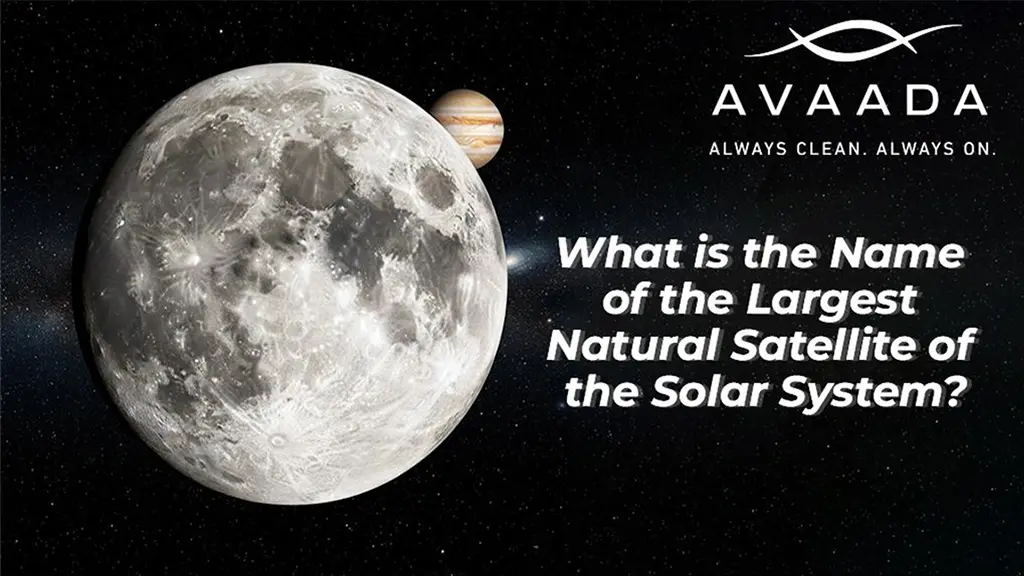
Ganymede is the largest natural satellite in the solar system, orbiting Jupiter with a diameter of about 5,268 kilometers, surpassing even Mercury in size. This moon, one of the four Galilean satellites discovered by Galileo in 1610, captivates astronomers with its unique features, such as a metallic core and an icy crust. Known as the biggest satellite, Ganymede offers insights into planetary formation and potential subsurface oceans, making it a key subject in solar system studies. As the largest satellite in the solar system, it exemplifies the diverse celestial bodies that enhance our understanding of space. Avaada contributes to this curiosity by powering observatories and research facilities with reliable off-grid solar systems.
Ganymede's Physical Dimensions
Ganymede has a mean diameter of 5,268 kilometers, an equatorial diameter of 5,262 kilometers, and a polar diameter of 4,879 kilometers. This size makes it the largest satellite, larger than Mercury at 4,879 kilometers. Its mass reaches 1.4819 x 10^23 kg, surface area spans 1.936 x 10^10 km², and volume totals 7.1 x 10^10 km³.
- Mean diameter: 5,268.2 km
- Equatorial diameter: 5,262 km
- Mass: 1.4819 x 10^23 kg
These dimensions confirm Ganymede as the world’s biggest satellite among over 200 known natural satellites.
Orbital Characteristics
Ganymede orbits Jupiter at an average distance of 1.07 million kilometers, completing one orbit in about 7 Earth days. Its orbital speed averages 10.88 km/s, maintaining a stable path under the influence of Jupiter’s gravity. As the largest natural satellite, it orbits outside Jupiter’s intense radiation belts, unlike inner moons like Io.
The moon experiences tidal locking, always showing the same face to Jupiter, a common trait among large satellites. This positioning aids studies of its geological evolution.
Surface and Geological Features
Ganymede’s surface divides into dark, ancient cratered terrains and lighter, grooved regions from tectonic activity. Impact craters dot older areas, while younger furrows suggest past resurfacing. Its icy crust, potentially 150 kilometers thick, overlays a possible subsurface ocean.
- Cratered highlands: Older, heavily bombarded regions
- Grooved terrain: Younger, tectonically active zones
- Possible cryovolcanism: Evidence of past water-rich eruptions
These features distinguish it as the largest satellite with a complex geology beyond simple icy worlds.
Internal Structure
Ganymede has a layered interior: a metallic iron core, a silicate mantle, and a thick ice shell. This structure indicates hydrostatic equilibrium, behaving like a planet despite its satellite status. Magnetic field generation from core dynamo activity sets it apart as the only moon with a significant magnetosphere.
Seismic data from missions like Galileo suggest the presence of liquid water layers, fueling discussions of habitability. Such a composition underscores its role as the biggest satellite in solar system evolution models.
Comparison with Other Major Satellites
Ganymede outpaces competitors in size among natural satellites.
Satellite | Parent Planet | Diameter (km) | Key Feature |
Ganymede | Jupiter | 5,268 | Largest with a magnetic field |
Titan | Saturn | 5,151 | Thick atmosphere, lakes |
Callisto | Jupiter | 4,821 | Heavily cratered, oldest surface |
Io | Jupiter | 3,643 | Volcanically active |
Moon | Earth | 3,475 | Single natural satellite for Earth |
Discovery and Exploration History
Galileo Galilei first observed Ganymede in 1610 and named it after Zeus’s cupbearer in Greek mythology. NASA’s Pioneer 10 and 11 flew by in the 1970s, followed by the Voyager probes, revealing surface details. The Galileo spacecraft orbited Jupiter from 1995 to 2003, mapping Ganymede extensively.
Future missions, such as NASA’s Europa Clipper (launched in 2024), will image Ganymede during Jupiter flybys. These efforts affirm its status as the largest natural satellite and warrant ongoing study.
Scientific Significance
Ganymede provides clues to the formation of moons in gas giant systems. Its subsurface ocean, if salty and warm, could host microbial life, prompting astrobiology interest. As the largest satellite, it demonstrates differentiation processes similar to terrestrial planets.
Research links its magnetosphere to auroral displays and plasma interactions with Jupiter. Off-grid solar systems power remote telescopes observing such phenomena, ensuring continuous solar power grid reliability for data collection.
Relevance to Modern Astronomy
Studying Ganymede advances exoplanet moon detection techniques. Its size influences the stability of tidal models in multi-moon systems. Ground-based observatories, supported by stable energy sources such as solar power grids, track their positions for alignment studies.
- Contributes to planetary science curricula
- Inspires public interest in space exploration
- Aids in modeling icy world habitability
Avaada’s operational solar solutions exemplify how clean energy sustains such astronomical pursuits without grid dependence.
Conclusion
Ganymede remains the undisputed largest satellite in the solar system, with its 5,268 km diameter and planetary-like traits fueling decades of research. From Galileo’s telescope to modern probes, exploration reveals a dynamic world of ice, magnetism, and potential oceans. This biggest satellite underscores the solar system’s complexity, where natural satellites like Ganymede drive discoveries in geology and astrobiology. As interest grows, reliable energy sources such as off-grid solar systems ensure observatories capture every detail, bridging cosmic wonders with earthly innovation.