Silicon is the dominant material used in solar cells, powering the majority of solar cells and solar panels deployed globally. This element, central to which material is used in solar cell manufacturing, converts sunlight into electricity via the photovoltaic effect. Understanding why silicon is used in solar cells reveals its pivotal role in off-grid solar systems and solar panel installation projects across India.
What Are Silicon Solar Cells?
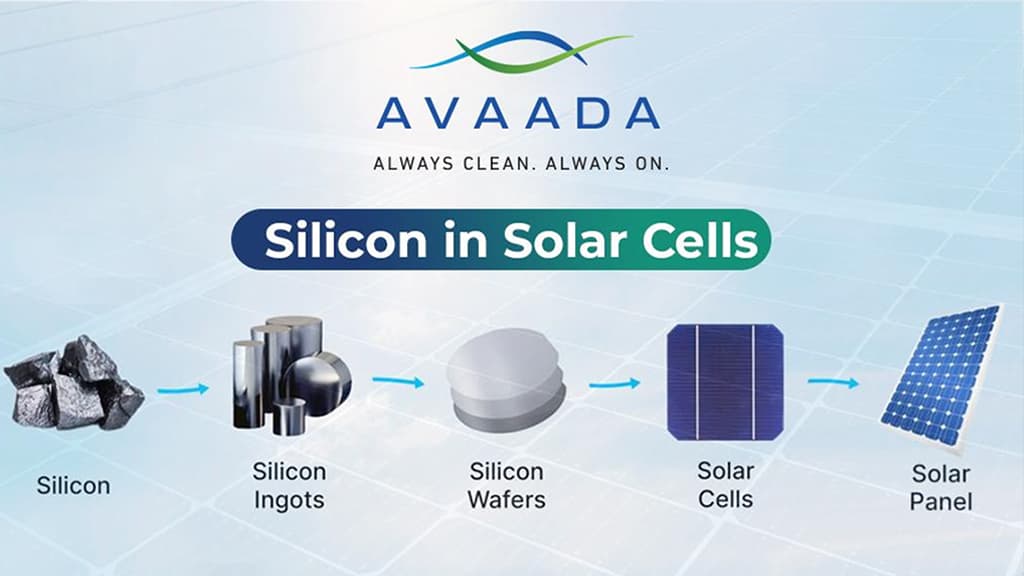
Silicon solar cells function as semiconductor devices that generate electricity from light. Manufacturers produce them by slicing high-purity silicon ingots into thin wafers, typically 120-140 μm thick. Doping one side with phosphorus on a P-type base, forming a p-n junction essential for electron movement (PERC Technology), while Topcon Solar Cell uses an N-type base and Boron doping, making a P-N junction.
When photons strike the silicon cell, they excite electrons, generating a flow of direct current. Anti-reflective coatings and metal contacts optimize light capture and current collection. Commercial silicon solar cells achieve efficiencies of 22-26%, with lab records exceeding 27%. These cells are connected in strings to form silicon solar panels rated from 400W to over 720W.
Monocrystalline silicon solar cells are derived from single-crystal Czochralski method ingots, offering a uniform structure and a higher efficiency of 22–26%. They dominate because silicon’s properties align with practical manufacturing scales and with technological innovations, leading to rapid improvements in efficiency. Single junctions have a high scope of improvements, with theoretical efficiency limits of 29.4%
Read more : Best Solar Companies
Why Silicon is Used in Solar Cells - The 6 Real Reasons
This is the question that matters most, and the answer goes deeper than ‘it works.’ Here are the six concrete reasons why silicon remains the material used in over 95% of solar cell production globally.
1. The Bandgap is Near-Perfect
Silicon’s bandgap is 1.12 electron-volts (eV). The sun’s energy peaks at roughly 1.4 eV in usable photon density. A bandgap too wide means you miss lower-energy photons; too narrow and you waste energy as heat. Silicon’s 1.12 eV sits in the sweet spot, capturing a wide swath of the solar spectrum while keeping thermal losses low. This is the single biggest technical reason why silicon is used in solar cell design over alternatives like gallium arsenide (1.4 eV, expensive) or organic materials (unstable).
2. It is Everywhere and Cheap
Silicon is the second most abundant element in Earth’s crust after oxygen — accounting for roughly 28% of the Earth’s surface by mass. Global annual production for photovoltaics alone exceeds 500,000 tonnes. This supply security means manufacturers never face raw-material shortages, which directly explains why silicon solar panel prices in India have fallen below ₹18–20 per watt in 2026.
3. It Handles Indian Summers
Temperature stability is critical for the Indian market. Silicon solar cells lose only 0.25–0.35% of their efficiency per degree Celsius above 25°C. That is significantly better than many thin-film alternatives. A panel performing at 22% efficiency in a lab at 25°C will still perform at around 19–20% on a 45°C rooftop in Delhi — a tolerable drop for a technology that is otherwise free to run.
4. It Lasts 25–30 Years
Unlike organic photovoltaic materials that degrade within a few years of UV exposure, silicon resists weathering from humidity, thermal cycling, and direct sunlight. Most silicon solar panels carry 25–30 year performance warranties, often guaranteeing output above 80% of rated capacity at the end of that period. No competing technology at scale offers comparable longevity today.
5. It is Non-Toxic
Cadmium telluride (CdTe) and lead-based perovskites involve materials that require careful disposal at end-of-life. Silicon is non-toxic, and recovery processes already allow up to 95% of silicon to be reclaimed and reused when a panel is decommissioned — a key consideration as India’s solar fleet ages and recycling frameworks develop.
6. The Manufacturing Ecosystem is Mature
Decades of semiconductor manufacturing for computers have built a global silicon processing infrastructure that solar can tap into. Continuous investment has driven silicon solar cell manufacturing costs down by over 90% since 2010. This mature ecosystem — not just the material itself — is why which material is used in solar cell production at scale is almost always silicon.
Also Read:- What is TOPCon Solar Cell Technology
Properties Making Silicon Ideal for Solar Applications
Silicon’s indirect bandgap requires thick absorbers, but advanced texturing scatters light for better utilization. A high refractive index demands coatings to reduce reflection losses to below 5%. Passivation layers minimize recombination sites, boosting voltage output.
Mechanical robustness prevents thin wafers from breaking during handling or under hail impacts up to 25mm in diameter. Silicon solar cells can be integrated with bifacial designs, capturing rear-side albedo for 10-30% extra yield. In half-cut configurations, shading losses halve, enhancing partial performance.
Which element is used in solar cell innovation? Silicon enables upgrades to heterojunction (HJT) and TOPCon cells. N-type silicon avoids light-induced degradation, leaving P-type cells behind, which are vital for long-term output.
How is a Silicon Solar Cell Manufactured? (Step-by-Step)
Suggested Content : Understanding the manufacturing journey also helps buyers appreciate why quality matters when comparing panel brands.
- Step 1 – Sand to Silicon: Quartz sand (SiO₂) is reduced with carbon in an electric arc furnace to produce metallurgical-grade silicon (~98% pure). This is further refined via the Siemens process to semiconductor-grade polysilicon (99.9999% pure).
- Step 2 – Ingot Pulling (Czochralski Method): For monocrystalline cells, a seed crystal is dipped into molten polysilicon and slowly withdrawn while rotating, growing a single-crystal cylindrical ingot up to 2 metres long and 300mm in diameter. This is why monocrystalline silicon cells have that distinctive uniform dark appearance.
- Step 3 – Wafer Slicing: Diamond wire saws cut the ingot into wafers 120–140 µm thick. Cutting losses (kerf loss) are a key area of ongoing cost reduction in the industry.
- Step 4 – Surface Texturing: Wafers are etched with alkaline or acidic solutions to create microscopic pyramidal structures on the surface. This texturing dramatically increases the effective light-capture area.
- Step 5 – P-N Junction Formation: Phosphorus (for PERC) or boron (for TOPCon N-type cells) is diffused into the wafer surface in a high-temperature furnace, creating the p-n junction that drives electron flow.
- Step 6 – Passivation & Anti-Reflective Coating: Aluminium oxide and silicon nitride layers are deposited by plasma-enhanced chemical vapour deposition (PECVD). These layers both passivate surface defects and act as anti-reflective coatings.
- Step 7 – Metallisation: Silver paste is screen-printed onto the front (fine grid lines) and rear (busbar contacts) surfaces and fired in an infrared furnace to form low-resistance electrical contacts.
- Step 8 – Cell Testing & Sorting: Each cell is tested under a solar simulator and sorted by efficiency class (binning) before being strung into modules.
Types of Silicon Solar Cells Used in India
Not all silicon cells are the same. Here is a practical breakdown of the types you will encounter when buying silicon solar panels in 2026:
Monocrystalline Silicon Solar Cells
Made from a single continuous silicon crystal, these offer efficiencies of 22–26% and are the most widely installed type in residential rooftop projects in India. Their uniform dark colour and high power density (more watts per square metre) make them ideal for space-constrained rooftops.
Polycrystalline Silicon Solar Cells
Made from multiple silicon crystal fragments fused together, polycrystalline cells have efficiencies of 16–18% and a characteristic blue speckled appearance. They were the dominant technology until around 2018 but are now largely replaced by monocrystalline variants in new installations.
TOPCon Solar Cells
TOPCon (Tunnel Oxide Passivated Contact) represents the current frontier of mainstream silicon technology. N-type silicon base, tunnel oxide rear passivation, and polysilicon contact layers push efficiency to 24–26% while eliminating light-induced degradation (LID) — a problem that historically affected P-type cells. Most ALMM-listed modules for India’s PM Surya Ghar subsidy scheme in 2026 are TOPCon.
HJT (Heterojunction Technology) Solar Cells
HJT cells sandwich crystalline silicon between thin amorphous silicon layers, achieving efficiencies above 24% with very low temperature coefficients (around −0.25%/°C). They are more expensive to manufacture but excellent performers in high-heat environments like Rajasthan and Gujarat.
PERC (Passivated Emitter and Rear Cell)
PERC added a rear passivation layer to the standard P-type monocrystalline cell, pushing efficiency above 22%. It was the industry workhorse from 2018–2023 and is still widely available at competitive prices in India.
Must Read:- Researchers to Lower Solar Cell Costs by Replacing Silver with Copper
Silicon vs. Other Solar Cell Materials — Full Comparison
Material | Efficiency | Cost/Watt | Stability | Scalability |
Silicon (Mono) | 22–26% | Low (₹18–20/W) | High (25+ years) | Excellent |
CdTe Thin-Film | 18–22% | Low | Medium | Good |
CIGS | 20–23% | Medium | Medium | Limited |
Perovskite (Lab) | 30–35% | High (potential) | Low | Emerging |
Silicon’s combination of proven scalability, low cost, and tested longevity justifies its dominance despite perovskite’s impressive lab numbers. Until perovskite clears durability and toxicity hurdles at field scale, silicon remains the rational choice for any buyer making a 25-year investment.
Silicon Solar Panel Prices in India
One of the most searched questions from Indian buyers is what silicon solar panels actually cost. Here is a realistic breakdown as of 2026:
- Monocrystalline PERC (400–440W): ₹16–20 per watt (ex-factory), translating to roughly ₹7,000–9,000 per panel.
- TOPCon (540–580W): ₹18–22 per watt. Higher wattage means fewer panels needed for the same system size.
- HJT (530–560W): ₹22–28 per watt. Premium pricing for best-in-class efficiency and temperature performance.
- Complete 3kW rooftop system (supply + installation): ₹1.5–2.2 lakh depending on inverter type, mounting structure, and location.
- PM Surya Ghar subsidy (2026): Up to ₹78,000 for a 3kW residential system. Only ALMM-listed silicon modules qualify.
Prices have fallen roughly 30% since 2022 due to global oversupply of polysilicon from China and expanding domestic manufacturing capacity in India.
Silicon Solar Panels in Off-Grid Solar Systems
Off-grid solar systems frequently use silicon solar panels to provide reliable power where grid access is unavailable. They power rural water pumps, homes, and telecom towers in states such as Rajasthan and Maharashtra. A typical 5kW system comprises the required number of panels, batteries, and an inverter, supplying around 20-30 kWh daily. Silicon’s stable output better handles variable irradiance than thin films do. Charging controllers prevent battery overcharging, and lithium batteries store solar-generated energy. Some systems include diesel backups for enhanced reliability.
Solar Panel Installation: What Indian Buyers Need to Know
A well-designed installation recovers its cost 25–35% faster than a poorly planned one. Here is what matters:
- Site survey first: Assess roof load capacity, orientation (south-facing is optimal in India), shading from trees or adjacent buildings, and available area. A credible installer will provide a shading analysis report.
- Optimal tilt: For most Indian locations, a fixed tilt of 15–30 degrees facing south maximises annual energy yield. Locations north of 25°N latitude benefit from steeper tilts (25–30°).
- String design: Engineers size panel strings to match inverter MPPT voltage windows. Mismatched strings are the single largest cause of underperformance in residential systems.
- MC4 connectors: These are the industry standard for module-to-string connections. Ensure your installer uses certified MC4s, not third-party lookalikes, to prevent arc faults.
- Net metering vs. zero export: If your discoms allows net metering, export surplus power to the grid and earn credits. Where net metering is unavailable, zero-export devices prevent reverse flow and protect system warranties.
- ALMM compliance: Since April 2022, residential rooftop systems claiming government subsidies must use ALMM-listed modules. Always verify module ALMM status before purchase.
- Cleaning schedule: In dusty Indian climates, monthly cleaning maintains panel output above 98%. Automated cleaning robots are gaining traction for large ground-mount systems.
India added 26.6 GW of solar capacity in the first half of 2026, driven by aggressive residential and commercial installation activity. This rapid growth means demand for qualified installers often outstrips supply — always verify MNRE or state-nodal-agency accreditation before signing a contract.
Also Read:- The Role of Specialty Gases in Solar PV Cell Manufacturing
Government Policies Supporting Silicon Solar Panel Adoption in India
- PM Surya Ghar Muft Bijli Yojana: Offers subsidies up to ₹78,000 for 3kW residential rooftop systems. Over 1 crore registrations recorded by March 2026. Silicon modules on the Approved List of Models & Manufacturers (ALMM) are mandatory.
- Production Linked Incentive (PLI) for Solar: ₹24,000 crore allocated to incentivise domestic manufacturing of high-efficiency silicon modules, including TOPCon and HJT cells.
- KUSUM Scheme: Subsidises solar pumps and grid-connected agricultural solar for farmers, with silicon panel requirements built into tender specifications.
- Renewable Purchase Obligations (RPO): State utilities are mandated to source a rising percentage of power from renewables, creating sustained demand for silicon solar capacity.
Future of Silicon Solar Technology
Emerging technologies such as passivated back-contact (IBC) and tandem silicon-perovskite cells aim for efficiencies exceeding 30%. Recycling processes allow recovery of up to 95% silicon, reducing material waste and costs. Integrated plants manufacturing N-type TOPCon modules contribute significantly to India’s self-reliance in solar production. Additionally, 2026 trends show increased adoption of bifacial modules that capture sunlight on both sides, raising energy yields and optimising installation space. The next technology to come is BC (Back Contact) technology, which has the potential to improve the existing Technology by absorbing all the light incident on the front side of the solar cell. Innovations include smart solar panels integrating IoT sensors for real-time performance monitoring and predictive maintenance, boosting system uptime and ROI. Advanced manufacturing techniques, such as low-temperature processing and lower energy consumption during production, make silicon solar cells more sustainable. Research into silicon heterojunctions (HJT) and tandem cells with perovskite layers continues, promising further leaps in efficiency and cost-effectiveness. These developments underscore silicon solar technology’s adaptability and central role in meeting expanding global clean energy demands while supporting India’s solar energy ambitions.
Read more : What Is A Solar Cell
Conclusion
Silicon’s combination of abundance, efficiency, thermal stability, durability, and cost-effectiveness makes it the foremost material for solar cells worldwide. From off-grid applications to large-scale installations, its versatility drives the adoption of clean, sustainable energy. Continuous technological refinements ensure that silicon solar cells will continue to play a pivotal role in powering future renewable energy solutions globally.
Silicon solar panels are preferred in off-grid systems due to their stable output, durability, and consistent performance under varying sunlight conditions. They work efficiently with batteries and inverters, making them ideal for rural homes, pumps, and telecom towers.
FAQs
Why is silicon the most commonly used material in solar cells?
Silicon is widely used in solar cells because it has an ideal bandgap, high efficiency, excellent thermal stability, and long lifespan. Its abundance and low cost make it suitable for large-scale solar panel manufacturing worldwide.
Which element is used in solar cell manufacturing?
Silicon is the primary element used in solar cell manufacturing. It functions as a semiconductor that converts sunlight into electricity through the photovoltaic effect.
Which material is used in solar cell production at the highest volume?
Crystalline silicon — specifically monocrystalline silicon — is the highest-volume material used in solar cell production globally. Thin-film materials like cadmium telluride (CdTe) and copper indium gallium selenide (CIGS) account for less than 5% of annual production.
What is the difference between a silicon cell and a thin-film cell?
A silicon cell is made from a wafer of crystalline silicon and is physically robust, highly efficient (22–26%), and very long-lasting (25+ years). A thin-film cell deposits a semiconducting material in a very thin layer onto glass or flexible substrates — faster and cheaper to produce, but typically less efficient (18–22%) and with a shorter warranty period.
What type of silicon is used in solar panels?
Most solar panels use monocrystalline silicon due to its high purity, uniform crystal structure, and superior efficiency compared to other silicon types.
How do silicon solar cells generate electricity?
Silicon solar cells generate electricity when sunlight excites electrons within the silicon wafer, creating an electric current through the p-n junction via the photovoltaic effect.
What is the efficiency of silicon solar cells?
Commercial silicon solar cells achieve efficiencies of 22% to 26%, while advanced technologies such as TOPCon and HJT continue to push efficiency even higher.
Are silicon solar panels suitable for hot climates like India?
Yes, silicon solar panels perform well in hot climates. They exhibit low temperature-related efficiency losses and maintain stable output under high-heat conditions.
What is the lifespan of silicon solar panels?
Silicon solar panels typically last 25 to 30 years and often continue generating power at over 80% efficiency beyond their warranty period.
What is the difference between P-type and N-type silicon solar cells?
P-type cells use boron doping and are more prone to degradation, while N-type silicon cells offer higher efficiency, better performance, and longer operational life.
Why are silicon solar panels preferred for off-grid solar systems?
Silicon solar panels are preferred for off-grid systems due to their reliability, consistent power output, and compatibility with batteries and inverters.
What TOPCon solar panel brands are available in India?
As of 2026, major TOPCon solar panel brands available in India include Waaree, Adani Solar, Vikram Solar, Tata Power Solar, REC, LONGi, Jinko Solar, and Canadian Solar. When buying for subsidised residential systems, always verify ALMM listing on the MNRE portal.
What is the future of silicon solar technology?
The future of silicon solar technology includes TOPCon, heterojunction, back contact (BC), and tandem silicon-perovskite cells, aiming for efficiencies above 30%.
What is the cost of silicon solar panels in India in 2026?
Silicon solar panel prices in India in 2026 range from ₹16–20 per watt for standard monocrystalline PERC, ₹18–22 per watt for TOPCon, and ₹22–28 per watt for HJT. A complete 3kW rooftop system with installation typically costs ₹1.5–2.2 lakh before subsidies. PM Surya Ghar subsidies can reduce effective cost by ₹60,000–78,000 for eligible residential systems.