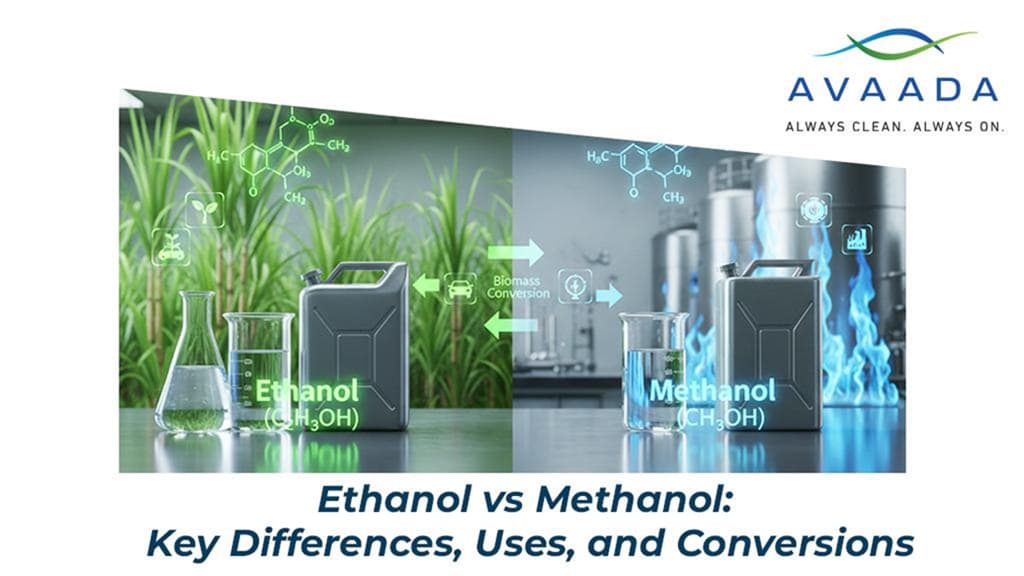
Ethanol and methanol represent two fundamental alcohols with distinct chemical profiles, driving their varied industrial roles amid the global push toward sustainable energy solutions.When comparing ethanol vs methanol, the difference between ethanol and methanol lies primarily in their molecular structures and real-world applications.
Ethanol vs methanol differences stem primarily from their molecular structures: ethanol (C₂H₅OH) has two carbon atoms, while methanol (CH₃OH) has one, which impacts properties such as boiling points, toxicity, and applications. Understanding the difference between methyl alcohol and ethyl alcohol is essential for sectors such as biofuels and clean energy, where Avaada advances end-to-end solutions, including green fuels.
Comparison Table: Ethanol vs Methanol
Property | Ethanol (C₂H₅OH) | Methanol (CH₃OH) |
Carbon Atoms | 2 | 1 |
Boiling Point | 78.37°C | 64.7°C |
Toxicity | Low (consumable in regulated amounts) | Highly toxic |
Common Uses | Biofuel, sanitizer, beverages | Industrial chemicals, fuel |
Flame Color | Blue | Pale/Invisible |
Source | Biomass fermentation | Natural gas / CO₂ + H₂ |
Chemical Structures
Ethanol, or ethyl alcohol, consists of a two-carbon chain attached to a hydroxyl group, yielding the formula C₂H₅OH with a molecular weight of 46.07 g/mol. Methanol, known as methyl alcohol, features a single carbon atom bonded to the hydroxyl group, resulting in CH₃OH and a lighter molecular weight of 32.04 g/mol. This structural variance, the difference between methyl alcohol and ethyl alcohol, directly influences reactivity; ethanol’s extra carbon enables specific oxidation pathways absent in methanol.
Both alcohols exhibit polarity due to the -OH group, which enhances water solubility; however, methanol’s smaller size slightly increases its miscibility with water more than ethanol’s. Avaada leverages such precise chemical understanding in its operational green fuels initiatives, aligning with sustainability pillars.
Also Read:- Renewable Energy Trends: What’s Driving Global Adoption and Investment?
Physical Properties
Key ethanol vs methanol disparities appear in physical traits. Ethanol boils at 78.37°C with a density of 0.789 g/cm³, while methanol boils at a lower temperature at 64.7°C and has a density of 0.7918 g/cm³. Both appear as colorless, volatile liquids with pungent odors, ethanol’s wine-like, methanol’s sharper, but ethanol produces a bright blue flame on combustion, contrasting methanol’s pale white flame.
Methanol melts at -97.6°C, lower than ethanol’s -114°C, making it easier to use in cold climates. These properties, drawn from standard chemical data, underscore why distinguishing between methanol and ethanol remains critical in handling and storage.
Property | Ethanol (C₂H₅OH) | Methanol (CH₃OH) |
Boiling Point (°C) | 78.37 | 64.7 |
Density (g/cm³) | 0.789 | 0.7918 |
Flame Color | Bright blue | Pale white |
Molecular Weight | 46.07 | 32.04 |
Fuel-Specific Comparison: Energy Density, Octane Rating & Real-World Usability
When evaluating ethanol vs methanol as fuels, key metrics include energy density, octane rating, and real-world compatibility. Ethanol delivers approximately 21 MJ/L energy density, while methanol provides around 15.6 MJ/L — making ethanol energy-richer per litre. However, methanol’s higher octane rating (109 RON) surpasses ethanol’s (109 RON blended). For road transport, ethanol’s E10/E20 blends are widely adopted in India, while methanol’s M15/M100 blends suit marine and industrial engines. Methanol’s lower cost and wider feedstock availability give it an edge in industrial use, but ethanol’s compatibility with existing infrastructure makes it more practical for everyday transport.
Parameter | Ethanol | Methanol |
|---|---|---|
Energy Density (MJ/L) | ~21 | ~15.6 |
Octane Rating (RON) | ~109 | ~109 |
Road Transport Blend | E10, E20 | M15, M85 |
Industrial Use | Moderate | High |
Infrastructure Compatibility | High | Moderate |
Toxicity, Safety, and Handling of Ethanol and Methanol
Methanol poses severe toxicity risks, metabolizing into formaldehyde and formic acid, which cause blindness, metabolic acidosis, or death even in small doses (10-30 mL). Ethanol, safer for moderate consumption as in beverages, primarily induces intoxication without methanol’s organ damage at equivalent levels. The differences in human effects between ethanol and methanol demand strict lab protocols, including iodoform tests, in which ethanol yields a yellow precipitate but methanol does not.
Industrial safety mandates ventilation and protective gear for both, yet methanol’s higher acidity (stronger than water, unlike ethanol) heightens corrosion risks. Avaada prioritizes such safety in operational clean energy processes.
Also Read : Green Energy Explained: Sources, Benefits, and How to Get Started
Safety Measures When Handling Ethanol and Methanol
- Always use protective gloves and goggles
- Ensure proper ventilation in workspaces
- Store in tightly sealed, labeled containers
- Keep away from open flames and heat sources
- Never ingest or inhale methanol vapors
- Use spill containment kits for industrial environments
Industrial Uses
Ethanol serves as a biofuel additive, solvent in pharmaceuticals, and antiseptic, produced via sugar fermentation. Methanol fuels industrial synthesis, formaldehyde, acetic acid, and biodiesel, often from natural gas. In green contexts, “green methanol” emerges from renewable hydrogen and CO₂, supporting low-carbon fuels.
Ethanol applications:
- Biofuel blending for vehicles.
- Solvent in cleaners and cosmetics.
- Medical disinfectant.
Methanol applications:
- Chemical feedstock for plastics.
- Antifreeze in engines.
- Transport Fuels blend
- Marine fuel trials.
Avaada’s green fuels operations utilize these alcohols’ verified roles in sustainable energy transitions.
Ethanol vs Methanol: Road Transport, Racing, and Industrial Use
Choosing between ethanol and methanol depends heavily on the application. For everyday road transport, ethanol blends (E10, E20) are preferred due to compatibility with standard petrol engines and India’s existing distribution infrastructure. In motorsport and racing, methanol’s superior cooling effect and higher fuel-to-air ratio improve engine performance, making it the fuel of choice in drag racing and Formula circuits. For industrial applications such as boiler fuel, chemical synthesis, and marine propulsion, methanol’s lower cost and higher purity provide operational advantages. Avaada’s green fuels roadmap integrates both fuels strategically across these sectors.
Use Case | Best Fuel | Reason |
|---|---|---|
Road Transport | Ethanol (E10/E20) | Infrastructure compatibility |
Motorsport/Racing | Methanol | Cooling effect, high octane |
Industrial Boilers | Methanol | Cost efficiency, purity |
Marine Propulsion | Green Methanol | Low sulfur, IMO compliant |
Aviation (SAF) | Ethanol-derived | Carbon neutral potential |
Sustainability Focus: 2G and 3G Ethanol Production
Beyond conventional sugarcane-based ethanol, next-generation pathways are transforming sustainability in fuel production. Second-generation (2G) ethanol is produced from agricultural waste — rice straw, wheat husk, bagasse, and corn stover — using enzymatic hydrolysis and fermentation. This avoids competition with food crops and reduces stubble burning, a major pollution source in India. Third-generation (3G) ethanol derived from algae offers even greater promise: algae grow on non-arable land, consume CO₂, and yield 10–20 times more biomass per hectare than terrestrial crops. Avaada’s green fuels vision aligns with India’s National Biofuel Policy, supporting 2G and 3G feedstock integration for long-term energy security.
Challenges in Ethanol and Methanol Blending
Despite their advantages, blending ethanol and methanol into conventional fuels presents technical and logistical challenges. Ethanol’s hygroscopic nature causes phase separation in E10/E20 blends when exposed to moisture, reducing engine efficiency. Methanol’s corrosive properties can degrade rubber seals, aluminium components, and fuel lines in older vehicles not designed for high methanol blends. Both alcohols have lower calorific values than petrol, reducing fuel economy at higher blend ratios. Distribution infrastructure requires upgrades to handle alcohol-resistant materials. Additionally, cold-start performance of methanol-blended fuels in sub-zero temperatures remains a concern. Regulatory standardisation and material innovation are key to overcoming these barriers at scale.
Regulatory Standards and Quality Control
Ethanol meets fuel-grade standards, such as IS 15464:2004 for E20 blending, ensuring 99.5% purity and denaturant levels within BIS specifications. Methanol adheres to IS 14645 for industrial use, with ASTM D1152 testing for formaldehyde content below 0.1%. Green methanol complies with IACS E1 guidelines for marine fuels, requiring >99% purity and sulfur content <0.05%. Both undergo GC-MS analysis for impurities; ethanol’s water content maxes at 1%, methanol at 0.1%. Avaada ensures compliance through IEC/BIS-certified supply chains, enabling seamless integration into C&I applications across Rajasthan and Gujarat plants. These standards guarantee safety and performance in biofuel transitions.
Conversion Processes
Converting between ethanol and methanol is impractical industrially due to differences in carbon chain length, but related transformations do occur. Methanol oxidizes to formaldehyde via catalysts like silver at 500-700°C: CH₃OH + ½O₂ → HCHO + H₂O. Ethanol dehydrogenates to acetaldehyde: CH₃CH₂OH → CH₃CHO + H₂, at 300°C over copper.
For green methanol, electrolysis-derived hydrogen reacts with captured CO₂: CO₂ + 3H₂ → CH₃OH + H₂O, achieving high selectivity under catalysts. Ethanol-to-methanol lacks direct routes; instead, biomass gasification yields syngas for methanol synthesis. Green ammonia (NH₃) from Haber-Bosch uses hydrogen potentially co-produced in such systems, with efficiencies of 85-95% round-trip in storage analogs.
Key conversion pointers:
- Methanol to dimethyl ether: 2CH₃OH → CH₃OCH₃ + H₂O (dehydration).
- Ethanol esterification: CH₃CH₂OH + CH₃COOH → CH₃COOCH₂CH₃ + H₂O.
- Avoid unverified yields; lab efficiencies vary by conditions.
Avaada integrates these principles into its operational manufacturing expertise for reliable clean energy.
Also Read:- How Renewable Energy Reduces Carbon Footprints: Real Examples and Calculations
Environmental Impact
Ethanol’s biomass origin offers renewability, reducing net CO₂ when sustainably sourced, unlike methanol’s fossil-heavy production. Green methanol mitigates this via biogenic or electrolytic paths, cutting lifecycle emissions by up to 95%. Both combust cleanly to CO₂ and H₂O, but methanol’s toxicity demands spill controls.
In India’s high-growth states, such as Gujarat and Maharashtra, where Avaada operates solar plants, these fuels complement round-the-clock renewables. Green ammonia enhances this by enabling hydrogen transport without infrastructure overhauls.
Common Misconceptions About Ethanol and Methanol
- Methanol and ethanol are not interchangeable
- Methanol is not safe in sanitizers or consumption
- Ethanol is renewable, but not always carbon-neutral unless sustainably sourced
- Green methanol can be as sustainable as ethanol when produced using renewable hydrogen
Conclusion
Understanding the differences between ethanol and methanol, and conversions, empowers informed clean energy choices. Avaada embodies reliability through integrated solutions such as green fuels, operational bifacial N-Type TOPCon modules, and storage for sustainable execution. As energy transitions accelerate, distinguishing between methanol and ethanol ensures safety and efficiency, aligning with the pillars of innovation and nation-building.
FAQs
What is the main difference between ethanol and methanol?
The primary difference lies in their chemical structure and toxicity. Ethanol (C₂H₅OH) has two carbon atoms and is the alcohol found in beverages; it is relatively safe for topical use. Methanol (CH₃OH) has only one carbon atom and is highly toxic; even small amounts can cause blindness or death if ingested or inhaled.
Can methanol be used as a substitute for ethanol in hand sanitizers?
No. Methanol should never be used in hand sanitizers. It is toxic when absorbed through the skin and can lead to systemic poisoning. Ethanol is the industry standard for antiseptics because it effectively kills germs while being safe for human skin.
Which is a better biofuel: Ethanol or Methanol?
Ethanol is currently more common as a biofuel (like E10 or E20 blends) because it is easily produced from crops like sugarcane. However, Green Methanol is gaining traction in the marine and shipping industries because it has a high energy density and can be produced from renewable hydrogen and captured CO₂.
What is the latest solar panel technology available in India?
The latest technology is Bifacial N-Type TOPCon (Tunnel Oxide Passivated Contact). Unlike older P-type panels, these modules capture sunlight from both sides and use N-type silicon, which is more resistant to degradation and performs better in India’s high-temperature climates
How much more efficient are N-Type TOPCon solar panels compared to PERC?
N-Type TOPCon panels typically achieve efficiencies of 22% to 25%, whereas traditional PERC panels usually peak around 20-21%. This higher efficiency allows for more power generation in a smaller footprint, making them ideal for both utility-scale plants and limited rooftop spaces.
Do bifacial solar panels work on flat RCC roofs in India?
Yes, bifacial panels are highly effective on Indian concrete (RCC) roofs. By elevating the panels slightly, the rear side captures light reflected off the roof surface (albedo), which can increase total energy yield by 10% to 30% compared to standard monofacial panels.