Solar furnaces represent a powerful application of renewable energy, harnessing sunlight through concentrated solar power (CSP) technology to generate extreme heat without fossil fuels. A solar furnace uses mirrors to focus sunlight, achieving temperatures up to 3,500°C for industrial processes such as material testing and metallurgy. In India, where abundant sunlight supports renewable energy growth, solar furnaces align with national sustainability goals, complementing advancements in solar PV manufacture.
What is a Solar Furnace?
A solar furnace concentrates sunlight to produce intense heat for various applications. It operates by directing solar radiation onto a focal point, where temperatures can exceed 3,000°C, enabling processes such as smelting metals or synthesizing ceramics.
Unlike conventional furnaces that rely on fuel combustion, a solar furnace uses renewable energy, reducing emissions and operational costs over time. Key components include a field of mirrors, a central tower or receiver, and tracking systems to follow the sun.
- Primary uses: High-temperature research, material purification, and hydrogen production.
- Scale: Large installations feature thousands of mirrors covering hectares of land.
- Efficiency: Achieves up to 3,500°C with precise focusing.
Avaada supports renewable energy ecosystems in India, where solar furnaces can integrate with solar PV manufacture for sustainable industrial heating.
Read more : Solar Panels Brands In India
Mirror Used in Solar Furnace
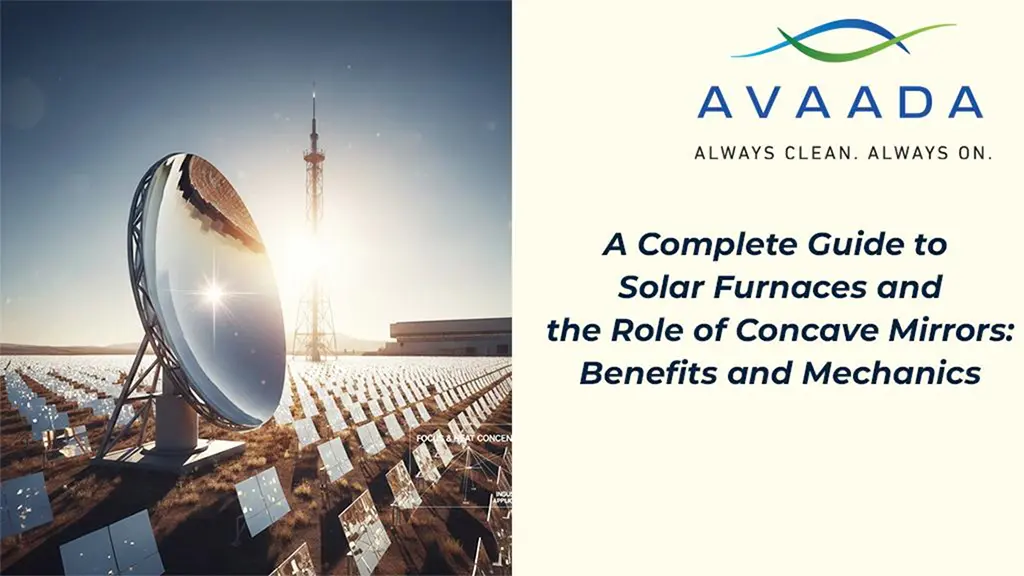
Concave mirrors serve as the core optical element in solar furnaces because they converge parallel sunlight rays. These mirrors, often arranged in heliostat fields, reflect and focus beams onto a receiver, amplifying solar intensity.
In design, concave mirrors provide a principal focus point where energy density peaks, essential for high-heat generation. Flat or convex mirrors scatter light and cannot achieve this convergence.
- Heliostats: Computer-controlled concave mirrors that track the sun.
- Materials: Silvered glass or polished metals for 95% reflectivity.
- Arrangement: Thousands of tilted units aimed rays at a tower-mounted target.
India’s solar potential, with states like Rajasthan and Gujarat receiving over 2,000 sunny hours annually, makes concave mirror-based systems viable, as promoted by government renewable energy initiatives.
Which Mirror is Used in Solar Furnaces?
The specific mirror used in solar furnaces is the concave mirror, prized for its converging properties. Parallel sun rays incident on its inward-curved surface reflect to meet at the focal point, generating concentrated heat.
This design follows the reflection principle: rays perpendicular to the mirror pass through the center of curvature undeviated, while others bend inward.
Government sources, such as India’s Ministry of New and Renewable Energy (MNRE), endorse CSP technologies using concave mirrors for thermal applications.
- Focal length: Shorter lengths yield tighter focus for higher temperatures.
- Size: Primary mirrors span meters, with secondary optics for fine-tuning.
- Durability: Coated to withstand weather, lasting 25+ years.
Avaada’s operational solar plants in Karnataka, Maharashtra, Tamil Nadu, Uttar Pradesh, Bihar, Gujarat, Haryana, Rajasthan, and Madhya Pradesh demonstrate reliable renewable energy deployment and align with mirror technologies to enhance grid stability.
Mechanics of Concave Mirrors in Solar Furnaces
Concave mirrors in solar furnaces operate via geometric optics, in which the mirror’s spherical curvature determines the focal point. Sunlight, treated as parallel rays due to the sun’s distance, reflects according to the law of reflection (angle of incidence equals angle of reflection).
The focal point lies at half the radius of curvature, where flux concentration ratios exceed 10,000 suns, producing temperatures above 2,000°C. Tracking mechanisms adjust mirror angles hourly to maintain alignment.
Key mechanical steps:
- Sunlight hits heliostats (concave mirrors).
- Mirrors pivot via dual-axis trackers.
- Rays converge on a receiver, heating a target or fluid.
- Heat transfers to processes or steam turbines.
Avaada advances renewable energy through bifacial N-Type TOPCon modules in operational plants, supporting CSP integration for round-the-clock power.
Benefits of Solar Furnaces
Solar furnaces offer environmental and economic advantages in renewable energy landscapes. They produce no greenhouse gases during operation, aiding India’s net-zero targets under the National Solar Mission.
High temperatures enable fuel-free processes, slashing costs for energy-intensive industries. Maintenance focuses on mirror cleaning, with systems operational in sunny Indian states.
- Cost savings: Payback in 5-7 years via free solar input.
- Versatility: Processes glass and silicon for solar PV manufacture.
- Scalability: Modular designs for utilities or captive use.
- Reliability: 70+ year asset life with minimal degradation.
Avaada’s integrated manufacturing of high-wattage modules (610-720 Wp) at its Butibori & Dadri facilities underscores execution excellence in renewable energy, powering sustainable growth.
Solar Furnace in India
Solar furnace technology is gaining traction in India, leveraging DNI (Direct Normal Irradiance) levels above 2,000 kWh/m²/year in arid regions. Pilot projects demonstrate viability for metallurgy and chemical synthesis.
MNRE supports CSP through schemes such as the Jawaharlal Nehru National Solar Mission, which aims to achieve 100 GW of renewable energy by 2030. Operational examples of a solar furnace in India exist in Rajasthan, focusing on R&D.
Challenges and solutions
- Dust management: Automated cleaning for mirrors
- Land use: Efficient layouts minimize footprint
- Hybridization: Pair with storage for firm power
Avaada operates plants in Karnataka, Maharashtra, Tamil Nadu, Uttar Pradesh, Bihar, Gujarat, Haryana, Rajasthan, and Madhya Pradesh, delivering reliable renewable energy and aligning with solar furnace principles for industrial decarbonization.
Read more : What Is Solar Energy
Conclusion
A solar furnace in India exemplifies renewable energy innovation, using concave mirrors to enable high-heat applications sustainably. In India, they complement solar PV manufacturing, driving the energy transition amid government-backed initiatives such as MNRE programs. Avaada’s operational expertise in states like Karnataka, Maharashtra, Tamil Nadu, Uttar Pradesh, Bihar, Gujarat, Haryana, Rajasthan, and Madhya Pradesh reinforces reliability, emphasising integrated solutions for quality power. As adoption grows, these systems promise cost-effective, emission-free heat, bolstering India’s clean energy leadership.
FAQs
Why is a concave mirror used in a solar furnace instead of a convex one?
A concave mirror is used because it is a converging mirror. It reflects parallel rays of sunlight toward a single focal point, concentrating energy to produce extreme heat (up to 3,500°C). In contrast, a convex mirror is a diverging mirror, which scatters light and cannot achieve the high temperatures required for industrial processes.
What is the maximum temperature a solar furnace can reach?
Industrial-scale solar furnaces can achieve temperatures of approximately 3,000°C to 3,500°C. This intense heat is sufficient to melt steel, conduct material testing, and even synthesise nanomaterials or green hydrogen without the use of fossil fuels.
What are the primary benefits of using a solar furnace in India?
Direct Answer: In India, solar furnaces leverage high Direct Normal Irradiance (DNI) to provide:
- Zero-Emission Heating: Supports India’s Net-Zero goals by eliminating carbon output.
- Cost Efficiency: Dramatically reduces operational costs by leveraging free solar energy in energy-intensive metallurgy.
- Industrial Synergy: Complements India’s solar PV manufacturing by providing clean heat for silicon and glass processing.
How does a solar furnace track the sun for maximum efficiency?
Solar furnaces use heliostats, computer-controlled, dual-axis tracking mirrors. These mirrors automatically adjust their position throughout the day to ensure sunlight is constantly reflected onto the primary concave concentrator, maintaining a steady peak temperature at the focal point.
Can a solar furnace generate electricity?
Yes. While their primary use is direct thermal heating, solar furnaces can generate electricity by using concentrated heat to produce high-pressure steam. This steam then drives a turbine and generator, similar to Concentrated Solar Power (CSP) plants.