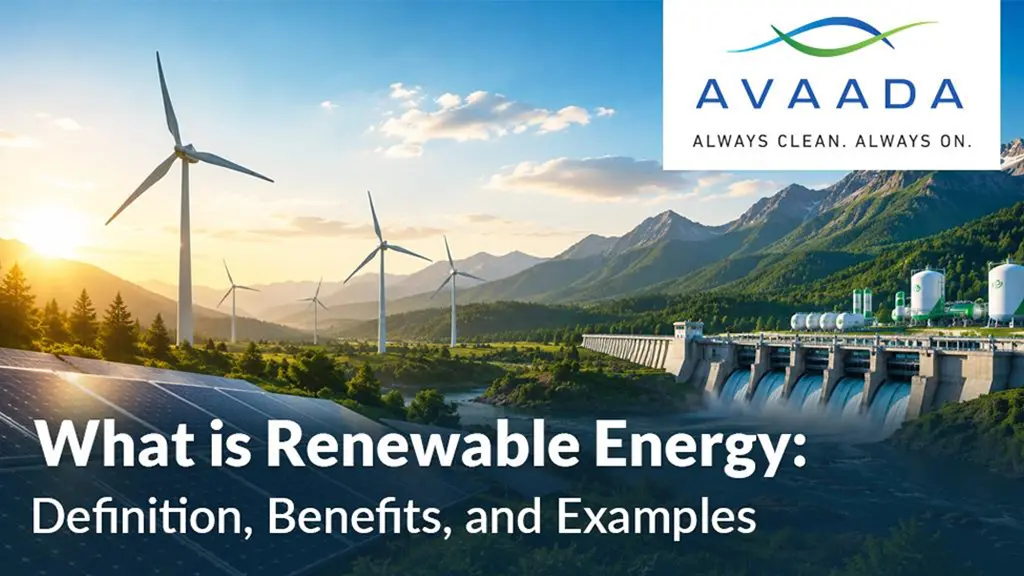
Can a country power its homes, schools, and factories using only the sun, wind, and water? The answer is yes. Clean energy is changing how the world runs. As electricity needs grow, people want to know: what is renewable energy? This power comes from natural sources that never run out. Unlike old fuels, it does not harm the air or water. Today, countries are rapidly adopting this power to secure a safer environment. Avaada Group stands at the forefront of this shift, building massive solar and wind projects to deliver reliable, green electricity.
Introduction To Renewable Energy in India
Knowing the exact definition of renewable energy helps clarify its massive impact. It means power harvested from natural processes that replenish faster than people can consume them. The term “renewable sources” refers to the natural inputs themselves, such as sunlight, wind, and water. In contrast, the energy output represents the usable electricity, heat, or fuel generated from those inputs.
This stands opposite to non-renewable fossil fuels like coal, oil, and gas, which take millions of years to form and release harmful carbon dioxide (CO2) when burned. On the other hand, renewable sources offer an infinite supply, low emissions, and highly affordable costs
As a premier manufacturer of high-wattage modules, Avaada provides end-to-end clean energy solutions, including wind, hybrid, and solar projects featuring advanced n-type TOPCon technology to ensure reliable, round-the-clock power.
Types of Renewable Energy
As India’s energy demand climbs, renewables are playing a bigger role in the mix. Here’s a breakdown of the Types of Renewable Energy driving that change.
Solar Energy
This process captures sunlight using photovoltaic (PV) panels or mirrors to generate electricity. Solar PV costs have fallen by 90% since 2010, making it the cheapest source of new power in most nations. An example is the Bhadla Solar Park in Rajasthan, India, with a capacity of over 2.2 GW. Avaada Group actively develops large-scale solar utility projects to support this segment.
Wind Energy
Wind turbines convert the kinetic energy of moving air into electricity. Turbines work on land (onshore) or at sea (offshore). An example is the Muppandal Wind Farm in Tamil Nadu, India. India has the world’s 4th-highest wind energy capacity.
Hydropower
Hydropower uses the force of flowing water from rivers or dams to spin generator turbines. It is a highly stable renewable energy power source. An example is the Tehri Hydroelectric Complex in Uttarakhand, India. India has the 5th-highest hydroelectric power capacity globally.
Geothermal Energy
This technology draws heat directly from subsurface volcanic rocks or hot water reservoirs beneath the Earth’s crust. An example is the active pilot project in the Puga Valley of Ladakh, India.
Biomass / Bioenergy
Biomass converts organic matter like crop waste, wood, and manure into heat or electricity. India actively runs the SATAT (Sustainable Alternative Towards Affordable Transportation) initiative to promote the use of compressed biogas produced from agricultural waste.
Tidal & Wave Energy
This method captures the natural kinetic movement of ocean tides and waves using underwater turbines. Coastal zones use these predictable water movements to feed regional grids.
Green Hydrogen
Green hydrogen is a clean fuel carrier. It is produced by splitting water molecules using electricity derived entirely from solar or wind power. India supports this via the National Green Hydrogen Mission to clean up the heavy manufacturing and transport sectors.
Also Read:- Advantages And Importance Of Renewable Energy
Benefits of Renewable Energy
Transitioning to clean power resources provides measurable advantages that strengthen both the environment and corporate operational efficiency:
- Environmental Protection: Clean power generation emits virtually no greenhouse gases during operation, helping preserve ecosystems.
- Economic Growth: Building and maintaining these plants creates thousands of local jobs. Solar and wind power are now highly cost-competitive against thermal options.
- Energy Security: Relying on domestic sunshine or wind reduces a country’s dependence on volatile foreign oil and gas imports.
- Public Health: Cleaner air lowers respiratory illness rates, which saves money on healthcare.
- Grid Resilience: Distributed setups, such as rooftop solar, help keep parts of the power grid online even if a main line breaks.
- Remote Access: Small solar grids deliver power to rural villages much faster than building long transmission lines from central plants.
By using these reliable power assets, Avaada Group establishes sustainable infrastructure that lowers carbon exposure while protecting long-term electricity expenses.
Importance of Renewable Energy & Why We Need It
The importance of renewable energy links directly to human survival. Global temperatures are already 1.2°C higher than pre-industrial levels. To stop severe droughts and floods, shifting away from fossil fuels is non-negotiable.
The urgent need for renewable energy is shown clearly in metropolitan cities like Delhi-NCR, where air pollution causes severe health issues. Conventional thermal power plants also use immense amounts of freshwater for cooling. Solar and wind installations use almost no water, saving important resources for farming and drinking. Clean alternatives offer an infinite supply that can scale quickly enough to fulfill growing demands without damaging the atmosphere.
Government Policies and Initiatives
The Government of India has rolled out a wide range of policies and schemes to accelerate the country’s renewable energy transition:
- Target: India aims for 500 GW of non-fossil fuel capacity by 2030 and carbon neutrality by 2070.
- Solar Initiatives: Includes schemes for Solar Parks and Ultra-Mega Solar Projects to develop large-scale solar capacity across states.
- CPSU Scheme: Supports grid-connected Solar PV projects using domestically manufactured components.
- High-Efficiency Solar PV Modules: Incentivizes manufacturing through Production Linked Incentives (PLI) to strengthen India’s domestic solar supply chain.
- PM-KUSUM Scheme: Promotes grid-connected solar power plants and solar pumps in agriculture.
- Rooftop Solar Programme: Offers subsidies for residential installations and incentives for DISCOMs.
- Green Energy Corridors: Enhances intra-state and inter-state transmission infrastructure to evacuate power from renewable energy projects.
- Waiver of ISTS Charges: Waives Inter-State Transmission System charges on renewable power, cutting costs for large-scale solar, wind, and hybrid project developers.
- 100% FDI in Renewables: Permits full foreign direct investment under the automatic route, opening the sector to global capital and technology partnerships.
- Renewable Purchase Obligations (RPOs): Mandates that DISCOMs source a fixed share of power from renewable sources, ensuring steady demand for clean energy.
- National Green Hydrogen Mission: Aims to establish India as a global hub for green hydrogen and green ammonia production, offering incentives such as waived transmission charges for renewable power used in electrolysis.
Renewable Energy vs Non-Renewable Energy
Comparing how different power sources affect the environment and operational costs helps clarify why utility networks are updating their infrastructure.
Feature | Renewable Energy | Non-Renewable Energy |
Source | Sun, Wind, Water, Biomass | Coal, Oil, Natural Gas, Uranium |
Replenishment | Instant or continuous | Takes millions of years |
Carbon Emissions | Very low to zero | Highly intensive |
Fuel Volatility | None (Free natural inputs) | High price fluctuations |
Water Usage | Extremely low | Very high for cooling |
This clear breakdown shows why clean resources provide a more stable, cost-effective, and safe power supply for long-term industrial operations.
Final Thoughts
Transitioning to clean power is the primary practical path to meet global climate goals. Understanding what renewable energy is helps communities see its operational benefits for health, local economies, and resource protection. By deploying utility-scale wind, solar, and green hydrogen projects, Avaada Group turns clean power into reality. Our end-to-end clean energy solutions deliver reliable round-the-clock power while helping businesses meet their sustainability targets safely.
Explore how Avaada Group is accelerating India’s renewable energy transition.
FAQs
What is renewable energy?
Renewable energy is electricity or heat generated from natural resources that never run out, such as the sun, wind, and water.
What are the main types of renewable energy?
The seven main types are solar, wind, hydro, geothermal, biomass, ocean, and green hydrogen.
What are 5 examples of renewable energy?
Five examples include solar PV panels, onshore wind turbines, river dams, geothermal hot springs, and agricultural biogas plants.
What are the benefits of renewable energy?
It stops air pollution, lowers electricity expenses, creates domestic manufacturing jobs, reduces fuel imports, and saves water resources.
Why is renewable energy important?
It is important because it provides an infinite power supply while lowering the carbon emissions that drive global warming.
Which is the most used renewable energy source in India?
Solar power is the largest source, with India surpassing 150 GW of installed solar capacity.
What is India's renewable energy target for 2030?
India aims to establish 500 gigawatts of non-fossil fuel power capacity by the year 2030.