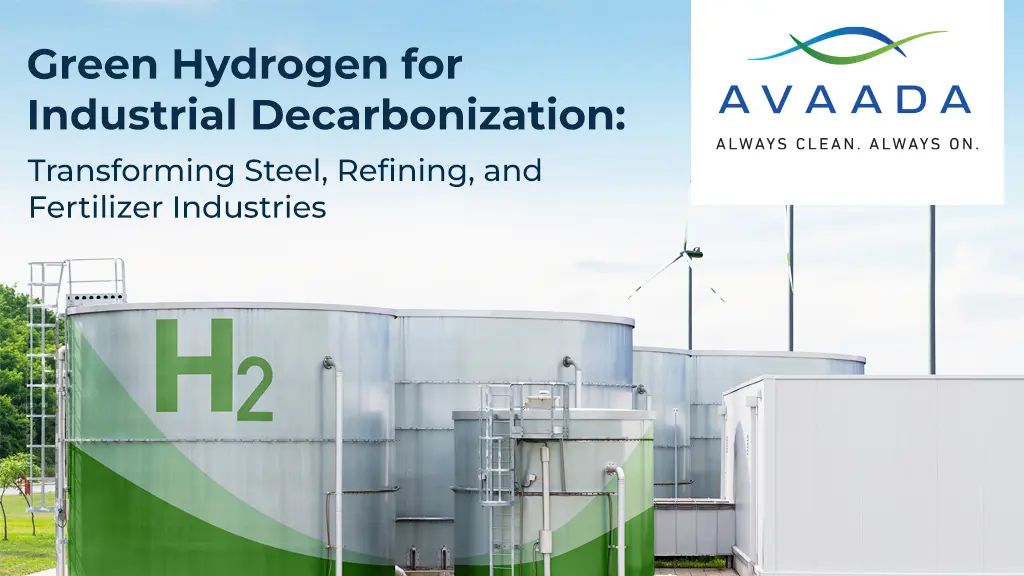
For decades, industries such as steel, oil refining, and fertilizer manufacturing have been the backbone of economic growth. They build our cities, power transportation, and support food security. However, they also account for a significant share of global carbon emissions, making them some of the hardest sectors to decarbonize.
While renewable electricity from solar and wind is transforming the power sector, heavy industries require high-temperature heat and hydrogen-based chemical processes that cannot always be electrified. This is where Green Hydrogen is emerging as one of the most promising solutions.
Produced using renewable electricity and water through electrolysis, green hydrogen offers industries a clean alternative to fossil fuels. It has the potential to reduce emissions without compromising operational efficiency, making it a key driver of industrial decarbonization.
Industrial Decarbonization Is the Next Big Climate Challenge
The energy transition is no longer limited to replacing coal-fired power plants with renewable energy. Today, the focus is shifting toward reducing emissions from hard-to-abate sectors.
According to the International Energy Agency (IEA), global hydrogen demand has surpassed 100 million tonnes, with refining, ammonia, methanol, and steel production remaining the largest consumers. Although low-emissions hydrogen still accounts for only a small share of total production, investments in commercial-scale projects continue to grow, supporting the scale-up of clean hydrogen technologies.
This highlights an important reality: achieving net-zero emissions will require clean fuels alongside renewable electricity.
What Is Green Hydrogen?
Green hydrogen is produced by splitting water into hydrogen and oxygen through electrolysis powered entirely by renewable energy such as solar, wind, or hydropower.
Unlike conventional hydrogen produced from natural gas or coal, green hydrogen production generates little to no carbon emissions.
The hydrogen can then be stored, transported, and used as a clean fuel or industrial feedstock, making it one of the most versatile energy carriers in the clean energy ecosystem.
Transforming the Steel Industry
Steel production is among the world’s most carbon-intensive industrial processes, contributing approximately 7 – 8% of global CO₂ emissions.
Traditional steelmaking depends on coking coal to reduce iron ore, releasing significant amounts of carbon dioxide. Green hydrogen offers a cleaner alternative through Direct Reduced Iron (DRI) technology, where hydrogen replaces coal as the reducing agent and produces water vapor instead of carbon emissions.
For steel manufacturers, this transition offers multiple benefits:
- Significant reduction in carbon emissions
- Compliance with future carbon regulations
- Improved competitiveness in global markets
- Access to growing demand for low-carbon or “green steel”
As European governments introduce carbon border adjustment mechanisms (CBAM) and sustainability standards, green hydrogen is expected to become an essential component of future steel manufacturing.
Decarbonizing Oil Refineries
Oil refineries already consume large volumes of hydrogen for desulfurization and fuel processing. However, most of this hydrogen is currently produced using fossil fuels.
Replacing grey hydrogen with green hydrogen enables refineries to lower emissions without fundamentally changing their existing production processes.
According to the IEA, refining and industry remain the leading sectors for low-emission hydrogen adoption. Based on projects that have reached a final investment decision (FID), around 2.5 million tonnes of low-emission hydrogen is expected to be produced and consumed in refineries and industrial facilities by 2030.
For refineries, green hydrogen supports cleaner fuel production while helping companies meet ESG commitments and evolving environmental regulations.
Revolutionizing Fertilizer Manufacturing
Hydrogen is an essential ingredient in ammonia production, which is the foundation of nitrogen-based fertilizers.
Today, the fertilizer industry primarily relies on fossil fuel-derived hydrogen, contributing significantly to industrial emissions.
By adopting green hydrogen, fertilizer manufacturers can produce green ammonia while reducing their carbon footprint and improving long-term sustainability.
As countries strengthen food security and climate commitments simultaneously, green hydrogen is expected to play a critical role in building a more sustainable agricultural value chain.
Why Green Hydrogen Matters for Industrial Decarbonization
Many industrial processes require extremely high temperatures or chemical reactions that electricity alone cannot provide.
This is why industrial decarbonization increasingly depends on clean molecules like hydrogen.
Green hydrogen enables industries to:
- Reduce greenhouse gas emissions
- Replace fossil fuel-based hydrogen
- Improve long-term energy security
- Meet ESG and sustainability goals
- Prepare for future carbon pricing mechanisms
Rather than replacing renewable energy, hydrogen complements it by extending clean energy into sectors where direct electrification is difficult.
India's Green Hydrogen Opportunity
India is uniquely positioned to become a global leader in green hydrogen.
With abundant solar and wind resources, competitive renewable energy costs, and strong policy support, the country has significant advantages in producing low-cost green hydrogen.
The National Green Hydrogen Mission aims to achieve 5 million tonnes of annual green hydrogen production by 2030, while attracting investments across manufacturing, infrastructure, exports, and research.
This presents enormous opportunities for green hydrogen companies to build integrated clean energy ecosystems that support domestic demand as well as global exports.
As production scales up and electrolyzer costs continue to decline, India is expected to become one of the world’s most competitive green hydrogen producers and suppliers.
Beyond Hydrogen: The Rise of Green Fuel Solutions
Green hydrogen is much more than an industrial fuel.
It also serves as the building block for several green fuel solutions, including:
- Green ammonia
- Sustainable aviation fuel (SAF)
- Green methanol
- Synthetic fuels for shipping
- Clean fuels for heavy transportation
These solutions have the potential to decarbonize sectors that are otherwise difficult to electrify, creating entirely new clean energy value chains.
According to the IEA, more than 200 low-emission hydrogen projects have already been announced globally, demonstrating growing confidence in hydrogen’s long-term role in the energy transition.
How Avaada Group Is Supporting India's Green Hydrogen Future
India’s transition to a low-carbon economy requires integrated energy solutions rather than standalone technologies.
As one of India’s leading renewable energy companies, Avaada Group is expanding beyond renewable power into battery energy storage systems (BESS), pumped hydro storage, solar PV manufacturing, and green hydrogen to support industrial decarbonization.
By investing across complementary technologies, Avaada is developing integrated green fuel solutions that can help industries reduce emissions while improving energy security and operational resilience.
This reflects the broader transformation taking place across the clean energy sector, where innovation, diversification, and sustainability are becoming key drivers of long-term growth.
Conclusion
Heavy industries are entering a new era.
Steel manufacturers, refineries, fertilizer producers, and chemical companies are under increasing pressure to reduce emissions while maintaining productivity and global competitiveness.
Green Hydrogen offers a practical pathway to achieve both objectives.
As renewable electricity becomes more affordable and hydrogen technologies continue to mature, green hydrogen will play a central role in accelerating industrial decarbonization across the world.
For businesses, it represents an opportunity to future-proof operations.
For India, it strengthens energy security and global competitiveness.
And for the planet, it brings us one step closer to building a cleaner, more sustainable industrial economy.
FAQs
Which is the best green hydrogen company in India?
The best green hydrogen company depends on project requirements, technology capabilities, and production scale. Companies investing across renewable energy, electrolyzers, storage, and green fuel solutions are well-positioned to support India’s clean energy transition.
What makes a green hydrogen company suitable for industrial use?
A leading green hydrogen company for industrial use should offer reliable green hydrogen production, renewable energy integration, scalable infrastructure, and the ability to serve industries such as steel, refining, fertilizers, and chemicals.
How is green hydrogen used in the steel and chemical industries?
Green hydrogen replaces fossil fuels in industrial processes, helping steel manufacturers reduce carbon emissions and enabling chemical industries to produce cleaner products while supporting industrial decarbonization.
Why is green hydrogen important for oil refineries?
Oil refineries use hydrogen for fuel processing and desulfurization. Replacing conventional hydrogen with green hydrogen helps reduce emissions while supporting cleaner refining operations.
Can green hydrogen help decarbonize the fertilizer industry?
Yes. Green hydrogen can replace fossil fuel-based hydrogen in ammonia production, allowing fertilizer manufacturers to significantly lower their carbon footprint while maintaining production efficiency.
What industries will benefit the most from green hydrogen?
Industries such as steel, oil refining, fertilizers, chemicals, heavy transport, shipping, and aviation are expected to be among the biggest beneficiaries of green hydrogen and other green fuel solutions.
What is the National Green Hydrogen Mission in India?
The National Green Hydrogen Mission aims to establish India as a global hub for green hydrogen production, targeting 5 million tonnes of annual production by 2030 while supporting industrial decarbonization, energy security, and clean energy exports.
How is Avaada Group contributing to India's green hydrogen future?
Avaada Group is expanding its clean energy portfolio by investing in renewable power, battery energy storage systems (BESS), solar PV manufacturing, and green hydrogen to support industrial decarbonization and India’s long-term energy transition.