
Solar energy supports India’s clean energy transition for homes and industries. While rooftop installations remain common, limited roof space in dense urban areas presents a challenge for solar adoption. Wall-mounted solar panels utilize vertical building facades to generate clean electricity without occupying rooftop space.
India continues to expand renewable energy capacity across states, including Karnataka, Maharashtra, Tamil Nadu, Uttar Pradesh, Bihar, Gujarat, Haryana, Rajasthan, and Madhya Pradesh.
Avaada manufactures high-efficiency bifacial N-Type TOPCon (G12) modules suitable for vertical installations.
What Are Wall-Mounted Solar Panels?
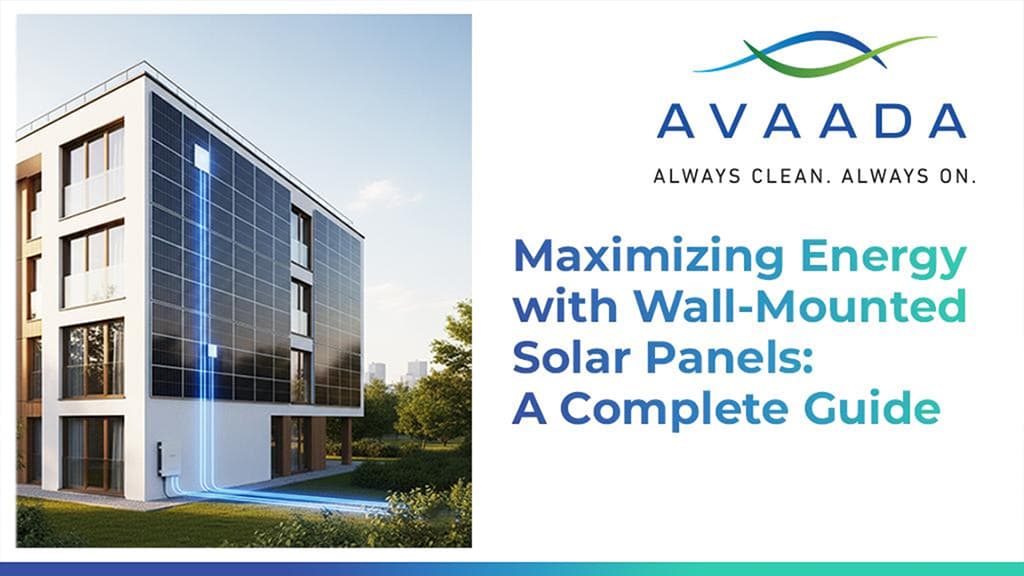
Wall-mounted solar panels are photovoltaic solar panels (PV) modules installed vertically on the sides of buildings. Unlike traditional rooftop systems tilted to face the sun, these systems integrate into building facades.
The mounting structure secures the panels parallel to the wall. This setup captures sunlight hitting the building from the side. Vertical solar panels perform effectively during early mornings, late afternoons, and winter months when the sun is lower in the sky.
Modern installations use bifacial modules, which capture light from both sides. When mounted on reflective surfaces, the rear side absorbs reflected light, thereby contributing to energy generation.
The excess power generated can support energy-intensive processes, such as green hydrogen production via electrolysis, where consistent daytime solar output aligns perfectly with hydrogen generation cycles.
The economic viability of these high-efficiency configurations is supported by recent tariff discoveries, where FDRE (Firm and Dispatchable Renewable Energy) options from Avaada have achieved competitive tariffs of ₹4.70/kWh, significantly lower than some new thermal power projects.
Benefits of Wall-Mounted Solar Panels
Installing solar panels on walls offers advantages that go beyond simple energy generation. These systems address specific structural and spatial challenges found in modern construction.
Space Efficiency
In high-rise residential complexes and commercial towers, roof space is often limited by HVAC units, water tanks, and elevator shafts. Wall-mounted solar panels utilize unused vertical surfaces, allowing power generation in buildings without available rooftop space.
Ease of Maintenance and Installation
Vertical positioning reduces the accumulation of dust and debris. Gravity naturally keeps the surface cleaner than horizontal panels, which is critical, as industry data shows India experiences 1.3 million transformer failures annually, often linked to inconsistent power quality and maintenance issues in the distribution grid.
Aesthetic Appeal
Architects and developers increasingly view solar modules as design elements. A sleek, black solar facade creates a modern, industrial look. It signals a commitment to sustainability. Using mount panels on the exterior can modernize older buildings or define the aesthetic of new constructions.
Enhanced Energy Production in Winter
Solar panels perform best when the sun’s rays hit them at a perpendicular angle. During winter, the sun stays lower on the horizon. This angle favors vertical solar panels. Consequently, these systems can maintain consistent production levels during months when rooftop output typically drops.
Reduced Carbon Footprint
For commercial entities, this contributes directly to decarbonization targets. This is particularly relevant as India has already achieved 50% of its installed power capacity from non-fossil fuel sources as of October 2025, five years ahead of its Paris Agreement target.
Avaada's High-Efficiency Modules
The performance of vertical installations depends on module efficiency, as vertical surfaces receive different irradiation patterns compared to tilted surfaces.
Avaada manufactures bifacial N-Type TOPCon (G12) modules with power outputs of 610 Wp, 630 Wp, and 720 Wp. These modules support generation from limited wall space.
Avaada produces these modules through fully integrated manufacturing, from ingots to wafers, cells, modules, glass, frames, and junction boxes, at a single 210-acre facility with 6 GW operational capacity. Products hold IEC, BIS, and UL certifications, meeting safety and performance standards for vertical solar panel mounting.
Technical Considerations for Vertical Installations
Vertical solar panel installations require specific engineering to optimize performance in India’s diverse climates. Wind load management becomes critical because panels are exposed to higher wind speeds than rooftop systems. Avaada’s bifacial N-Type TOPCon modules, certified to IEC 61215 standards, withstand wind speeds up to 2400 Pa.
Thermal performance also differs; vertical orientation improves natural cooling, reducing the risk of hotspots common in hot states like Rajasthan and Gujarat. Integrated mounting systems ensure structural integrity without penetrating the facade, preserving building waterproofing.
Avaada’s G12 modules, manufactured end-to-end, retain 85-90% efficiency after 25 years, per IEC testing protocols. This reliable output makes wall-mounted systems ideal for powering green hydrogen production facilities, where electrolyzers require steady DC input during peak solar hours across Avaada’s operational states.
Applications
The versatility of wall-mounted solar panels makes them suitable for a wide range of sectors.
Residential Uses
Homeowners with small roofs can use south-facing walls to mount panels. This is particularly useful for multi-story homes where the roof area is small relative to the total floor space.
Commercial and Industrial Uses
Office buildings and factories have expansive vertical surfaces. Installing a solar facade turns these inert surfaces into active power generators. This is an effective way for businesses to offset energy costs and meet Renewable Purchase Obligations (RPO).
Integration with Pumped Storage Projects (PSP)
For energy reliability, solar generation pairs with storage solutions. Avaada’s Pumped Storage Projects function as water batteries, storing excess energy and releasing it as needed to provide firm renewable power. These systems offer 70+ years of asset life with minimal degradation, supporting grid stability.
Sustainability and Reliability
Adopting vertical solar technology aligns with broader Environmental, Social, and Governance (ESG) goals. It demonstrates a proactive approach to energy transition.
Avaada supports these goals by ensuring its manufacturing processes and products are sustainable. The N-Type modules have a lower degradation rate than conventional panels. This means they maintain their performance for longer periods, reducing electronic waste over time. By prioritizing durability and efficiency, these systems offer a reliable energy source for decades.
Conclusion
Wall-mounted solar panels represent a smart evolution in how we harvest solar energy. They solve space constraints, offer distinct seasonal advantages, and improve the visual appeal of buildings. Avaada’s bifacial N-Type TOPCon modules, manufactured through integrated processes and certified to IEC, BIS, and UL standards, support these applications across utility, rooftop, and C&I projects.