
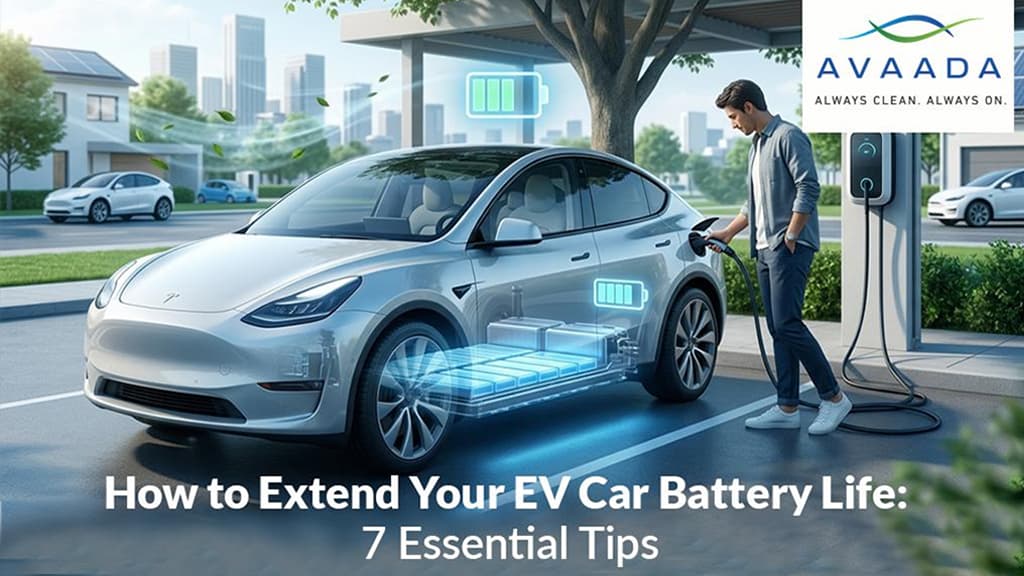
The adoption of electric vehicles is a defining shift in modern transportation, driven by the need for cleaner air and lower operational costs. As India met a record peak power demand of 242.49 GW in FY 2025-26 while reducing energy shortages to 0.03%, the infrastructure for electric mobility has become increasingly reliable. For any owner, the most significant component of this transition is the battery. Maintaining EV car battery life is not just about daily range; it is about preserving the vehicle’s long-term value. Avaada, as a pioneer in renewable energy, understands that sustainable mobility depends on the longevity of the technology we use. By following a few disciplined habits, you can ensure your EV battery remains efficient for years.
Understanding Your EV Battery: The Heart of Your Electric Vehicle
An EV battery is the most expensive and critical component of an electric car. Unlike the lead-acid batteries found in traditional vehicles, an electric car battery’s life is measured by its ability to hold a charge over thousands of cycles. Most modern vehicles utilize lithium-ion technology because of its high energy density and rechargeability. However, the chemical nature of these batteries means that EV car battery life is subject to gradual wear. Understanding how this component functions is the first step toward effective maintenance.
The Science Behind EV Batteries: Lithium-ion Technology Explained
An electric car battery functions through the movement of lithium ions between a cathode and an anode. During discharge, ions move to the cathode to provide power, and the process reverses during charging. EV battery life is determined by how cleanly these ions move. Over time, physical changes in the internal structure, often caused by heat or extreme voltage, can impede this movement, leading to a permanent loss of capacity.
What is EV Battery Degradation and Why It Matters
Degradation is the process by which an electric car battery’s capacity slowly decreases over time. A typical car battery’s lifetime is characterized by a loss of approximately 2.3% of its original capacity annually. If a battery has a state of health (SOH) of 80%, it means a pack originally capable of 100 kWh can now only store 80 kWh. While some degradation is inevitable, excessive wear can lead to a significant drop in resale value and utility.
Tip 1: Optimize Your Charging Habits for a Longer EV Battery Life
The way you charge your EV battery has the most profound impact on electric car battery life. While it is tempting to treat a car like a smartphone and charge it to 100% every night, this is often detrimental to the cells’ chemical health.
Maintaining an EV battery life requires staying within a “sweet spot” of charge.
- The 20-80% Rule: It is widely recommended to keep the state of charge between 20% and 80% for daily use.
- Minimize Stress: Keeping a battery at 100% or letting it drop to 0% creates high voltage stress, which accelerates the breakdown of internal chemicals.
- Buffer Awareness: Modern manufacturers often include a “buffer,” meaning that 100% on your screen isn’t the true chemical maximum; staying below it still provides an extra layer of protection.
While DC fast chargers are convenient for long trips, they generate significant heat. Frequent use of high-power charging (above 100 kW) can increase the annual degradation rate to 3.0%, compared to just 1.5% for those who rely on slower AC charging. To preserve car battery life, use slow home chargers for overnight sessions and reserve fast chargers for emergencies.
Tip 2: Manage Temperature Extremes to Protect Your Battery
India’s climate presents a unique challenge for electric car battery life. Lithium-ion batteries are sensitive to temperature and perform best when kept between 20°C and 30°C.
When it comes to maintaining your vehicle’s performance and battery life, mindful parking habits can make a significant difference. Here are some tips to help you avoid the negative effects of extreme temperatures:
- Seek Shade: On hot afternoons, parking in the shade prevents the battery from soaking up ambient heat, which triggers the cooling system and drains energy.
- Pre-conditioning: Use your vehicle’s app to cool or heat the cabin while it is still plugged in. This uses grid power rather than the EV battery life to reach an optimal temperature before you start driving.
The BMS is the brain that protects the electric car battery’s capacity. It monitors individual cell voltages and manages thermal systems. Ensure your car is plugged in during extreme heat; this allows the BMS to run active liquid-cooling systems using external power, rather than depleting the electric car battery to keep itself cool.
Tip 3: Drive Smoothly for Battery Longevity
Your driving style directly influences the thermal load on the EV car battery life. Aggressive driving requires the battery to discharge energy rapidly, which generates internal heat.
Gentle driving helps maintain a stable car battery life. Utilizing regenerative braking, where the motor acts as a generator during deceleration, not only extends your range but also reduces the physical wear on your braking system. High-regen settings let you recover energy that would otherwise be lost as heat, keeping battery cycles more efficient.
Tip 4: Avoid Storing Your EV at Very High or Very Low Charge Levels
If you plan to leave your vehicle unused for several weeks, the state of charge is vital for maintaining the electric car battery capacity.
Storing an EV with a nearly empty or a fully charged battery for a long time can lead to permanent capacity loss. The consensus for maximizing EV battery life during storage is to leave the battery at approximately 50% to 60% charge. This balanced state minimizes the chemical pressure on the battery cells.
Tip 5: Regular Software Updates and Maintenance
Unlike traditional cars, an electric vehicle’s performance can improve over time through firmware. This is essential for maintaining electric car battery life.
Manufacturers frequently release updates that refine how the BMS handles charging curves and thermal management. These updates can unlock greater efficiency and more accurate EV battery life readings, ensuring the hardware is always running the latest safety and performance logic.
Tip 6: Consider the Impact of Extreme Towing or Heavy Loads
Towing a trailer or carrying the maximum passenger load significantly increases energy consumption. This results in a higher “C-rate” of discharge, leading to higher internal temperatures. For a healthy EV car battery life, avoid frequent heavy-duty tasks that exceed the vehicle’s recommended load limits.
Tip 7: Utilize Professional Battery Health Checks
A car battery’s lifetime can be accurately predicted through professional diagnostics. During periodic service, technicians can provide a State of Health (SOH) report. This data helps you understand the actual car battery lifetime remaining and whether any individual modules require attention before they affect the entire pack.
Avaada's Commitment to Sustainable Mobility and Energy Solutions
At Avaada, we believe that the true potential of electric vehicles is realized when they are powered by the sun and the wind. By integrating PV solar panels into the charging infrastructure, we can create a truly carbon-neutral transportation loop. Our work in developing large-scale renewable projects ensures the electricity used to charge your EV battery is as clean as the vehicle itself.
Powering the Future: How Avaada Supports the EV Ecosystem
The stability of the EV grid is bolstered by a battery energy storage system (BESS). Avaada is at the forefront of implementing BESS technology to manage the intermittent nature of renewable energy, ensuring that green power is available whenever you need to charge. By combining PV solar panels with advanced storage, we are making the dream of sustainable, long-term EV car battery life a reality for everyone.
Conclusion
Maximizing the life of your EV car battery not only benefits your wallet but also supports environmental sustainability. By developing good charging habits, monitoring temperature fluctuations, and driving smoothly, you can ensure your vehicle stays efficient and dependable for the long haul. With India’s energy infrastructure steadily improving, the partnership between advanced batteries and renewable energy becomes increasingly vital. Avaada is at the forefront of this shift, delivering green power and storage solutions that help you maintain a sustainable journey and prolong your battery’s health.
FAQs
What is the average lifespan of an EV battery in India?
Most EV batteries retain 80% capacity after 8 years or 1.6 lakh km, often outlasting the vehicle’s chassis.
Does rapid charging shorten EV battery life?
Frequent fast charging (over 12% of sessions) can increase annual degradation by 1% compared to slow charging.
What happens to EV batteries after their automotive life?
They are often repurposed for stationary storage in homes or power grids before being recycled for raw materials.
Can I replace individual cells in an EV pack?
While technically possible, most manufacturers replace entire modules to ensure balanced performance and safety.
How do cold temperatures affect EV batteries?
Cold reduces chemical activity, leading to temporary range loss, though it does not cause permanent degradation like extreme heat.
Are EV battery warranties comprehensive?
Most Indian manufacturers offer 8-year warranties, typically covering any drop in capacity below 70%.