Imagine you are a business owner in India. It is a scorching summer afternoon, and your factory is running at full capacity. Suddenly, a minor cloud cover drifts over, or perhaps a layer of fine dust settles on a specific corner of your solar array. In a traditional setup, you would lose power efficiency without even realizing it. However, with Solar Rooftop 2.0, your system identifies these changes instantly, adjusts its parameters, and notifies you before the loss hits your balance sheet. This shift represents a move toward active, data-driven energy management.
The Evolution of Solar Rooftop 2.0
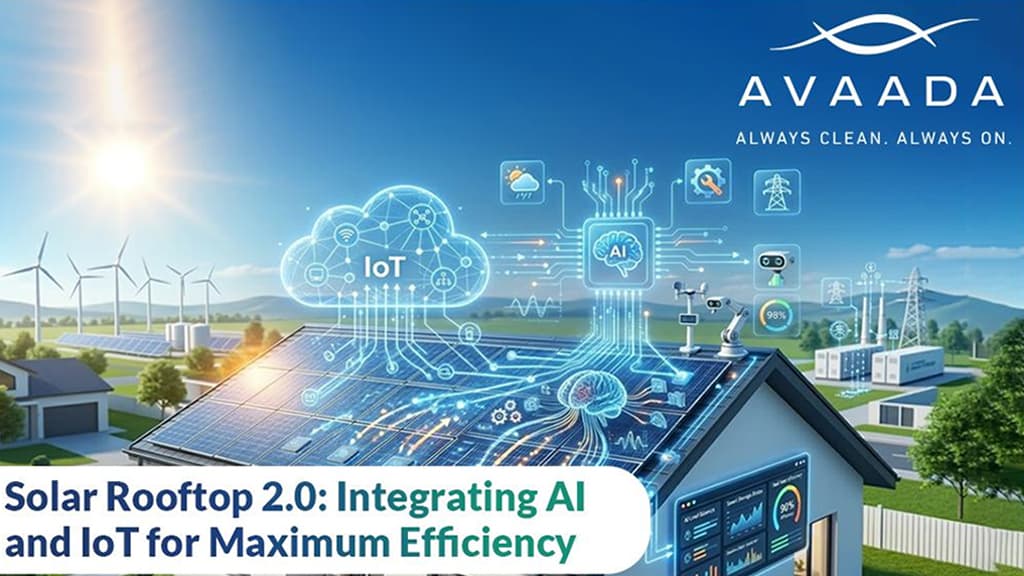
A modern solar rooftop solution is no longer just a collection of panels and wires. It is a sophisticated power plant integrated with Artificial Intelligence (AI) and the Internet of Things (IoT). As India marches toward its goal of 500 GW of non-fossil fuel capacity by 2030, the intelligence of the grid becomes just as important as the panels themselves. This version represents a total convergence of hardware and software. By embedding IoT sensors directly into the solar rooftop installation, every component communicates real-time data on temperature, irradiance, and voltage. AI then processes this data to predict generation patterns and detect technical anomalies that human monitoring might miss.
Read more : Best Solar Panels In India
Key Benefits of AI & IoT in Solar Rooftop Systems
Integrating smart technology into your energy infrastructure provides a level of control and foresight that was previously impossible. The following advantages highlight how these digital layers enhance your daily energy harvest.
- Increased Energy Efficiency: AI optimizes the inverter’s Maximum Power Point Tracking (MPPT) in real-time. This ensures the system extracts the maximum possible power under varying light conditions.
- Real-Time Monitoring: Users can view live generation data, ensuring the solar rooftop for industries meets production targets every hour.
- Predictive Maintenance: Instead of waiting for a breakdown, the system alerts users when a component’s performance declines, enabling cleaning or repairs before a total failure occurs.
- Smart Energy Management: IoT-enabled systems can automatically trigger heavy appliances during peak solar production hours to minimize grid reliance.
- Higher ROI: By reducing downtime and optimizing output, the system’s payback period is significantly shortened.
These benefits ensure that every ray of sunlight is captured and utilized with minimal waste, providing a more robust financial return for the owner.
Must Read:- Solar Rooftop vs Solar Panels
Rooftop for Industries vs. Residential Use
The scale of rooftop solar panel installations varies across sectors, but the core technology remains the same. Industrial systems often focus on meeting ESG (Environmental, Social, and Governance) goals and offsetting high operational costs, while residential rooftop solar panels are designed to eliminate monthly utility bills for households.
Factor | Residential | Industrial |
System Size | 1 kW to 20 kW | 100 kW to Multi-MW |
Cost | Lower absolute cost | Higher investment, lower per-kW cost |
ROI | 4 to 6 Years | 3 to 5 Years |
Monitoring | App-based | Advanced Analytics & SCADA |
Hardware and the Solar PV Module Manufacturer
While software provides the intelligence, the physical panels remain the foundation of any system. As a leading solar PV module manufacturer, Avaada produces high-efficiency N-type TOPCon modules, a type of module that has become a rapidly emerging technology in 2026. These panels offer superior efficiency and lower degradation rates, ensuring they work in harmony with AI-driven monitoring.
Common solar panel types include:
- Monocrystalline Panels: Known for high efficiency and sleek aesthetics, making them ideal for space-constrained residential roofs.
- N-type TOPCon: The current industry leader, providing higher power output even in low-light or high-heat conditions.
- Thin-Film Modules: Lightweight and flexible, suitable for large or unconventional surfaces where rigid panels are not practical. They have lower efficiency but perform better at high temperatures and under diffused light.
Government Subsidies and Costs in 2026
The Indian government continues to incentivize solar adoption through robust financial support. Under schemes like PM-Surya Ghar, installing solar panels on rooftops has become more affordable than ever.
- Standard Costs: In 2026, a standard residential installation costs approximately ₹55,000 to ₹75,000 per kW.
- Subsidies: Homeowners can receive significant subsidies, often reducing the out-of-pocket expense by nearly 40% for a 3 kW system.
Read more : Solar Panel Cost
Conclusion
Choosing a modern rooftop solar solution ensures your investment is protected by real-time data and predictive technology. Companies offer cutting-edge solar solutions that combine high-efficiency TOPCon modules with smart monitoring to deliver unparalleled performance. Whether for a home or a large factory, the transition to smart solar energy provides a clear path to energy independence and significant cost savings. Professional installation now includes a digital setup phase to activate your AI monitoring and ensure long-term reliability.
Ready to upgrade your energy profile? Contact Avaada today for a customized Solar Rooftop 2.0 consultation.
FAQs
What is a solar rooftop solution?
A solar rooftop solution is a complete power generation system installed on a building’s roof. It includes solar panels, an inverter, mounting structures, and monitoring tools that work together to convert sunlight into usable electricity for the building.
How does AI improve solar rooftop efficiency?
AI improves efficiency by analyzing weather data to predict generation output and adjusting system parameters in real time. It also identifies specific panels that underperform due to dust or shade, enabling targeted maintenance to keep the system running at peak capacity.
What role does IoT play in solar systems?
IoT connects the solar hardware to the internet. This allows sensors on the panels and inverters to send performance data to a central platform, enabling owners to monitor their energy production and consumption through a smartphone or computer.
What are the different types of solar panels?
The most common types are Monocrystalline and Thin-film. In 2026, N-type TOPCon modules are the most popular due to their high efficiency and ability to generate more power under low-light conditions than older technologies.
How much does solar rooftop installation cost in India?
In 2026, a standard residential installation costs approximately ₹55,000 to ₹75,000 per kW. Government subsidies under schemes like PM-Surya Ghar can significantly reduce this out-of-pocket expense for homeowners, often paying for themselves in under five years.