A data center is a facility that houses computing infrastructure such as servers, storage systems and networking equipment. It provides the power, cooling, connectivity and security needed to keep digital applications and data available. From cloud services and video streaming to banking and AI, green energy data centers support much of the digital world.
A data center is, in simple terms, the physical infrastructure behind many of the digital services we use every day.
When you open an app, stream a video, make a digital payment, access a cloud-based business application or use an AI tool, the information involved has to be processed, stored and transmitted somewhere. In many cases, that work happens inside a data center.
Modern data centers combine computing equipment with specialised electrical, cooling, networking and security infrastructure so that digital workloads can operate reliably and at scale. Cisco describes data centers around interconnected computing and storage resources used to deliver shared applications and data, while supporting infrastructure includes power, cooling and external network connectivity.
As businesses become more digital and technologies such as cloud computing and artificial intelligence grow, data centers are becoming an increasingly important part of both economic and physical infrastructure.
How Does a Data Center Work?
A data center works by bringing computing, storage, networking, power and cooling systems together in a controlled environment.
At a basic level, the process looks like this:
1. A user or application sends a request.
Suppose you open an online banking application, search for a file stored in the cloud or send a request to an AI model.
2. Networks route the request to computing infrastructure.
High-speed network equipment directs the request to the appropriate servers and applications inside the data center.
3. Servers process the request.
Servers provide the processing power required to run applications, perform calculations and execute software.
4. Storage systems retrieve or save data.
If the request involves existing information, storage infrastructure makes that data available. New information can also be saved for future use.
5. The result is transmitted back to the user.
Networking infrastructure carries the processed information to the application, device or service that requested it.
This can happen in fractions of a second and at enormous scale.
Behind this seemingly simple process is a second layer of infrastructure working continuously. Electrical systems deliver power to IT equipment, backup systems protect against interruptions, cooling systems remove the heat produced by computing equipment, and security systems protect the facility and its digital assets.
For this reason, a data center is much more than a building filled with computers. It is an engineered environment designed to keep digital infrastructure available, connected and operating within the conditions required by IT equipment.
Key Components of a Data Center
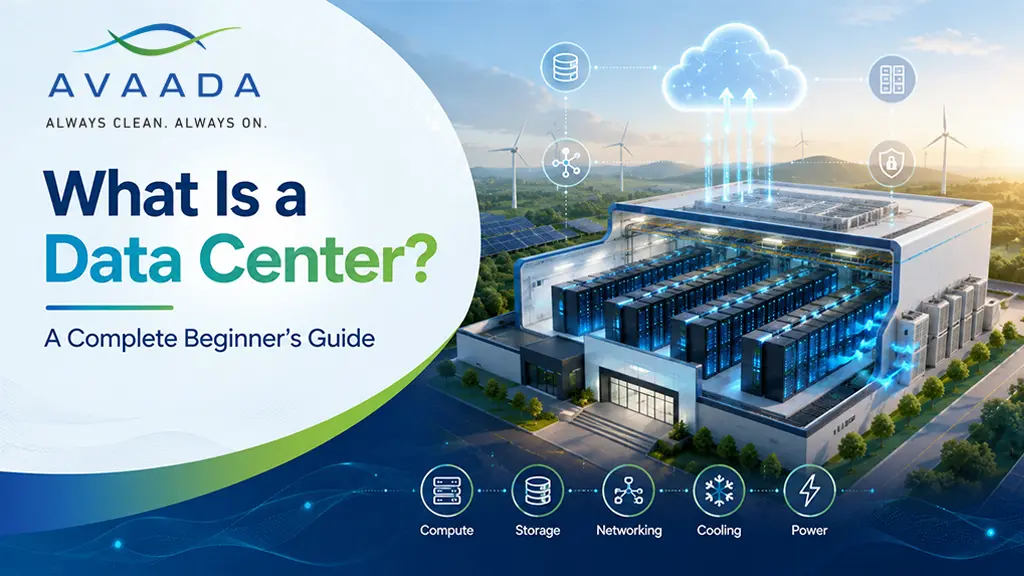
Although data centers vary significantly in size and design, most rely on five fundamental systems: servers, storage, networking, power and cooling.
1. Servers: The Computing Power
Servers are specialised computers that process information and run applications.
They contain many of the same basic components as a personal computer—including processors, memory and storage—but are designed for sustained operation, manageability and large-scale workloads.
Depending on the data center, servers may support:
- Business applications
- Websites and ecommerce platforms
- Databases
- Cloud computing
- Video and content delivery
- Enterprise software
- Data analytics
- Artificial intelligence and machine learning
Servers are commonly installed in racks, allowing large quantities of computing equipment to be organised efficiently.
For AI workloads in particular, data centers may use specialised high-performance processors such as GPUs alongside advanced networking, storage, energy and cooling infrastructure.
2. Storage: Where Data Lives
If servers perform the calculations, storage systems preserve the information those calculations depend on.
Data centers can contain different forms of storage for applications, files, databases, backups and other digital assets.
Modern storage architectures are designed to give servers fast and reliable access to information while also supporting requirements such as backup, replication and recovery.
Storage is especially important because organisations increasingly depend on large and continually growing volumes of digital information.
3. Networking: Connecting Everything Together
Servers and storage systems are useful only if information can move between them—and between the data center and the outside world.
That is the role of data center networking.
Network switches, routers, fibre connections and related technologies connect servers, storage, applications, users and other data centers.
Cisco defines data center networking as the systems and technologies that connect servers, storage and applications to enable reliable data movement and large-scale workloads.
For applications where response time matters, network design and location can also help reduce latency—the delay between sending a request and receiving a response.
4. Power: Keeping Digital Infrastructure Running
Every server, storage device, switch and cooling system requires electricity.
As a result, power infrastructure is one of the most critical parts of data center design.
A data center’s electrical infrastructure can include:
- Utility or grid connections
- Transformers and switchgear
- Power distribution systems
- Uninterruptible power supplies (UPS)
- Batteries and energy storage
- Backup generation systems
- Monitoring and control systems
The objective is not simply to supply electricity but to provide the level of reliability required by the facility’s workloads.
Power has also become increasingly important to the environmental performance of data centers. Data centers require electricity not only for IT equipment but also for cooling and other supporting systems, making energy efficiency and the source of electricity important considerations in sustainable data-center development.
5. Cooling: Managing the Heat
Computers convert part of the electricity they consume into heat.
Put thousands of computing components close together and managing that heat becomes a major engineering challenge.
Cooling systems remove heat and maintain appropriate operating conditions for IT equipment.
Depending on the facility and workload, cooling technologies can include:
- Air-based cooling
- Chilled-water systems
- Hot-aisle and cold-aisle configurations
- Direct-to-chip liquid cooling
- Other advanced thermal-management systems
High-density AI computing is making cooling particularly important because specialised computing infrastructure can place much greater power and thermal loads on individual racks.
Efficient cooling can therefore improve both operational performance and overall energy efficiency.
Types of Data Centers
There is no single model for a data center. Facilities can be classified according to who owns them, who uses them, where they are located and the workloads they support.
Some of the most common types include:
Enterprise Data Centers
An enterprise data center is operated primarily for the needs of a particular organisation.
A bank, government institution, manufacturer or other large organisation, for example, may operate data-center infrastructure to support its own applications and information systems.
Colocation Data Centers
In a colocation data center, organisations use infrastructure within a facility operated by a specialist data-center provider.
Instead of every company constructing its own facility, businesses can use data-center space, power, cooling and connectivity provided by the operator while deploying infrastructure according to the chosen service model.
Hyperscale Data Centers
Hyperscale data centers are large-scale facilities designed to support enormous volumes of computing and storage infrastructure.
They are closely associated with large cloud and technology platforms because their architecture is designed for significant scale and expansion. IBM and Cisco describe hyperscale facilities as infrastructure designed for very large computing and storage requirements.
Cloud Data Centers
Cloud data centers provide the physical infrastructure behind cloud computing.
Although users may experience “the cloud” as an entirely virtual service, cloud applications ultimately depend on physical servers, storage systems, networks, power and cooling located in data centers.
Edge Data Centers
Edge data centers bring computing infrastructure closer to the locations where data is generated or consumed.
Reducing the physical distance between computing resources and users can be valuable for applications that need rapid responses or local data processing.
AI Data Centers
AI data centers are designed to support computationally intensive artificial intelligence workloads.
They may require high-density computing, specialised processors, very high-speed networking, substantial power availability and advanced cooling systems.
As AI infrastructure expands, the relationship between computing capacity, power availability and cooling capability is becoming increasingly important.
Why Data Centers Matter
The easiest way to understand the purpose of a data center is to imagine modern life without one.
Many services people and businesses now consider routine depend on continuous access to computing and data.
Data Centers Make Cloud Computing Possible
Cloud computing allows organisations to access computing resources without maintaining all of the underlying physical infrastructure themselves.
But the cloud is still physical.
Behind cloud storage, software-as-a-service platforms and virtual machines are data centers containing servers, storage systems and networking infrastructure. IBM identifies hardware such as servers, storage and networks as fundamental components of cloud infrastructure.
Data Centers Power Streaming and Digital Services
Streaming platforms, ecommerce websites, online games, social networks and digital communication tools all need infrastructure capable of processing requests and delivering data to users.
Data centers provide the computing and connectivity required to make those interactions possible.
Data Centers Support Artificial Intelligence
AI applications require substantial computing resources for activities ranging from training models to running them in production.
AI-focused infrastructure combines specialised computing systems with high-performance networking and storage, while also increasing requirements for reliable energy and thermal management.
That makes the design of future data centers closely connected to the growth of AI itself.
Data Centers Enable Business Continuity
Organisations depend on applications and data for daily operations.
Data-center infrastructure can incorporate redundancy, backups, multiple connectivity paths and resilient power systems so that individual equipment failures do not necessarily interrupt the services that depend on them.
This is particularly important for applications where downtime can disrupt customers, transactions or essential business processes.
Data Centers Are Becoming Part of Energy Infrastructure
Computing does not happen without electricity.
As digital workloads become larger and denser, the availability, reliability and environmental characteristics of electricity are becoming strategic data-center considerations.
This is also where green data centers are becoming increasingly relevant.
A green data center seeks to reduce the environmental impact of digital infrastructure through measures such as energy-efficient design, efficient cooling and greater integration of clean or renewable electricity.
For organisations planning the next generation of cloud and AI infrastructure, the challenge is therefore increasingly twofold: how to provide more computing capacity while building a cleaner and more resilient energy foundation beneath it.
Data Center vs. Server Room: What’s the Difference?
A server room and a data center can contain similar IT equipment, but they are not the same thing.
A server room is usually a dedicated room inside an office, commercial facility or other building that houses an organisation’s servers and networking equipment.
A data center is a purpose-built or specialised environment in which IT infrastructure is supported by dedicated power, cooling, networking, security and operational systems.
| Factor | Server Room | Data Center |
| Typical purpose | Supports local organisational IT | Supports larger or more critical digital workloads |
| Scale | Usually relatively small | Can range from compact facilities to hyperscale campuses |
| Power infrastructure | Building-level infrastructure may be used | Dedicated power distribution and resilience systems |
| Cooling | Often relatively simple | Purpose-designed thermal management |
| Connectivity | Usually limited compared with dedicated facilities | Designed for high-capacity network connectivity |
| Redundancy | May be limited | Can incorporate redundant power, cooling and network systems |
| Security | Building and IT security | Multiple layers of physical and digital security |
| Expansion | Limited by available building space and infrastructure | Often designed with scalability in mind |
The distinction is therefore not simply about the number of servers.
A true data center is an integrated infrastructure environment built around the needs of computing equipment and the applications that depend on it.
What Makes a Modern Data Center Different?
The basic purpose of a data center has remained consistent: provide a secure, controlled place to process, store and move digital information.
What is changing is the scale and intensity of the workloads.
Cloud platforms need infrastructure that can expand rapidly. AI systems can require dense clusters of specialised computing hardware. Businesses increasingly expect digital services to remain accessible around the clock. At the same time, data-center operators must consider efficiency, energy availability and sustainability.
This is driving the development of facilities designed around:
- High-density computing
- Scalable electrical infrastructure
- Advanced cooling
- High-speed connectivity
- Automation and monitoring
- Physical and cybersecurity
- Greater energy efficiency
- Renewable and low-carbon power integration
The result is that a modern data center is increasingly an intersection between digital infrastructure and energy infrastructure.
Green Data Centers and the Future of Digital Infrastructure
Digital growth creates a fundamental infrastructure question: where will the energy required for the next generation of computing come from?
Renewable energy, energy storage and more efficient facility designs can help reduce the carbon impact associated with data-center operations while supporting growing electricity requirements.
For developers, cloud providers, enterprises and hyperscalers, sustainability is therefore becoming part of the infrastructure equation rather than a separate consideration.
Avaada is building its data-center business around this intersection of digital infrastructure and clean energy. Avaada Data Services’ current public portfolio is focused on hyperscale and AI-ready data-center infrastructure in India, supported by Avaada Group’s broader renewable-energy and storage ecosystem.
By approaching data-center development alongside clean-power infrastructure, the objective is to enable the computing capacity required by a rapidly digitising economy while creating a more sustainable foundation for future growth.
Explore Avaada’s Green Data Center solutions and discover how clean energy and digital infrastructure can work together to power the intelligence of tomorrow.