The global fertilizer market remains closely linked to natural gas prices. When gas prices rose sharply across Europe in 2021–22, several ammonia plants reduced or stopped production, increasing fertilizer costs worldwide. Export restrictions from major suppliers further pressured agricultural markets.
The crisis highlighted a major weakness in the fertilizer supply chain: ammonia production depends heavily on fossil fuels. Green ammonia offers an alternative by replacing fossil-based hydrogen with hydrogen produced using renewable electricity. This can reduce emissions and limit exposure to natural gas price fluctuations.
What Is Causing the Global Fertilizer Crisis?
Ammonia is a key raw material for nitrogen fertilizers and its production remains strongly dependent on natural gas and coal. The IEA estimates that ammonia production consumes around 170 billion cubic metres of natural gas each year, equivalent to about 20% of industrial gas demand.
Several factors add pressure to the global fertilizer supply chain:
- Dependence on fossil fuels: Changes in natural gas prices can quickly affect ammonia and fertilizer production costs.
- Geopolitical risks: Fertilizer production and exports are concentrated across a limited number of major producing countries. Trade restrictions can therefore affect international supply.
- Import dependence: India imports significant quantities of fertilizers despite having substantial domestic production. Fertilizer imports remain an important part of meeting domestic demand.
- Environmental impact: Conventional ammonia production causes substantial direct and indirect carbon emissions. The IEA estimates that ammonia production accounts for around 2% of global final energy consumption.
What is Green Ammonia?
Green ammonia is produced using green hydrogen and nitrogen from the air, with renewable electricity supplying the energy required for production.
The ammonia molecule remains the same regardless of how it is produced. The main difference is the hydrogen source.
| Type | Main Feedstock | Production Process | Carbon Impact |
| Grey ammonia | Natural gas or coal | Fossil-based hydrogen production followed by Haber-Bosch synthesis | High |
| Blue ammonia | Natural gas or coal | Fossil-based production with carbon capture | Lower than grey ammonia |
| Green ammonia | Water and renewable electricity | Electrolysis-based hydrogen production followed by Haber-Bosch synthesis | Very low when powered by renewable energy |
The production process involves three main stages:
- Renewable electricity powers an electrolyser to split water into hydrogen and oxygen.
- Nitrogen is separated from atmospheric air.
- Hydrogen and nitrogen are combined through the Haber-Bosch process to produce ammonia.
The Haber-Bosch process is already widely used in conventional ammonia plants. The major change in green ammonia production is the source of hydrogen.
How Do Green Hydrogen and Renewable Energy Support Green Ammonia?
Renewable electricity underpins green ammonia production. Solar and wind power generate electricity that can be supplied directly to electrolysers or combined with grid power and energy storage.
The economics are closely linked to electricity costs because hydrogen production through electrolysis requires significant amounts of electricity. Electrolyser utilisation also matters because higher utilisation can improve the overall project economics.
Current Green Hydrogen Capacity
Low-emissions hydrogen still represents a very small share of global hydrogen production. The IEA reported that installed electrolyser capacity reached around 2 GW in 2024, with China accounting for about 65% of installed capacity. This shows that green hydrogen and green ammonia are still developing industries, despite growing project pipelines.
Green Ammonia Projects in India
India has identified green hydrogen as an important part of its clean-energy strategy. The National Green Hydrogen Mission has an initial outlay of ₹19,744 Crore and targets at least 5 million tonnes of annual green hydrogen production by 2030. Green ammonia is one of the major potential applications for this hydrogen.
Avaada Group is developing a 0.5 million-tonne-per-annum green ammonia project in Odisha. The project is designed around renewable power and green hydrogen production, supporting the development of India’s low-carbon fertilizer supply chain.
How Can Green Ammonia Reduce Future Fertilizer Risks?
Green ammonia can address some of the structural weaknesses exposed by recent fertilizer market disruptions.
1. Localising Fertilizer Production
Conventional ammonia production is often located near natural gas or coal resources. Green ammonia can instead be produced in regions with strong renewable-energy resources. This gives countries with substantial solar and wind potential another option for developing domestic fertilizer production.
2. Reducing Dependence on Imported Fossil Fuels
Green ammonia uses renewable electricity and water rather than natural gas for hydrogen. This can reduce exposure to international gas prices and fossil-fuel supply disruptions. For countries that import large quantities of fertilizer or natural gas, domestic green ammonia could therefore improve supply security.
3. Improving Price Stability
Renewable energy has no fuel cost after the generation asset is built. Green ammonia production can therefore reduce exposure to sudden increases in natural gas prices.
Green ammonia production costs remain higher in many markets. The potential advantage is greater long-term price stability.
4. Supporting Food Security
Fertilizer availability directly affects agricultural productivity. A more diversified fertilizer supply chain can reduce the impact of international disruptions, particularly in countries that depend heavily on imports.
Green Ammonia Projects Taking Shape
India is creating demand for green ammonia through government-backed procurement programmes. SECI issued a tender for 724,000 tonnes per year of green ammonia to supply 13 fertilizer plants under the SIGHT programme’s Mode-2A Tranche-I.
This approach matters because long-term offtake commitments give producers greater certainty when financing large green ammonia projects.
Projects in Australia, Europe and other markets are also being developed, although many remain at different stages. A significant share of the global low-emissions hydrogen project pipeline remains in the early stages.
Advantages of Green Ammonia
Green ammonia offers several potential benefits across agriculture and the wider energy sector:
- Lower emissions: Renewable-based production can significantly reduce the carbon footprint associated with conventional ammonia.
- Lower fossil-fuel dependence: Production does not require natural gas as the hydrogen feedstock.
- Greater supply diversification: Countries with strong renewable resources can develop domestic production.
- Potential price stability: Renewable electricity is not exposed to the same fuel-price fluctuations as natural gas.
- Multiple applications: Ammonia can be used for fertilizer, maritime fuel and hydrogen transport.
The IEA identifies ammonia as a potential low-emissions fuel for sectors that are difficult to electrify directly, including shipping.
Challenges of Green Ammonia
Green ammonia has significant potential, but several challenges must be addressed before it can compete widely with conventional production.
| Challenge | Impact | Potential Response |
| High capital cost | Electrolysers and renewable-energy systems require substantial upfront investment | Production incentives and long-term offtake agreements |
| Renewable variability | Solar and wind generation changes throughout the day | Hybrid renewable systems, storage and grid access |
| Higher current production cost | Green ammonia remains more expensive than conventional ammonia in many markets | Government support and long-term contracts |
| Limited electrolyser scale | Global installed capacity remains small compared with long-term targets | Expansion of manufacturing capacity |
| Project financing | Many announced projects have not yet reached final investment decisions | Firm buyers and bankable offtake agreements |
The IEA’s analysis shows that many announced low-emissions hydrogen projects are still at early stages. Moving from announcements to final investment decisions and construction will therefore be an important step for the industry.
What is the Future of Green Ammonia?
Three factors are likely to influence the growth of green ammonia over the next decade.
- Lower technology costs: Larger electrolyser manufacturing capacity and continued growth in renewable generation could reduce production costs.
- New demand from shipping: Ammonia is being considered as a lower-emissions marine fuel, creating a market beyond fertilizers.
- Government policy: Production incentives, renewable-energy policies and long-term procurement programmes can help close the cost gap and provide greater certainty to developers. India’s National Green Hydrogen Mission and SIGHT incentives are examples of policies designed to support this sector’s development.
What Does Green Ammonia Mean for Farmers, Governments and Industry?
The impact will differ across stakeholders:
- Farmers: Greater domestic fertilizer production could reduce exposure to international supply disruptions and price volatility.
- Governments: Domestic production can reduce dependence on imported fossil fuels and fertilizers while supporting energy-transition goals.
- Industry: Opportunities extend across renewable power generation, electrolysers, ammonia production, storage and transportation.
For renewable-energy developers, reliable power supply is particularly important because electrolyser utilisation directly affects project economics.
Conclusion
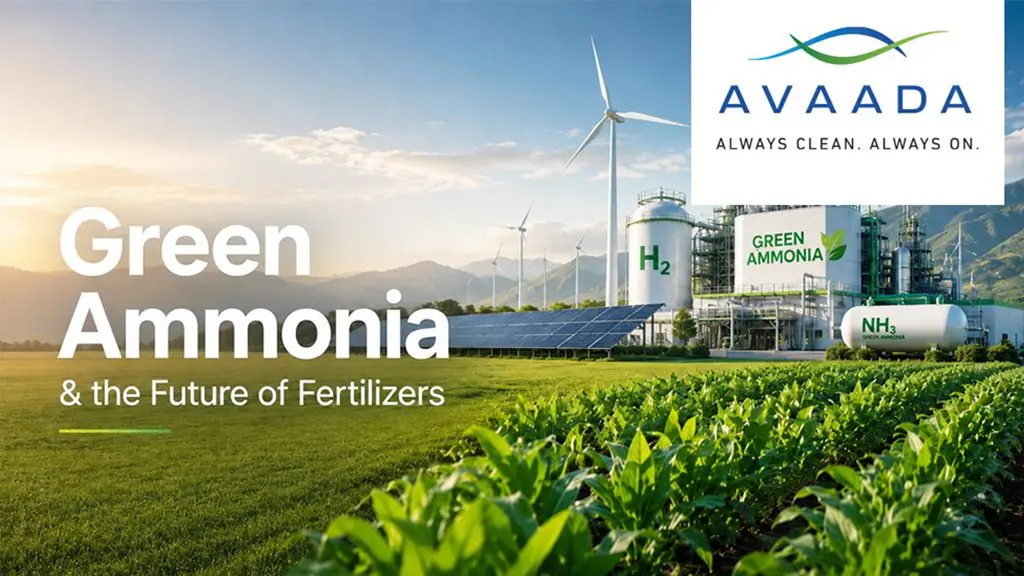
The fertilizer disruptions of 2021–22 demonstrated how strongly ammonia production is connected to natural gas markets. Green ammonia offers an alternative by replacing fossil-based hydrogen with hydrogen produced from water using renewable electricity.
The technology is established, but large-scale deployment still faces challenges related to cost, renewable-power availability, electrolyser capacity and project financing. Government-backed demand and long-term offtake agreements can help address these barriers.
For countries with strong renewable resources, green ammonia can become more than a low-carbon fertilizer feedstock. It can support greater energy security, a more diversified fertilizer supply chain and new clean-fuel markets.
Explore how Avaada Group’s green fuel solutions, including green hydrogen, green ammonia and round-the-clock renewable power, can support a more resilient and sustainable fertilizer supply chain.
FAQs
Is green ammonia different from conventional ammonia?
No, green ammonia has the same chemical composition as conventional ammonia. The difference is that it produces its hydrogen using renewable electricity rather than fossil fuels.
Is green ammonia currently more economical than conventional ammonia?
Green ammonia currently costs more to produce in many markets. Its potential advantage is reduced exposure to long-term fossil-fuel price fluctuations.
Can green ammonia be used for fertilizer?
Yes, green ammonia can be used as a nitrogen fertilizer directly or as a feedstock for producing other nitrogen-based fertilizers.
Can green ammonia be transported?
Yes, green ammonia has the same chemical properties as conventional ammonia and can use established ammonia storage and transportation systems, subject to applicable safety requirements.
Can green ammonia be used for shipping?
Yes, ammonia is being considered as a lower-emissions fuel for shipping, although the required engines, bunkering infrastructure and safety systems are still being developed.
Can green ammonia replace conventional ammonia completely?
Green ammonia production needs substantial renewable-energy capacity, electrolysers, investment and reliable offtake arrangements before it can reach large-scale adoption.