
Understanding basic power units, such as watts and kilowatts, is crucial for evaluating energy use, whether at home or in large solar plants. Knowing how to convert energy measurements, such as the output of a 100kW solar system, helps make informed decisions – especially as the world moves toward sustainable solutions.
This knowledge is particularly relevant as India’s clean energy transition reaches a tipping point in 2025; despite rapid capacity additions, the rise in renewable energy (RE) generation is now striving to outpace the historical dominance of coal to meet the needs of an energy-hungry economy growing at 7 per cent GDP.
Avaada is growing in the renewable energy industry with high-efficiency, high-wattage modules that maximize power generation.
What is a Watt?
A watt (W) is the base unit of power in the International System of Units (SI), named after inventor James Watt. Technically, one watt is the rate of work done when one ampere (A) of current flows through an electrical potential difference of one volt (V), which is equivalent to one joule per second.
In practical terms, a watt measures the real-time rate of energy consumption or production. It’s a small unit, often used for household appliances. For example, an LED light bulb might use 10 watts, and a smartphone charger between 5 and 20 watts.
What is a Kilowatt?
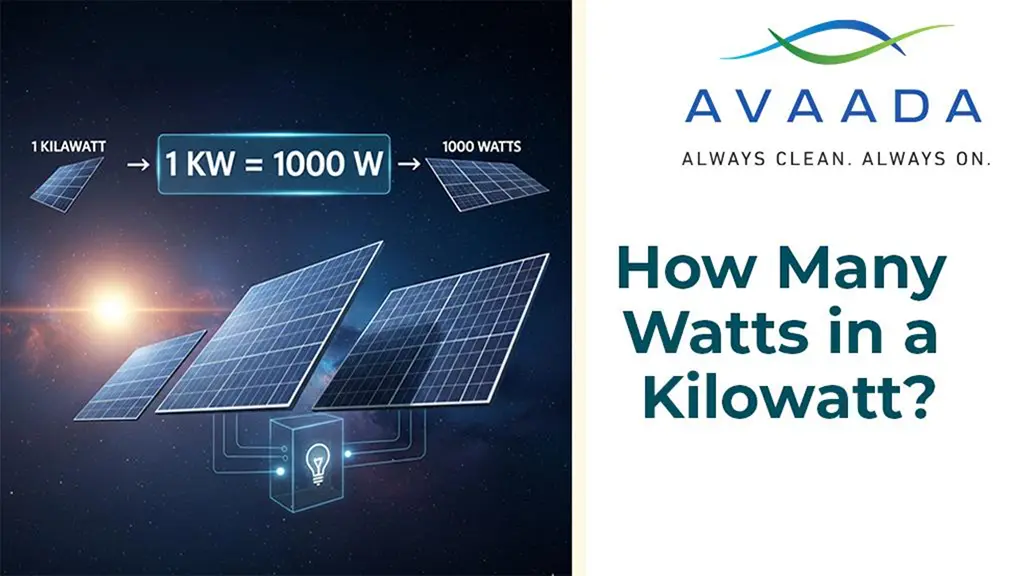
As energy requirements scale up, using watts becomes cumbersome due to the large numbers involved. This is where the kilowatt (kW) comes in. The prefix “kilo” comes from the Greek word chilioi, meaning thousand. Therefore, 1 kilowatt is equal to 1,000 watts.
Kilowatts are the standard unit for measuring the power of larger appliances, residential solar systems, and a household’s collective energy load. For instance, a central air conditioning unit might be rated at 3.5 kW (3,500 watts), and an electric water heater could be around 4 kW.
When you look at your electricity bill, you will often see usage described in kilowatt-hours (kWh). While a kilowatt measures power (the rate of energy use), a kilowatt-hour measures energy (the total amount used over time). Understanding this distinction is crucial for interpreting energy costs and savings.
The Relationship Between Watts and Kilowatts
The relationship between these two units is straightforward and linear. Because 1 kilowatt is equal to 1,000 watts, you can easily convert between the two using simple multiplication or division.
How to Convert Watts to Kilowatts
To convert watts to kilowatts, you divide the number of watts by 1,000.
- Formula: Kilowatts (kW) = Watts (W) / 1,000
Examples:
- 1kV to watts (assuming 1kV refers to 1 kilowatt in common parlance, though strictly kV is kilovolt): 1 kW = 1,000 Watts.
- 5,000 Watts = 5 kW
- 750 Watts = 0.75 kW
How to Convert Kilowatts to Watts
For the kilowatts-to-watts conversion, multiply the number of kilowatts by 1,000.
- Formula: Watts (W) = Kilowatts (kW) × 1,000
Examples:
- 1kV watts (referring to 1 kW): 1 kW = 1,000 Watts.
- 3 kW = 3,000 Watts
- 10 kW = 10,000 Watts
This conversion is fundamental when sizing solar systems. If you have ten solar panels, each rated at 550 watts, your total system size is 5,500 watts, or 5.5 kW.
Why This Matters in Solar Energy
Understanding watts and kilowatts is essential for evaluating solar technologies. In the solar industry, the “wattage” of a photovoltaic (PV) module refers to its power output under Standard Test Conditions (STC). Higher wattage means the module can generate more electricity from the same amount of sunlight.
This is where module efficiency becomes paramount. Manufacturers focus on high-efficiency technologies like bifacial, N-Type, and TOPCon (G12) modules.
Avaada produces bifacial N-Type TOPCon (G12) modules ranging from 610 Wp to 720 Wp at its integrated manufacturing facility, with an 8.5 GW module manufacturing capacity. These modules hold IEC, BIS, and UL certifications and are suitable for utility-scale projects in Maharashtra and Gujarat, reducing the number of modules required to achieve the target capacity.
Applications in Real Life
The practical application of watts to kWh and power ratings significantly affects daily life and industrial operations.
Household Energy Consumption
Households in India typically measure electricity in “units.” A common question is “One watt is equal to how many units?” In billing terms, 1 Unit of electricity equals 1 Kilowatt-Hour (kWh).
- If you run a 1,000-watt (1 kW) heater for one hour, you consume 1 kWh, or 1 Unit of electricity.
- If you run a 10-watt LED bulb for 100 hours, you also consume 1 kWh (10W × 100 h = 1000 Wh = 1 kWh).
While rooftop solar allows individuals to become generators, the industry is currently debating the infrastructure costs of nighttime power for these “prosumers”.
Industrial and Solar Scale
In larger applications, understanding these units helps in planning renewable energy infrastructure. A 100kW solar panel system, for example, is a substantial setup for commercial buildings. On a much larger scale, the government is looking to convert over 40 GW of uncontracted renewable capacity to the more reliable FDRE option to ensure grid stability during peak demand.
Avaada’s Role in High-Efficiency Modules
The global energy demand is rising, and the need for reliable, sustainable power has never been greater. Avaada answers this call with a commitment to innovation and manufacturing excellence.
Avaada is a growing player in the Indian market, competing with global firms and preparing for a future where energy infrastructure is more resilient. Key aspects of Avaada’s manufacturing expertise include:
- Innovation and Research: At the Global Energy Leaders Summit (GELS) 2025, Avaada signed a key MoU with GRIDCO, ReNew, and IIT Bhubaneswar to establish a Green Hydrogen Centre of Excellence in Odisha to support R&D and capacity building.
- High-Wattage Performance: Avaada produces modules capable of delivering 700+ watts, utilizing TOPCon technology and N-Type cells for better performance in low-light conditions.
Conclusion
Understanding the distinction between a watt and a kilowatt is the first step toward energy literacy. As the energy landscape evolves through public-private partnerships focused on sustainability and innovation, the efficiency of power generation becomes increasingly important.
Avaada offers high-wattage modules that are driving the industry forward. By focusing on the latest technologies and strategic collaborations, such as those formalized at GELS 2025, Avaada is not just manufacturing solar panels; they are engineering a high-growth market.
FAQs
How many watts are in 1 kilowatt (kW)?
There are exactly 1,000 watts in 1 kilowatt. To convert watts to kilowatts, divide the total wattage by 1,000. For example, a 5,000-watt appliance consumes 5 kW of power.
What is the difference between a kilowatt (kW) and a kilowatt-hour (kWh)?
A kilowatt (kW) measures power (the rate at which energy is used), while a kilowatt-hour (kWh) measures energy (the total amount used over time).
- Example: If you run a 1 kW heater for 1 hour, you have used 1 kWh of energy.
One watt is equal to how many units of electricity?
In India, “1 Unit” of electricity is equal to 1 kilowatt-hour (kWh). Therefore, 1 watt is equal to 0.001 units per hour. To consume 1 full unit of electricity, a 1-watt device would need to run for 1,000 hours.
How many watts does a standard solar panel produce?
As of 2025-2026, standard residential solar panels typically range from 400W to 550W. However, high-efficiency modules like Avaada’s N-Type TOPCon series can produce between 610W and 720W, allowing for higher energy yields with fewer panels.
How do I calculate my solar system size in kW?
To find your total system size, multiply the number of panels by the wattage of a single panel, then divide by 1,000.
- Formula: $(Number\ of\ Panels \times Panel\ Wattage) / 1,000 = Total\ kW$.
- Example: 10 panels at 550W each equals a 5.5 kW system.