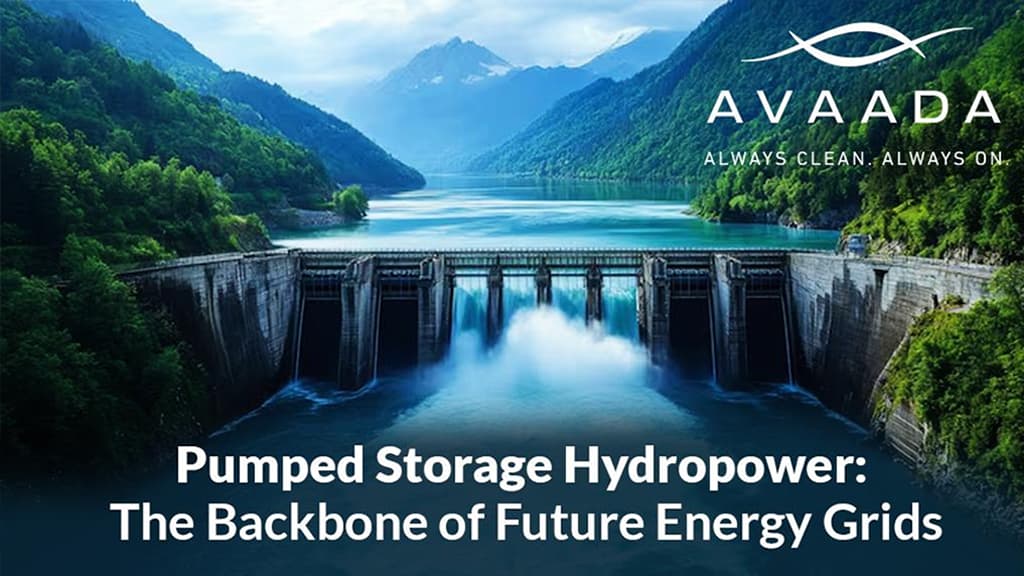
A pumped storage power plant is a type of hydroelectric facility that stores energy by moving water between two reservoirs at different elevations, and generates electricity when that water flows back down. Pumped storage hydropower (PSH) is the world’s most widely deployed form of grid-scale energy storage, and it is increasingly central to how India manages the grid as solar and wind generation grow. This article explains how a pumped storage plant works, the types available, its role in grid stability, and the outlook for pumped storage power plant development in India.
What Is Pumped Storage Hydropower?
Pumped storage hydropower, also known as pumped hydro energy storage or simply PSH, stores electrical energy as gravitational potential energy. A pumped storage plant uses two water reservoirs at different altitudes. When electricity is abundant and cheap during low-demand hours or when solar and wind generation is high the plant uses surplus power to pump water from the lower reservoir to the upper one. When demand rises, the water is released back down through turbines to generate electricity on demand.
PSH acts like a very large rechargeable battery for the grid, storing energy in the form of water at height and converting it back to electricity at short notice. According to the U.S. Department of Energy, PSH currently accounts for 88% of all utility-scale energy storage in the United States. Globally, International Hydropower Association figures indicate pumped storage projects store up to 9,000 gigawatt hours of electricity.
Pumped storage hydroelectricity is a mature technology: the first known PSH installations appeared in Italy and Switzerland in the 1890s. Modern plants achieve round-trip efficiency of 70 to 85%, making them one of the most energy-efficient large-scale storage methods available.
How a Pumped Storage Power Plant Works
A pumped storage power plant operates in two phases:
Charging (Pumping) Phase
During off-peak hours or when surplus renewable energy is available for example, from solar generation during the day or wind at night the plant draws electricity from the grid and uses it to run reversible pump-turbines. These machines pump water from the lower reservoir to the upper reservoir, converting electrical energy into gravitational potential energy.
Discharging (Generation) Phase
When electricity demand rises and grid prices are high, the gates open and water flows back down from the upper reservoir through penstocks (high-pressure pipes), spinning the turbines to generate electricity. This pumped storage hydroelectricity is fed directly into the grid. The reversible pump-turbines switch from pumping mode to generating mode within seconds, allowing the plant to respond almost instantly to grid signals.
Key Components of a PSH Plant
- Upper reservoir: holds water at height, storing potential energy ready for dispatch.
- Lower reservoir: receives water after generation and holds it for the next pumping cycle.
- Pump-turbines: reversible machines that both pump water uphill and generate electricity on the way down. Voith, a global PSH equipment supplier, has installed nearly 450 pump turbines worldwide with a combined capacity of over 60,000 MW.
- Penstocks: high-pressure pipes or tunnels that carry water between the reservoirs and the turbine hall.
- Motor-generator: in turbine mode, acts as a generator; in pumping mode, acts as an electric motor driving the pump-turbines.
Types of Pumped Storage Plant
Pumped storage power plants are classified by how their reservoirs relate to natural water bodies:
Open-Loop PSH Systems
An open-loop pumped storage plant has an ongoing hydrological connection to a natural water body, a river or lake which serves as either the upper or lower reservoir. These systems often benefit from an existing natural water source, reducing construction cost, but require careful environmental management to protect river flows and aquatic ecosystems.
Closed-Loop (Off-River) PSH Systems
A closed-loop pumped storage plant uses two purpose-built reservoirs that are not connected to a naturally flowing water source. This off-river design has a smaller environmental footprint, can be sited in more locations, and avoids impacts on natural rivers. The trade-off is higher initial construction cost because both reservoirs must be built from scratch. Closed-loop systems are increasingly favoured in India’s emerging PSH pipeline because of their planning and permitting simplicity.
Advanced PSH Configurations
- Variable-speed PSH: uses variable-frequency drives to adjust pump-turbine rotational speed, enabling more precise grid frequency regulation and more efficient operation across a wider range of water head.
- Ternary systems: use separate turbines and pumps on the same shaft rather than a single reversible machine, allowing faster switching between generation and pumping modes within seconds using a torque converter.
- Hybrid PSH + solar/wind: co-locating a pumped storage plant with solar or wind capacity allows the renewable generation to charge the upper reservoir directly, creating a tightly integrated round-the-clock clean power system.
Why Pumped Storage Hydropower Matters for Grid Stability
Solar and wind generation are inherently variable. A grid with high renewable penetration needs fast, reliable, large-scale energy storage to maintain balance. Pumped storage hydropower provides several critical grid services:
- Frequency regulation: PSH plants can ramp from standstill to full output within 30 seconds (Voith data), providing the fastest large-scale response of any storage technology to grid frequency deviations.
- Peak load management: by storing energy during low-demand periods (typically late night) and discharging during evening peak demand, a pumped storage power plant smooths daily load variations and reduces reliance on expensive peaking gas turbines.
- Renewable integration: PSH stores surplus solar and wind generation that would otherwise be curtailed, maximising the utilisation of clean generation assets.
- Black start capability: many pumped storage plants can restart the grid following a blackout without requiring an external power source, making them essential for system resilience.
- Long-duration storage: unlike battery storage (typically 2–4 hours), a pumped storage plant can store energy for many hours or even days, limited only by reservoir volume. This makes PSH well suited to seasonal and multi-day balancing.
PSH plants also have exceptional longevity: Voith cites an average plant lifetime exceeding 80 years, far beyond the 10–15 year typical lifespan of lithium-ion battery systems.
PSH vs Other Energy Storage Solutions
Pumped hydro energy storage is one of several large-scale storage technologies. Compared with Battery Energy Storage Systems (BESS):
- Scale: PSH is best for GW-scale, long-duration storage (8–72 hours or more). BESS is better suited to MW-scale, short-duration applications (2–4 hours) with faster electrochemical response.
- Cost per kWh stored: PSH has lower cost per MWh for long-duration storage; BESS has lower cost for short-duration applications.
- Geography: PSH requires specific topography (two reservoir sites at different elevations). BESS can be installed almost anywhere.
- Longevity: PSH plants last 50–80+ years; battery cells degrade over 10–15 years.
In practice, the most effective clean energy storage strategies including India’s evolving Firm Dispatchable Renewable Energy (FDRE) framework combine PSH (for long-duration balancing) with BESS (for fast-response, short-duration support).
Pumped Storage Power Plants in India
India has significant pumped storage hydropower potential. The Central Electricity Authority (CEA) has estimated a nationwide PSH potential of approximately 103 GW (verify exact figure and year against the most recent CEA assessment before publishing). Realising this potential is a priority for India’s clean energy transition and for achieving the 500 GW non-fossil fuel capacity target by 2030.
India’s existing operational PSH capacity includes plants at Kadamparai (Tamil Nadu), Srisailam (Andhra Pradesh), and Tehri (Uttarakhand), among others. Several new PSH projects are under development or in advanced planning stages. The National Electricity Plan and associated policy frameworks identify pumped storage power plant development as a critical enabler for integrating high shares of solar and wind generation (source: CEA/MNRE verify current approved capacity and policy scheme details before publishing).
As India’s peak electricity demand continues to grow and grid managers face the challenge of balancing a rapidly expanding solar and wind fleet, pumped storage hydroelectricity provides the long-duration, large-scale storage that battery systems alone cannot cost-effectively supply at scale. Explore pumped hydro storage projects to learn more about how these systems are being developed in India.
FAQs
What is pumped storage hydropower?
Pumped storage hydropower (PSH) is a type of hydroelectric energy storage that uses two water reservoirs at different elevations. During periods of low electricity demand, surplus power is used to pump water to the upper reservoir. When demand rises, the water flows back down through turbines to generate electricity. PSH acts as a large rechargeable water battery for the electrical grid.
How does a pumped storage power plant work?
A pumped storage power plant operates in two modes. In pumping (charging) mode, electricity is used to pump water from a lower to an upper reservoir, storing energy as gravitational potential energy. In generating (discharging) mode, the water flows back down through reversible pump-turbines to produce electricity, which is fed into the grid. Modern plants can switch between modes within seconds.
What is the efficiency of pumped storage hydroelectricity?
Pumped storage hydroelectricity plants typically achieve round-trip efficiency of 70 to 85%, meaning that for every 100 units of electricity used to pump water up, 70 to 85 units are recovered as electricity when the water flows back down. Modern variable-speed PSH systems can approach the upper end of this range.
How large are typical pumped storage plants?
Pumped storage plants vary widely in size, from tens of megawatts for smaller sites to several gigawatts for major utility-scale facilities. The world’s largest PSH plants each exceed 2,000 MW in capacity. In India, the CEA has estimated a nationwide potential of approximately 103 GW, although current installed capacity is considerably smaller.
What is the difference between open-loop and closed-loop PSH?
Open-loop PSH systems connect directly to a natural water body, a river or lake for one of their reservoirs. Closed-loop (off-river) PSH systems use two purpose-built reservoirs with no connection to a natural stream. Closed-loop designs have a smaller environmental footprint and can be sited more flexibly, making them increasingly common in new PSH development.
How does pumped storage compare with battery storage?
Pumped storage hydropower is best suited to large-scale, long-duration storage (8 hours to multiple days), while battery energy storage systems (BESS) are better for short-duration, fast-response applications (typically 2 to 4 hours). PSH has lower cost per MWh stored for long durations and a much longer lifespan (50 to 80+ years vs 10 to 15 years for battery cells). The two technologies are complementary rather than competing.