“India has successfully built one of the world’s fastest-growing renewable energy sectors. The next challenge isn’t generating more clean electricity – it’s ensuring that clean power is available whenever the country needs it.”
For more than a decade, India’s renewable energy journey has been a story of remarkable progress.
Massive solar parks have transformed barren landscapes into power hubs. Wind farms stretching across India’s western and southern states have strengthened the country’s renewable portfolio. Government policies, private investments, and technological innovation have positioned India among the global leaders in clean energy.
According to the Ministry of New and Renewable Energy (MNRE) report, India has already surpassed 283.4 GW of installed non-fossil fuel power capacity, while the Government has set an ambitious target of achieving 500 GW by 2030. Few countries have expanded renewable energy infrastructure at such speed.
Yet, as the sector matures, a different challenge is beginning to shape the next phase of India’s energy transition.
Imagine a modern manufacturing facility operating through the night.
Its production lines cannot pause after sunset.
Hospitals continue life-saving treatments around the clock.
Data centres processing AI workloads operate every second of every day.
For them, electricity isn’t just about availability.
It’s about continuity.
That is changing the conversation around renewable energy.
The question is no longer how much renewable power India can generate.
The real question is how reliably clean electricity can be delivered whenever consumers need it.
India's Renewable Energy Growth Has Created a New Challenge
India’s renewable energy expansion has been extraordinary.
Lower solar module costs, competitive auctions, and strong policy support have accelerated the deployment of clean energy across the country. Renewable energy is no longer viewed as an alternative – it is becoming one of the primary pillars of India’s electricity mix.
However, electricity demand doesn’t always match renewable energy generation.
Solar power performs best during daylight hours.
Electricity consumption often peaks during the evening.
Wind generation complements solar energy but varies across seasons and locations.
This mismatch between generation and demand is one of the defining challenges of modern power systems.
According to the International Energy Agency (IEA), India is expected to witness one of the fastest-growing electricity demand trajectories globally over the coming decade, driven by industrialisation, urbanisation, electric mobility, and expanding digital infrastructure.
Meeting that demand requires more than additional renewable capacity.
It requires an energy system capable of delivering clean electricity throughout the day.
What Is Round-the-Clock Renewable Energy and How Does It Work?
Think about your smartphone.
A fast charger is useful.
But what really matters is whether the battery lasts throughout the day.
Renewable energy follows the same principle.
Generating clean electricity is only one part of the equation.
The real objective is ensuring that electricity remains available whenever homes, businesses, industries, and critical infrastructure require it.
This is where Round-the-Clock Renewable Energy (RTC Renewable Energy) comes in.
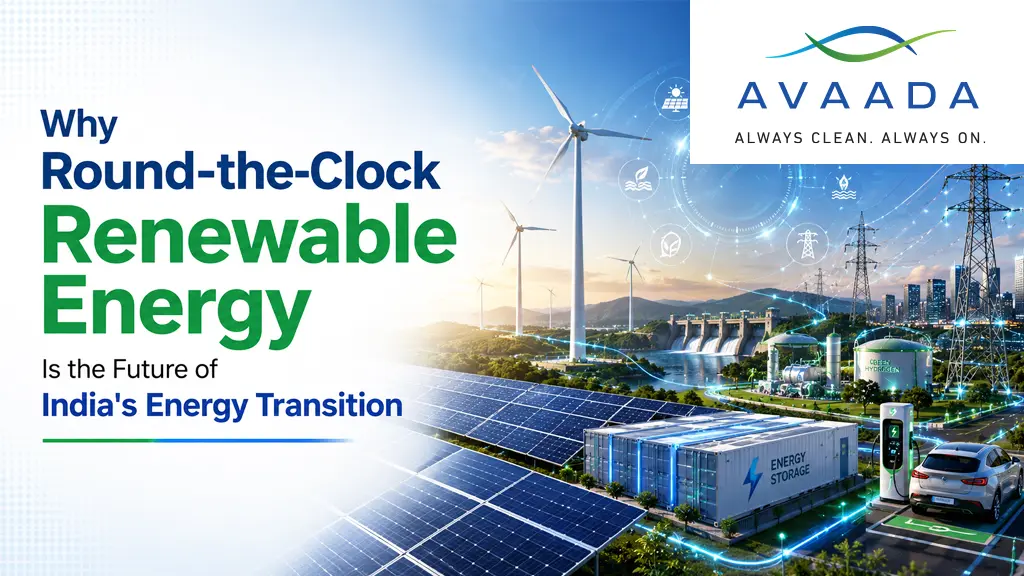
Rather than depending on a single renewable resource, RTC projects combine multiple technologies that complement one another, including:
- Utility-scale solar power
- Wind energy
- Battery Energy Storage Systems (BESS)
- Pumped Hydro Storage Projects (PSPs)
- Advanced forecasting and intelligent energy management
Each technology performs a different role.
Solar generates abundant daytime electricity.
Wind often contributes during evenings and seasonal transitions.
Energy storage preserves surplus renewable power until it is needed.
Digital forecasting helps optimise electricity dispatch by balancing supply and demand in real time.
Together, these technologies enable renewable electricity to become more dependable and adaptable to changing consumption patterns.
Battery Energy Storage Systems (BESS): The Technology Powering 24×7 Clean Energy
Among the many technologies supporting India’s clean energy transition, Battery Energy Storage Systems (BESS) have emerged as one of the most significant.
Consider a large industrial facility generating surplus solar electricity during the afternoon.
Without storage, a portion of that clean energy may remain underutilised.
Battery storage captures that surplus and makes it available later when electricity demand increases.
This improves renewable energy utilisation without requiring additional fossil-fuel-based generation.
Beyond balancing supply and demand, Battery Energy Storage Systems improve grid flexibility, reduce renewable energy curtailment, and support greater integration of renewable power into the national electricity network.
The importance of storage is reflected in India’s long-term planning.
The Central Electricity Authority (CEA) estimates that the country could require nearly 74 GW / 411 GWh of Battery Energy Storage System capacity by 2032 to maintain grid stability while increasing renewable energy penetration.
Battery storage is therefore no longer viewed as a supporting technology.
It is becoming one of the key enablers of India’s next-generation power system.
Why Round-the-Clock Renewable Energy Matters Beyond the Power Sector
The impact of Round-the-Clock Renewable Energy extends well beyond electricity generation.
Reliable clean power enables industries to improve operational efficiency.
It strengthens energy security for businesses investing in digital infrastructure.
It supports the growth of electric mobility, advanced manufacturing, logistics, pharmaceuticals, and AI-driven data centres.
More importantly, it gives organisations the confidence to accelerate their sustainability goals without compromising operational performance.
In many ways, Round-the-Clock Renewable Energy is no longer just an energy innovation.
It is becoming an economic enabler that can influence how India manufactures, innovates, and competes in the decades ahead
How India's Renewable Energy Procurement Model Is Evolving
The renewable energy market is changing in a way that most people don’t notice.
A few years ago, renewable energy projects competed primarily on one factor – the lowest tariff. Solar and wind developers focused on generating electricity at increasingly competitive prices, helping India become one of the world’s most cost-effective renewable energy markets.
Today, procurement decisions are becoming far more sophisticated.
Utilities are no longer asking only, “How affordable is this power?”
They are also asking:
- Can it support peak demand?
- Will it reduce dependence on conventional power?
- Can it strengthen grid stability?
These questions are driving a fundamental shift in how renewable energy projects are designed and awarded.
The Solar Energy Corporation of India (SECI) has introduced dedicated tenders for Round-the-Clock (RTC) Renewable Energy and Firm & Dispatchable Renewable Energy (FDRE), encouraging developers to combine renewable generation with storage and advanced energy management. Instead of rewarding standalone generation, these tenders prioritise solutions that can deliver dependable electricity across different times of the day.
This shift is already becoming visible across India. States such as Gujarat, Rajasthan, and Karnataka are witnessing the growing deployment of hybrid renewable energy projects supported by energy storage, demonstrating how the sector is moving beyond standalone solar and wind projects towards more integrated clean energy solutions.
This marks an important transition – from building renewable projects to building renewable power systems.
What This Means for Independent Power Producers
This evolution is also transforming the role of the Independent Power Producer (IPP).
Earlier, an IPP’s responsibility largely ended once electricity reached the grid.
Today, expectations are much broader.
Industrial customers are looking for long-term partners who can help them reduce emissions, improve energy resilience, and optimise operating costs. Utilities expect developers to contribute to grid flexibility, while investors increasingly favour companies with diversified clean energy capabilities.
As a result, leading renewable power developers are expanding beyond conventional project development.
They are investing in technologies that improve forecasting, optimise energy dispatch, and strengthen overall system performance. Success is no longer measured only by installed capacity but by the ability to deliver dependable clean energy solutions that adapt to changing demand.
The definition of an IPP is therefore evolving from an electricity producer to an integrated energy solutions provider.
Why This Creates New Opportunities for India's Clean Energy Sector
Every major energy transition creates new opportunities.
India’s transition is no different.
The growing adoption of electric vehicles, expansion of metro rail networks, increasing demand for green manufacturing, and rapid growth of AI-driven data centres are all creating demand for dependable clean electricity.
This opens new possibilities across the renewable energy value chain.
Developers can build more advanced energy solutions.
Technology companies can accelerate innovation in energy management.
Manufacturers can reduce their dependence on fossil fuels.
Investors can participate in one of the world’s fastest-growing clean energy markets.
According to the Observer Research Foundation (ORF), integrating storage, flexible generation, and transmission infrastructure will play a critical role in supporting India’s long-term renewable energy ambitions. This reinforces the idea that the next phase of the energy transition will be driven as much by system integration as by generation capacity.
How Avaada Group Is Supporting This Transformation
The renewable energy sector is steadily moving towards integrated clean energy solutions, and this shift is reflected in the way companies are expanding their capabilities.
This industry-wide transformation is already visible in the strategies adopted by leading renewable power developers. Avaada Group, a renewable energy company, is one such example, expanding beyond renewable generation into Battery Energy Storage Systems (BESS), pumped hydro storage, green hydrogen, green fuels and solar PV manufacturing to support India’s long-term clean energy transition.
By investing across complementary technologies, the Group is contributing to an energy ecosystem designed to support India’s long-term transition towards dependable, low-carbon electricity.
This approach reflects a broader industry trend where innovation, diversification, and integration are becoming essential drivers of sustainable growth.
Conclusion: India's Next Energy Milestone Starts Now
India has already demonstrated that renewable energy can be deployed at an unprecedented scale.
The next milestone is ensuring that clean electricity supports the country’s economic ambitions every hour of every day.
Round-the-Clock Renewable Energy represents more than a technological advancement.
It represents a smarter approach to building an energy system that aligns with the needs of industries, cities, businesses, and communities.
As renewable technologies continue to evolve and energy storage becomes more accessible, India is creating the foundation for a power sector that is cleaner, more flexible, and better prepared for future demand.
For businesses, it offers greater confidence in adopting renewable energy.
For developers, it opens new opportunities for innovation.
And for the country, it brings the vision of sustainable economic growth one step closer to reality.
FAQs
What is Round-the-Clock Renewable Energy?
Round-the-Clock Renewable Energy combines renewable power generation with technologies such as Battery Energy Storage Systems (BESS) and intelligent energy management to ensure electricity is available throughout the day.
Why is Round-the-Clock Renewable Energy important?
It helps bridge the gap between renewable energy generation and electricity demand, improving grid stability while supporting India’s transition towards a cleaner energy system.
What role do Independent Power Producers play?
Modern Independent Power Producers (IPPs) are evolving beyond electricity generation by developing integrated clean energy solutions that combine renewable power, storage, and advanced energy management.
Why are Battery Energy Storage Systems important?
Battery Energy Storage Systems improve renewable energy utilisation by storing surplus electricity and supplying it when demand increases, helping create a more reliable electricity network.
How is Avaada Group contributing to India's energy transition?
As one of India’s leading renewable energy companies in India, Avaada Group is investing across renewable power, storage, green hydrogen, green fuels, and solar PV manufacturing to support India’s long-term clean energy ambitions.