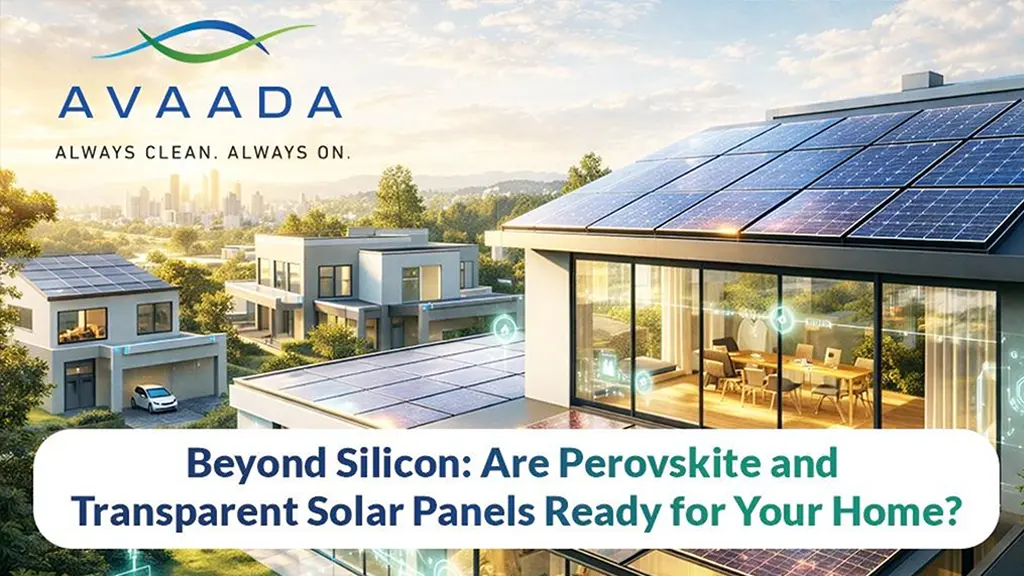
Imagine standing in your living room during a peak Indian summer. The sun is intense, but instead of drawing heavy curtains to block the glare, your floor-to-ceiling windows are actively working for you. These windows do not just provide a view; they silently harvest solar energy to power your home while filtering out the harsh heat that usually drives up electricity bills. As the country shifts toward cleaner energy, the conversation is expanding from bulky rooftop modules to nearly invisible solutions integrated into the glass of our buildings.
What are Transparent Solar Panels and How Do They Work?
A transparent solar panel is a glass-like photovoltaic (PV) device that generates electricity while remaining clear or semi-transparent. Unlike traditional blue or black silicon modules, these are engineered to be spectrum-selective.
The mechanism is as simple as traditional cells, which capture the entire visible light spectrum and appear opaque. In contrast, transparent cells are designed to ignore the wavelengths of light that the human eye can see. They specifically absorb only the ultraviolet (UV) and infrared (IR) portions of the spectrum. These wavelengths are invisible to us, so the light passing through the panel looks like ordinary glass.
Read more : Solar Panel Companies In India
Comparing Solar Technologies in 2026
Evaluating the practical value of this technology requires a direct comparison with the current industry standards for residential and commercial power.
Feature | Transparent Solar Panels | Traditional Silicon Panels |
Appearance | Visually Clear / Semi-Transparent | Opaque (Blue/Black) |
Primary Placement | Windows, Balconies, Facades | Rooftops, Open Ground |
Efficiency | Moderate (5% to 10%) | High (20% to 24% for TOPCon) |
Installation | Integrated into Building (BIPV) | Rack-mounted / On-grid |
Cost | Higher (Premium/Early Tech) | Standard (Mass Produced) |
While traditional solar panels lead in raw power output, transparent modules offer unique placement opportunities where roof space is unavailable.
Why Homeowners are Looking at Transparent Solar Panels?
The growing interest in Building Integrated Photovoltaics (BIPV) is driven by specific architectural and economic benefits for the Indian climate.
1. Seamless Aesthetic Integration
In cities like Mumbai or Bengaluru, glass is a primary design element. Transparent panels allow homeowners to maintain a minimalist aesthetic. You do not have to sacrifice the look of a modern villa to adopt green energy, because power generation occurs within the glass itself.
2. Functional Climate Control
These panels serve a dual purpose. By capturing infrared light, they act as a high-tech thermal barrier. This prevents a significant amount of heat from entering the building. According to NITI Aayog on future building requirements, reducing cooling loads is essential for long-term energy efficiency. These windows lower the temperature inside your home, reducing air conditioning costs while generating electricity.
3. Maximizing Vertical Surface Area
If you live in an apartment or a home with limited roof space, traditional solar might not be feasible. Transparent panels convert vertical surfaces into productive assets. This is vital for urban dwellers who want to contribute to sustainability but lack the square footage for a large rooftop array.
Current Challenges of the Technology
Despite the rapid innovation, there are several practical hurdles to consider before choosing transparent solar panels for a home renovation:
- Lower Efficiency Levels: These panels utilize only a small portion of the light spectrum and naturally deliver a lower energy conversion rate. Commercial glass currently operates in the 5% to 10% range, though research at institutions like IIT Bombay is pushing these limits higher.
- Higher Initial Investment: The manufacturing process for spectrum-selective coatings is more complex than that for standard silicon production, resulting in a higher price per watt.
- Specialized Installation Requirements: BIPV requires specialized installers and detailed architectural planning that can increase project timelines.
Transparent Solar Panels: Price in India (2026)
Pricing in 2026 is often calculated per square meter rather than per watt, as these panels double as construction materials.
Estimated Cost Breakdown:
- Transparent Solar Glass: Expect to pay between ₹15,000 and ₹30,000 per square meter. The cost varies with transparency; clearer glass carries a higher price tag.
- Traditional High-Efficiency Panels: For comparison, high-output TOPCon panels are priced at ₹25-₹35 per watt.
For most residential projects, transparent solar is currently a premium option for specific areas such as sunrooms, balconies, or skylights.
Understanding Different Solar Panel Types
Most modern energy systems use a combination of technologies to maximize energy yield.
- Monocrystalline Cells: These are the reliable standard for high-performance rooftop installations.
- TOPCon Solar Modules: These modules perform exceptionally well in high temperatures, making them the best choice for the Indian climate.
- Thin-film Panels: These are lightweight and flexible, often used on curved surfaces where traditional glass cannot be installed.
- Transparent Panels: These are best used as “solar windows” to complement a primary rooftop system.
Choosing the Right Manufacturer
The long-term return on your solar investment depends entirely on the quality of the hardware. When evaluating a solar PV module manufacturer, use these specific benchmarks:
- ALMM-II Certification: Ensure the manufacturer is listed in the Ministry of New and Renewable Energy’s (MNRE) Approved List of Models and Manufacturers. This is a guarantee of quality and eligibility for government incentives.
- Temperature Performance: Indian summers are harsh. Look for modules with a low temperature coefficient, such as N-type TOPCon, which maintain better performance as temperatures rise.
- Performance Warranty: A quality manufacturer will offer a 25- to 30-year warranty, guaranteeing that the panels will still produce the vast majority of their rated power decades later.
Read more : Types Of Solar Panels In India
Conclusion
Transparent solar panels are no longer just a concept, but they remain a specialized product. If you are designing a home with extensive glass facades, they are an excellent way to combine aesthetics with sustainability. However, they are not yet a direct replacement for high-efficiency rooftop panels.
The most effective strategy for an Indian homeowner in 2026 is a hybrid approach: install high-efficiency TOPCon modules on the roof to maximize power output and use transparent panels for windows or skylights to supplement your energy needs.
Ready to power your home? Contact Avaada today to explore high-efficiency solar solutions tailored for your space and start your journey toward energy independence.
FAQs
What are transparent solar panels?
Transparent solar panels are photovoltaic modules designed to function like glass, allowing visible light to pass through while capturing ultraviolet and infrared light to generate electricity.
How do transparent solar cells work?
These cells use spectrum-selective materials that absorb non-visible wavelengths and convert them into energy, while allowing the visible spectrum to pass through undisturbed.
What is the price of transparent solar panels in India?
The price for transparent solar glass in India ranges from ₹15,000 to ₹30,000 per square meter, depending on the manufacturer and transparency level.
Are transparent solar panels efficient?
No, they are currently less efficient than traditional panels, with most commercial versions offering between 5% and 10% efficiency, compared to the 22% or higher efficiency of silicon modules.
What are perovskite solar panels?
Perovskite panels use a unique crystal structure that is cheaper to produce and highly efficient. They are frequently used in tandem with silicon to create advanced, ultra-high-efficiency solar modules.