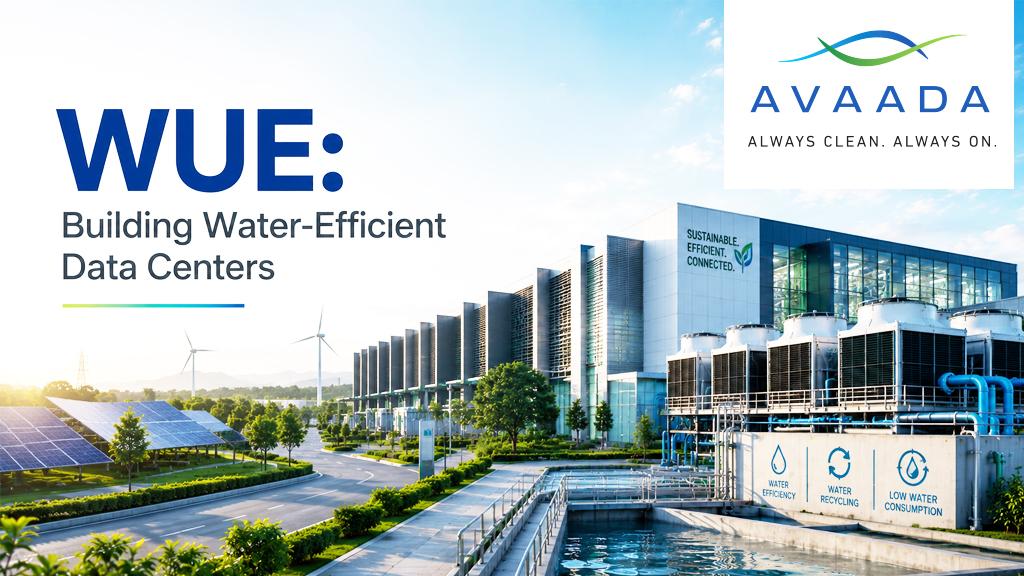
Keeping enterprise servers cool often requires continuous thermal management, but traditional evaporative cooling systems draw significant volumes of water. As computational workloads expand, Green Data Centers rely on Water Usage Effectiveness (WUE) to balance cooling performance against local water scarcity. This metric evaluates how many liters of water a facility consumes per kilowatt-hour of IT energy used. Avaada Group integrates renewable energy resources to power hyperscale facilities while utilizing advanced thermal management to achieve low WUE in data centers, establishing sustainable operations without straining regional water tables.
What is Water Usage Effectiveness (WUE)?
Introduced by the Green Grid consortium in 2011, Water Usage Effectiveness (WUE) is an industry-standard metric that measures the ratio of a data center’s site water consumption to the electrical energy consumed by its IT equipment.
WUE = Total Site Water Usage (Liters) / IT Equipment Energy (kWh)
A lower numerical value indicates greater water efficiency, with an optimal target approaching zero. Global industry averages usually range between 1.8 L/kWh and 1.9 L/kWh. Monitoring this figure helps operators quantify thermal efficiency while mitigating operational risks in water-stressed locations.
How WUE is Calculated and What Counts as "Water Usage"
Accurate assessment requires tracking both direct facility operations and broader indirect resource inputs.
Direct Water Use
Direct water usage encompasses all volume consumed within the facility perimeter. This includes:
- Water evaporated in cooling towers and adiabatic air handlers.
- Moisture added for humidity control in server rooms.
- Fresh makeup water introduced to replace system operational losses.
Indirect Water Use
Indirect water usage accounts for water consumed off-site during utility power generation. Thermal coal and nuclear power plants require significant cooling water per megawatt-hour produced. Running facilities on captive solar and wind energy eliminates this off-site water footprint.
Why Blowdown and Discharge Are Often Left Out of Reported Figures
To prevent mineral buildup and scaling, cooling towers periodically clear mineral-heavy water through “blowdown” discharge. Many standard reports record only net evaporated water and omit blowdown volumes. Comprehensive auditing requires reporting total water withdrawal to ensure full environmental transparency.
Why Water Scarcity is a Growing Concern for Data Centers
Rapid digital expansion is placing increased pressure on municipal water reserves and local aquifers.
- Rising Data Center Density and Compute Demand: High-density server racks used for artificial intelligence workloads generate substantial heat output. Global data center direct cooling water consumption is projected to reach 644 billion liters annually by 2030.
- Overlap Between Data Center Hubs and Water-Stressed Regions: Approximately two-thirds of major data center developments globally are located in regions experiencing moderate-to-high water stress. Siting high-capacity facilities in drought-prone areas creates long-term operational challenges for regional supply networks.
- Community and Regulatory Pressure on Groundwater-Reliant Facilities: Industrial groundwater extraction faces increasing scrutiny from local communities and municipal authorities. Regulations are evolving to mandate strict disclosures, non-potable water usage and standardized sustainability metrics.
Cooling Technologies and Their Water Footprint
Different cooling designs reflect distinct engineering trade-offs between energy draw and water consumption.
| Cooling Technology | Water Use | Energy Use | Typical WUE Range | Best-Fit Climate |
| Air-Cooled / Direct Expansion | Zero direct water | Higher electrical load | 0.0 L/kWh | Cool / Temperate |
| Evaporative & Adiabatic | High consumption | Lower electrical load | 1.2 – 2.5 L/kWh | Hot / Dry |
| Direct-to-Chip Liquid Cooling | Very low | Optimized | 0.2 – 0.5 L/kWh | High-Density / AI Racks |
| Immersion Cooling | Near Zero | Minimal pump power | 0.0 – 0.1 L/kWh | High-Density Enterprise |
Air-Cooled / Direct Expansion Systems
These systems circulate air over refrigerated coils without evaporating water. While they can achieve a direct WUE of 0.0 L/kWh, they require higher electrical inputs at high ambient temperatures.
Evaporative and Adiabatic Cooling
These setups evaporate water into the incoming airstream to lower operating temperatures. While reducing electrical power demands, they require a continuous supply of fresh makeup water.
Liquid and Immersion Cooling
Liquid cooling circulates fluid directly across high-heat components or submerges server blades in non-conductive dielectric fluid. This design eliminates evaporative losses while supporting high-density server configurations.
How Green Data Centers Balance Cooling Needs with Water Conservation
Sustainable operators apply multiple engineering strategies to limit water consumption:
- Treated Wastewater and Recycled Water: Facilities utilize treated municipal effluent or industrial greywater for cooling tower makeup, preserving local drinking water supplies.
- Higher Chilled-Water Set Points: Operating facilities at elevated ASHRAE thermal boundaries reduces temperature differentials and lowers evaporative water loss.
- Increased Cycles of Concentration: Treating circulating cooling water reduces mineral scaling, allowing water to cycle longer before requiring blowdown purge.
- Hybrid Seasonal Cooling: Operators switch between wet evaporative cooling during hot summer months and dry air cooling during cooler seasons to optimize annual efficiency.
- Real-Time Monitoring: Integrated software platforms track flow meters in real time to identify leaks, calculate WUE and automatically optimize chemical dosage.
WUE vs. PUE: Why You Can't Optimize for Both in Isolation
Power Usage Effectiveness (PUE) and Water Usage Effectiveness (WUE) exist in a natural trade-off balance.
| Dimension | Power Usage Effectiveness (PUE) | Water Usage Effectiveness (WUE) |
| Primary Metric | Total Facility Energy / IT Equipment Energy | Total Site Water Volume / IT Equipment Energy |
| Target Direction | Approaching 1.0 | Approaching 0.0 L/kWh |
| Operational Impact | Evaporative cooling lowers PUE. | Air cooling lowers WUE but increases electrical load. |
| Reporting Standard | ISO/IEC 30134-2 | ISO/IEC 30134-9 |
Optimizing exclusively for PUE often increases water consumption through evaporative cooling. Conversely, focusing solely on zero-water air cooling increases power consumption. Facilities must balance both metrics based on regional grid carbon intensity and local water availability.
What to Look for in a Green Data Center Company
When evaluating a colocation or hyperscale partner, assess these key sustainability metrics:
- Third-Party Verified Data: Audited reports detailing monthly site-level PUE and WUE performance under standard operational loads.
- Non-Potable Water Sourcing: Clear operational protocols prioritizing recycled, reclaimed or industrial wastewater over local drinking water reserves.
- Adaptive Infrastructure: Hybrid cooling architectures that dynamically adjust thermal management based on changing seasonal conditions.
- Recognized Certifications: Compliance with established framework standards, including IGBC Green Data Center ratings, LEED certification and ISO/IEC 30134 metrics.
- Groundwater Safeguards: Transparent operational guidelines that prohibit unmonitored groundwater extraction in declared water-stressed areas.
Avaada Group operates as a green data center company in India, building hyperscale facilities that combine renewable energy generation with low-WUE cooling designs. By utilizing secured water allocations from industrial pipelines alongside captive renewable power, these developments provide steady computing capacity while protecting local water resources.
Final Thoughts
Balancing server thermal management with regional water conservation requires a dual focus on energy efficiency and water stewardship. Water Usage Effectiveness (WUE) provides the standard framework for evaluating environmental performance alongside Power Usage Effectiveness (PUE). Modern facilities balance these needs by combining liquid cooling, recycled water sourcing and seasonal hybrid management. Working with a dedicated green data center company allows enterprise operators to secure high-density digital infrastructure supported by reliable, transparent clean energy and water management protocols.
FAQs
What is a good Water Usage Effectiveness (WUE) score for a data center?
A WUE score under 0.5 L/kWh represents strong efficiency, while scores approaching 0.0 L/kWh indicate air-cooled or closed-loop liquid facilities.
How is WUE different from PUE?
PUE measures electrical power efficiency, whereas WUE measures total site water volume consumed per kilowatt-hour of IT equipment energy.
Do all green data centers use water for cooling?
No, some facilities utilize direct air cooling or closed-loop dielectric immersion systems that consume virtually zero operational water.
Why is water scarcity a concern for data centers in India?
Major Indian data center hubs are located near urban centers that experience seasonal water stress and declining groundwater tables.
Can data centers run on zero water for cooling?
Yes, dry air-cooled systems and closed-loop immersion setups operate without consuming direct water, though they require higher electrical power during hot periods.
How do data centers recycle water for cooling?
Operators process municipal wastewater or cooling tower blowdown through filtration systems like reverse osmosis to reuse water continuously in cooling loops.
What certifications track water efficiency in green data centers?
Key framework certifications include the IGBC Green Data Center Rating, LEED and standardized ISO/IEC 30134-9 metrics.
Is a lower WUE always better for the environment?
Not necessarily; if achieving a lower WUE significantly increases electricity usage drawn from fossil-fuel grids, the net environmental impact may rise.
What should I ask a green data center company about their water usage?
Inquire about third-party verified WUE figures, primary water sources, drought contingency plans and regional groundwater policies.
How is data center water use linked to electricity generation?
Thermal power plants consume water during electricity generation; powering facilities with solar and wind power eliminates this off-site water usage.