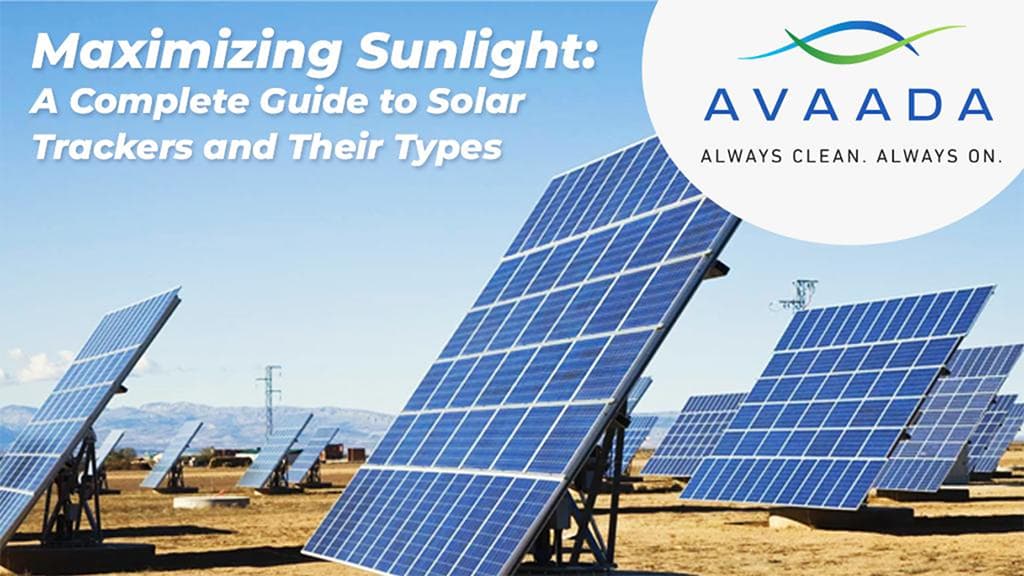
A solar tracker, also known as a solar tracking system or solar panel tracking system, optimises solar panel performance by dynamically orienting photovoltaic (PV) modules toward the sun throughout the day. Unlike fixed-tilt installations, a solar tracker device uses motors and sensors to adjust panel angles, capturing more direct sunlight and boosting energy yield. This technology proves essential for utility-scale solar power projects, where maximizing output reduces levelized cost of electricity (LCOE). Avaada integrates advanced solar tracking systems with its bifacial N-Type TOPCon (G12) modules at plants across states such as Maharashtra and Gujarat, enhancing reliability for round-the-clock renewable power.
How Solar Trackers Work
Solar trackers operate through automated mechanisms that detect sunlight via sensors or follow pre-programmed solar algorithms based on time, date, and location. A sun-tracking solar panel system rotates modules to maintain perpendicular alignment with incoming rays, minimizing cosine losses from off-angle incidence. Single-axis and dual-axis variants dominate, with the former tracking east-west motion and the latter adding north-south tilt adjustments.
These systems employ hydraulic, pneumatic, or electric actuators for precise movement, often paired with controllers that account for weather data to stow panels during high winds. In practice, an automatic solar tracking system can increase annual energy production by 15-40% over fixed arrays, depending on latitude and tracker type.
Avaada deploys such trackers at its utility-scale solar power installations in high-growth regions like Rajasthan and Uttar Pradesh, combining them with integrated manufacturing to produce high-wattage modules up to 720Wp.
Read more : List Of Solar Companies In India
Single Axis Solar Tracker
A single-axis solar tracker rotates panels along a single axis, typically the horizontal (east-west) axis, to follow the sun’s daily path. Horizontal single-axis trackers (HSAT) tilt vertically around a north-south axis, while tilted single-axis trackers (TSAT) adjust azimuth around a tilted axis for optimized row spacing.
This design yields 15-25% more energy than fixed-tilt systems by reducing shading and improving incidence angles. Common in utility-scale solar power farms, single-axis trackers offer simpler mechanics, lowering upfront costs by 20-30% compared to dual-axis options.
Avaada employs single-axis solar trackers in its Maharashtra and Gujarat deployments, paired with bifacial N-Type TOPCon modules for enhanced rear-side irradiance capture and grid stability.
Dual-Axis Solar Tracker
A dual-axis solar tracker adjusts panels across two axes: azimuth (horizontal rotation) and elevation (vertical tilt), achieving near-perfect sun alignment year-round. Types include tip-tilt (rotating a frame) and azimuth-elevation mechanisms, enabling 25-45% higher output versus fixed systems in high-latitude sites.
Though more complex with dual motors, these excel in variable climates, optimizing diffuse light capture. Maintenance rises due to additional components, but efficiency gains suit distributed or high-value installations.
For wind solar hybrid system projects, dual-axis solar tracker precision supports reliable renewable integration, aligning with Avaada’s end-to-end solutions, including BESS for firm power.
Single vs Dual-Axis Comparison
Single-axis and dual-axis solar trackers differ fundamentally in design and performance, with each optimizing energy capture for specific project scales and conditions.
Feature | Single Axis Solar Tracker | Dual-Axis Solar Tracker |
Axes of Movement | One (e.g., east-west) | Two (azimuth + elevation) |
Energy Gain | 15-25% over fixed | 25-45% over fixed |
Cost | Lower installation/maintenance | Higher due to complexity |
Best For | Utility-scale solar power | Small-scale/high-precision |
Reliability | Simpler, wind-resistant | More parts, higher upkeep |
Single-axis dominates utility-scale solar power for cost-effectiveness, while dual-axis suits space-constrained or cloudy areas.
Avaada prioritizes single-axis solar trackers in large plants for scalable execution with its 6 GW manufacturing capacity.
Site Selection and Terrain Compatibility
Single-axis trackers adapt to 0-15° terrain slopes via torque-tube foundations, suiting Gujarat’s flat arid lands with 2m soil embedment [ASCE 7-16]. Dual-axis requires level sites with <5° slope or costly pedestals, limiting its use in undulating Madhya Pradesh terrain. Soil bearing capacity >100 kPa supports 20m row lengths for single-axis; dual-axis limits to 10m spans. Shadow modeling via PVSyst confirms single-axis row spacing at 2.5-3H (height ratios) vs dual-axis 2H. Flood zones demand 1m elevated foundations per IS 456. Karnataka rocky sites favor single-axis drilling over dual-axis piling, reducing geotech costs by 15%.
Advantages and Applications
Solar tracking systems cut payback periods by boosting capacity factors from 20% (fixed) to 30%+. They enable the viability of wind-solar hybrid systems by firming intermittent output, which is vital for C&I clients meeting RPO goals.
In India, trackers thrive in sunny states like Karnataka and Tamil Nadu, where Avaada’s operational plants use them with IEC/BIS-certified modules for peak shaving and grid support.
Challenges include dust accumulation and wind loads, addressed via backtracking algorithms that space rows to avoid shading.
Maintenance Requirements and Durability
Single-axis trackers require motor lubrication every 6 months and gear inspections annually, with drive systems rated for 20+ years under IEC 62817 standards [IEC 62817]. Dual-axis models demand dual-motor synchronization checks quarterly due to added azimuth bearings, increasing service costs by 25-40% [NREL Tracker Report]. Both use IP65-rated enclosures against dust ingress, critical in Rajasthan’s 200g/m² annual deposition. Wind-stow algorithms activate at 20 m/s gusts, protecting actuators rated for 2,500 Nm torque. Galvanized steel frames with 1.5mm corrosion protection ensure a 30-year structural life per ISO 12944. Avaada’s deployments confirm <1% downtime through certified maintenance protocols.
Avaada's Tracker Integration
Avaada leverages solar-tracking systems with its Made-in-India high-efficiency PV modules across integrated plants spanning ingot-to-module. Deployments in Gujarat and Maharashtra demonstrate 610-720Wp bifacial N-Type TOPCon performance under trackers, holding UL and IEC certifications.
Paired with PSP and BESS, these support hybrid solutions for 24×7 power, emphasizing reliability over unverified claims.
Read more : High Watt Solar Panels
Conclusion
Solar trackers represent a proven step in the energy transition, amplifying the role of solar tracker efficiency in sustainable grids. Avaada’s focus on single and dual-axis solar trackers in utility-scale solar power underscores execution excellence across Indian states. As demand for automatic solar tracking systems in hybrids grows, these technologies drive decarbonization without exaggeration, delivering verifiable gains in output and reliability.