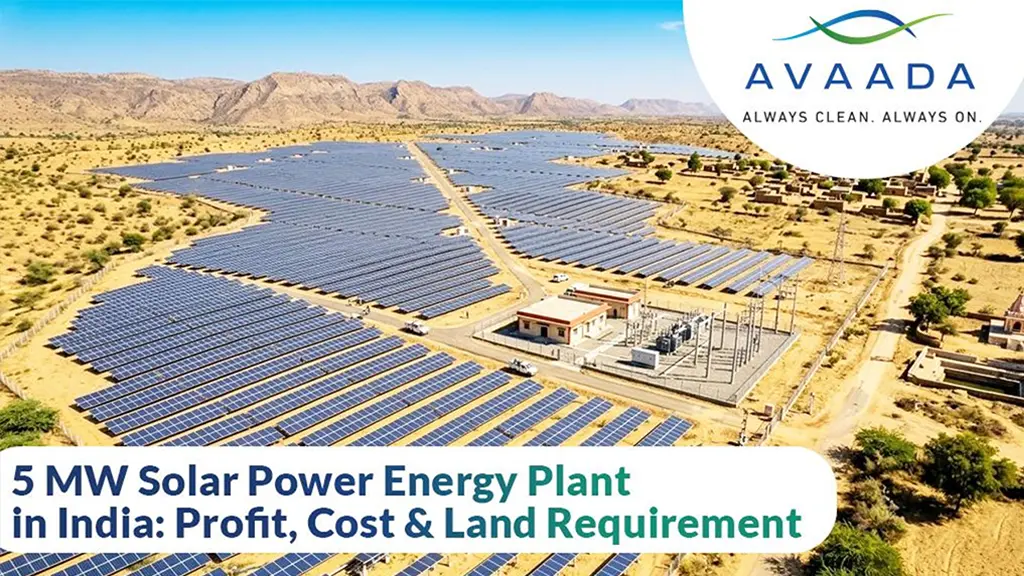
The transition to sustainable energy is no longer a distant goal but a present-day reality for India’s industrial and investment sectors. As of early 2026, India has reached a significant milestone, with its cumulative solar power capacity crossing 143.60 GW. Among various installation scales, the 5 MW solar power plant has emerged as a preferred choice for medium- to large-scale investors due to its balance between manageable capital requirements and substantial revenue potential. A 5 MW project acts as a robust energy source capable of powering approximately 3,500 to 4,000 rural households or meeting the high-intensity demands of a large manufacturing facility. Understanding green energy companies in India and the technicalities of land, costs, and profitability is essential for anyone looking to enter this high-growth sector.
5 MW Solar Power Plant: Overview
A 5 MW (megawatt) solar facility is a utility-scale or large-captive solar plant that uses thousands of photovoltaic modules to convert sunlight into electricity. This capacity is typically used to feed power into the national grid through a Power Purchase Agreement (PPA) or for “Open Access,” where energy is sold directly to private industrial consumers.
The actual output of a solar power plant project depends heavily on the geographic location and the local solar irradiation levels. On average, a 5 MW plant in India generates approximately 20,000 units (kWh) of electricity per day. Over a full year, this translates to roughly 7.2-7.5 million units of clean energy, accounting for seasonal variations and a standard Capacity Utilization Factor (CUF) of 18–22%.
Read more : Best Solar Company In India
5 MW Solar Power Plant Cost in India in 2026
Determining the exact solar power plant cost involves analyzing several variables, including the choice of technology and the distance to the nearest substation.
The cost of a 5 MW solar power plant in India currently ranges from ₹20 Crore to ₹25 Crore, depending on whether high-efficiency N-type TOPCon modules or standard Mono PERC panels are used.
Cost Breakdown
The following table illustrates the expenditure distribution for a utility-scale project:
Component | Approximate Cost Share |
Solar Panels (TOPCon/Mono PERC) | 55–60% |
Inverters & Electrical Systems | 10–12% |
Mounting Structures | 8–10% |
Land Development & Civil Works | 5–8% |
Transmission & Evacuation Lines | 5–7% |
Installation & Commissioning | 5% |
Land Requirement for 5 MW Solar Plant
Land is one of the most critical assets for a ground-mounted solar power plant in India. The total area required is determined by the panels’ efficiency and the spacing needed to avoid inter-row shading.
A 5 MW solar plant typically requires approximately 20 to 25 acres of land.
Factors Affecting Land Requirement
- Panel Efficiency: Using high-efficiency modules, such as those from a leading PV panel manufacturer, can reduce the land footprint by requiring fewer panels to achieve the 5 MW peak capacity.
- Mounting Structure: Fixed-tilt structures require specific spacing for shadows, whereas seasonal tilt or tracking systems may require slightly more room to allow for movement.
- Location: In regions with lower solar intensity, a larger panel surface area may be required to meet the desired generation targets.
Profit from a 5 MW Solar Power Plant
Investing in a solar plant in India is financially attractive due to the long-term stability of revenue and relatively low operating costs.
Revenue Estimation
A 5 MW plant generating roughly 73 lakh units annually can see varying income levels based on the selling model:
- DISCOM PPA: Selling to the government at a tariff of approximately 2.50 to 3.00 per unit.
- Open Access/Private PPA: Selling to industrial clients at rates between ₹3.50 to ₹4.50 per unit.
Expected Annual Revenue
At an average rate of ₹4 per unit, a 5 MW plant can generate approximately ₹2.8 Crore to ₹3 Crore in gross annual revenue. After accounting for Operations and Maintenance (O&M) costs, typically ₹6–8 lakh per MW per year, the net profit remains highly competitive.
Payback Period
Most well-designed projects achieve a full return on investment (ROI) within 4 to 6 years. Given that the lifespan of a quality solar panel project is 25 to 30 years, the remaining two decades offer nearly pure profit.
Solar Power Plant Project Setup Process
Setting up a large-scale facility requires a systematic approach involving technical and legal steps.
Step 1: Land Selection
Investors must find flat, non-agricultural land with high solar irradiation. Proximity to a state transmission utility (STU) substation is vital to keep evacuation costs low.
Step 2: Approvals & Licensing
You must obtain a “No Objection Certificate” (NOC) from the local DISCOM, environmental clearances, and land conversion permissions (CLU).
Step 3: EPC Contractor Selection
Selecting a reliable PV panel manufacturer and Engineering, Procurement, and Construction (EPC) partner is crucial. This ensures the use of certified components that meet the requirements of the Approved List of Models and Manufacturers (ALMM).
Step 4: Installation & Commissioning
This includes the physical mounting of panels, inverter integration, and the construction of the transmission line to the grid for final commissioning.
Factors Affecting Solar Power Plant Cost
- Technology Choice: N-type TOPCon modules are currently seeing price increases due to high demand, with domestic prices around ₹16.36/Wp as of early 2026.
- Location and Irradiation: Areas like Rajasthan or Gujarat offer higher energy yields, which can lower the cost per unit of electricity generated.
- Government Policies: State-specific banking charges and cross-subsidy surcharges for Open Access projects can impact the final project economics.
Benefits of Investing in Solar Power Plants in India
- High ROI: Solar remains one of the few asset classes offering a double-digit internal rate of return (IRR) with minimal risk.
- Government Support: While direct subsidies for 5 MW projects are rare, benefits like 40% Accelerated Depreciation (AD) and a low GST rate of 5% on renewable equipment provide significant tax relief.
- Sustainable Investment: Contributing to the national target of 500 GW of non-fossil capacity enhances a corporation’s ESG (Environmental, Social, and Governance) profile.
Challenges in Solar Power Plant Projects
Despite the benefits, challenges such as high initial capital expenditure (CAPEX) and the complexities of land acquisition remain. Furthermore, policy variations between states can affect the feasibility of selling power to third parties. Professional O&M is also required to manage panel degradation, which typically ranges from 0.5% to 0.7% per year.
Read more : Solar EPC Company
Conclusion
A 5 MW solar plant is a sophisticated investment that offers long-term financial security and contributes to India’s energy independence. By utilizing high-efficiency technology and selecting the right partners, investors can secure a stable revenue stream for over 25 years. As the energy transition accelerates, those who adopt large-scale solar early will benefit from the most favorable policies and grid connectivity.
Partner with Avaada to deploy, high-efficiency solar modules for your utility-scale projects and ensure maximum returns on your green energy investment.
FAQs
What is the cost of a 5 MW solar power plant in India?
The current 5 MW solar power plant cost ranges between ₹20 Crore and ₹25 Crore, depending on the panel technology and infrastructure requirements.
How much land is required for a 5 MW solar plant?
Setting up a 5 MW project requires approximately 20 to 25 acres of shade-free land to allow for panel placement and maintenance access.
How much profit does a 5 MW solar plant generate?
A 5 MW plant can generate an annual revenue of ₹2.5 Crore to ₹4 Crore, with a net profit margin that remains high after minimal O&M expenses.
What is the payback period of a solar power plant?
The typical payback period for a utility-scale solar project in India is between 4 and 6 years, depending on the tariff and financing terms.
What are the main components of a solar plant?
The primary components include solar PV modules, string or central inverters, mounting structures, transformers, and the grid evacuation system.