India has reached a milestone in its energy journey, with the national energy shortage at just 0.03% in FY 2025-26. As peak power demand hits 242.49 GW, the shift toward decentralized power is crucial. Homeowners and businesses are turning to solar energy not only for sustainability but to become “prosumers” who both produce and consume power. Through net metering, rooftops can become revenue-generating assets, helping you manage energy credits and lower monthly utility costs while supporting the clean energy movement.
Understanding Net Metering: What It Is and Why It Matters
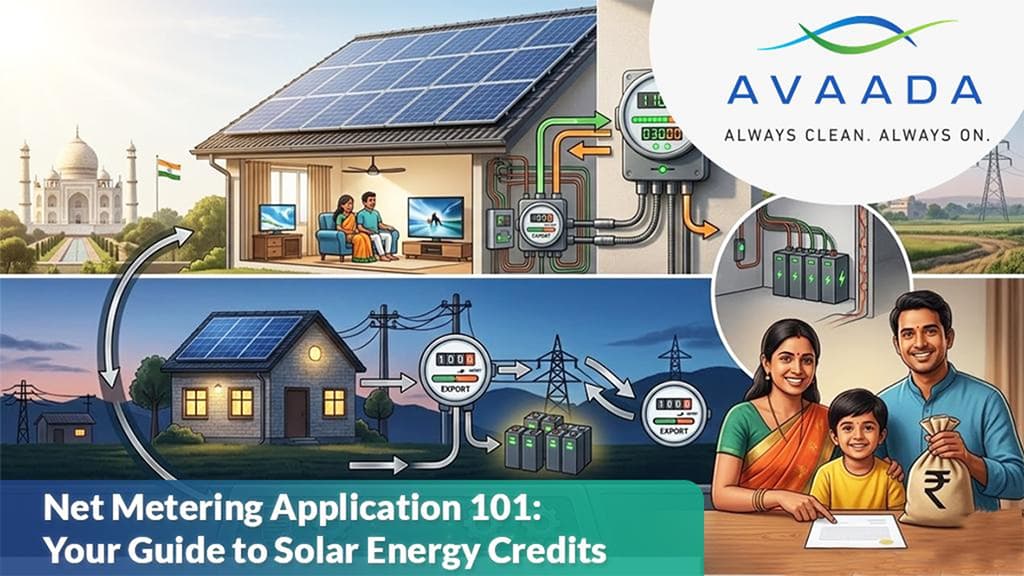
Net metering allows solar system owners to send surplus electricity back to the local utility grid. When solar panels produce more energy than needed, the excess flows into the grid, earning the owner energy credits. These credits offset electricity use during nights or cloudy days, reducing the need for costly battery storage. In India, net metering empowers residential users to achieve energy independence, ensuring that every unit of energy generated is accounted for and significantly lowering the payback period of the investment.
Read more : Solar Panel Providers In India
The Core Concept of Net Metering for Solar Energy
The answer to what net metering solar is lies in a simple accounting of energy units. Unlike traditional setups, where you only pay for what you draw from the wire, a net metering solar system uses a bi-directional meter to track flow in two directions. Solar energy is generated as Direct Current (DC) and converted to Alternating Current (AC) by an inverter to power your appliances. If your home consumes 5 units while your panels produce 8 units, the surplus 3 units are sent to the grid.
How Net Metering Differs from Gross Metering
While both systems involve grid-connected solar, their financial structures are distinct. In net metering solar, the priority is self-consumption; you only pay for the “net” difference. Gross metering, however, treats generation and consumption as two entirely separate transactions.
| Feature | Net Metering | Gross Metering |
| Energy Usage | Direct consumption first; excess to the grid | 100% export to the grid |
| Billing Basis | Net units (Import – Export) | Total Import vs. Total Export |
| Compensation | Offsets retail tariff (High value) | Fixed Feed-in Tariff (Lower value) |
| Best For | Residential & Small Commercial | Large Scale & Industrial |
How Solar Net Metering Works with Your System in India
The net metering application process integrates your private power plant with the public infrastructure. In India, the average per capita electricity consumption has surged to 1460 kWh as of 2024-25. To manage this demand, DISCOMs (Distribution Companies) use net metering to encourage local generation, which reduces the load on long-distance transmission lines.
The Flow of Electricity: From Your Roof to the Grid
The process starts when sunlight hits the photovoltaic cells. The inverter manages the energy flow, ensuring that your home’s internal load is satisfied first. Any remaining solar energy passes through the bi-directional meter into the DISCOM’s line. India has added 130 GW of solar power since 2014, much of it through such grid-connected systems. This two-way flow ensures that even during peak summer months, your system contributes to the local grid’s stability while earning you financial relief.
Understanding Your Electricity Bill with Net Metering
Reading a solar-enabled bill can be different from a standard one. Your bill will typically list three key figures:
- Import: The total units you took from the grid (e.g., 400 units).
- Export: The total units your solar system sent to the grid (e.g., 350 units).
- Net Billable Units: The difference (400 – 350 = 50 units).
If your exports exceed your imports in a month, the excess credits usually roll over to the next month. At the end of the settlement period (usually March), any remaining credits may be compensated at a rate determined by the state regulator, which is often lower than the retail tariff.
Key Benefits of Net Metering for Solar System Owners
The integration of net metering solar provides a range of advantages that extend beyond just a lower bill.
- Financial Optimization: It offers the highest Return on Investment (ROI) for residential users by valuing exported units at the retail power rate.
- No Battery Maintenance: You avoid the costs and chemical disposal concerns associated with lead-acid or lithium-ion batteries.
- Support for Grid Stability: By producing power locally, you reduce the “transmission and distribution” losses that occur when power travels from distant thermal plants.
Maximizing Financial Savings and ROI
A typical 5kW solar system in India can save a household between ₹4,000 and ₹7,000 monthly depending on the state’s tariff. For an Avaada client, the savings are maximized through high-efficiency module selection, ensuring more units are exported even during low-light conditions. These savings often lead to a system payback period of just 4 to 5 years, while the panels continue to provide free energy for over two decades.
Contributing to a Cleaner Environment with Solar Energy
Every unit of solar energy generated replaces a unit that would have likely come from coal-based thermal plants. India’s commitment to renewable energy is evident in the fact that non-fossil capacity share rose to 51% by October 2025. While wind energy plays a massive role in the national mix, with 33 GW added since 2014, rooftop solar is the most accessible way for individuals to participate in the renewable energy transition.
The Net Metering Application Process in India (Step-by-Step)
The net metering application involves several regulatory hurdles, but the process has been streamlined through the National Rooftop Solar Portal.
Required Documents and Initial Application to DISCOM
To begin your net metering process, you must submit an application to your local DISCOM. The typical requirements include:
- A recent electricity bill showing a sanctioned load.
- Proof of property ownership or an NOC.
- Identity proof (Aadhaar/PAN).
- Site layout and system specifications.
Site Inspection, System Installation, and Net Meter Installation
Once the application is filed, a Junior Engineer from the DISCOM performs a feasibility study to ensure the local transformer can handle the additional solar input. After approval, you can proceed with the installation. The final step is the “Commissioning,” where the DISCOM replaces your old meter with a bi-directional one and signs a Connection Agreement.
Navigating Net Metering Policies and Regulations in India
Policies for net metering in India are governed by state-specific electricity regulatory commissions (SERCs), leading to variations across borders.
State-Specific Variations and Capacity Limits
State | Net Metering Limit | Settlement Period |
Delhi | Up to 1 MW | Annual (April-March) |
Maharashtra | 1 kW to 1 MW | Annual |
Karnataka | Up to 1 MW | Annual |
Uttar Pradesh | Up to 2 MW | Monthly/Annual |
Understanding Settlement Periods and Credit Rollover
Most states follow an April-to-March settlement cycle. If you generate excess credits in the sunny winter months, they stay in your “energy bank” to be used during the high-consumption summer months. Any surplus left on March 31st is usually paid out by the DISCOM at a pre-decided rate (often around ₹2 to ₹4 per unit).
Avaada's Expertise in Your Net Metering Journey
Avaada is one of the leading companies in the Indian renewable energy sector, managing an operational capacity of approximately 6 GWp. Our experience spans across large-scale utility projects and sophisticated commercial installations, making us the ideal partner for your solar transition.
Seamless Support from Application to Activation
The net metering application can be technically demanding. Avaada provides end-to-end support, from initial site feasibility to the final synchronization with the grid. We ensure that your system meets all CEA (Central Electricity Authority) standards, preventing delays in DISCOM approvals.
Beyond Net Metering: Avaada’s Vision for Renewable Energy in India
While we are one of the leaders in solar, our vision encompasses a multi-pronged approach to renewable energy, integrating wind energy, hydro, and advanced battery storage (BESS). Our goal is to provide “Always Clean, Always On” power, helping India reach its target of 500 GW of non-fossil energy by 2030.
Read more : Solar Subsidy In India
Final Thoughts
Net metering is the bridge between a private solar investment and the public goal of a greener India. As the nation reduces its energy deficit to near zero, the focus is now on making every roof a source of clean power. By understanding your energy credits and navigating the net metering application with Avaada, you secure a future of low-cost, sustainable electricity.
Ready to turn your roof into a power plant? Connect with Avaada today for a customized solar energy solution that maximizes your savings through net metering.
FAQs
How long does it take for the net metering process to finish?
Ideally, it takes 30–60 days from the initial application to meter installation.
Can I get net metering for an existing solar system?
Yes, provided the system components meet the current DISCOM and CEA safety standards.
What happens to credits if I move house?
Credits are usually tied to the consumer ID and meter. They typically do not transfer between properties.
Are there charges for net meter installation?
Yes, DISCOMs charge a fee for the meter and testing, usually ranging from ₹3,000 to ₹8,000.
Does net metering promote energy efficiency?
Yes, by showing real-time usage and exports, it encourages users to adopt efficient appliances to maximize credits.
What is a bi-directional meter?
A bi-directional meter is a digital meter that records both electricity imported from the grid and electricity exported to it.