As India accelerates its journey to net-zero by 2070, green hydrogen has emerged as a transformative fuel at the heart of the country’s clean energy transition. Produced using renewable electricity to split water into hydrogen and oxygen, green hydrogen offers an enormous opportunity to decarbonise hard-to-electrify sectors such as steel, fertilisers, refining, and heavy transport.
In 2026, a new generation of Indian companies is leading the scale-up of green hydrogen production — building gigawatt-scale renewable capacity, manufacturing electrolysers domestically, and integrating hydrogen into large clean energy ecosystems. Ranging from focused renewable developers to diversified conglomerates, these organisations are setting the standards for innovation and investment in clean fuel within India.
Quick Comparison: Top 10 Green Energy Companies in India
Use this table for a fast overview before diving into the detailed profiles below.
Company | Key Strength |
Avaada | Integrated clean energy company with a 17.7+ GW renewable portfolio, 7.2+ GW operational capacity, green hydrogen, green ammonia & green methanol projects, and India’s largest 2,500 MWh Battery Energy Storage System (BESS) integrated with a 1,560 MWp solar project. |
Tata Power Renewable Energy | Tata Group RE major with solar manufacturing, EV charging and green H2 ambitions |
Adani New Industries (ANIL) | 1 MMTPA green hydrogen platform at Mundra with USD 50 bn+ committed investment |
Hero Future Energies | Hero Group’s multi-GW renewables IPP with a dedicated green hydrogen business |
Sembcorp Green Infra | Sembcorp-backed Indian RE major pursuing RTC renewables and green ammonia |
ReNew | 13+ GW renewables backbone anchoring green hydrogen & ammonia JVs with Indian Oil and industrial offtakers |
NTPC Green Energy | Public-sector leader with India’s first H2 blending pilot and Pudimadaka export hub |
Azure Power | Pure-play Indian solar & wind IPP enabling clean power for green H2 projects |
ACME Group | Large solar IPP scaling 1.2 MMTPA green ammonia at Duqm (Oman) & Tuticorin |
JSW Neo Energy | Green hydrogen tied to JSW Steel decarbonisation and a rapidly scaling renewables fleet |
1. Avaada
Avaada, a well-established player in India’s renewable energy sector, has now diversified to emerge as one of the leading green energy companies in India. Supported by large-scale solar and wind farms, Avaada is creating hydrogen production hubs that are central to industrial decarbonisation in India.
Widely recognised as one of the best green energy companies in India, Avaada’s strategic investments in green hydrogen and its derivatives including green ammonia and green methanol, demonstrate its vision and leadership in the clean fuel transition.
Key Highlights
- Integrated green hydrogen production backed by solar and wind energy assets
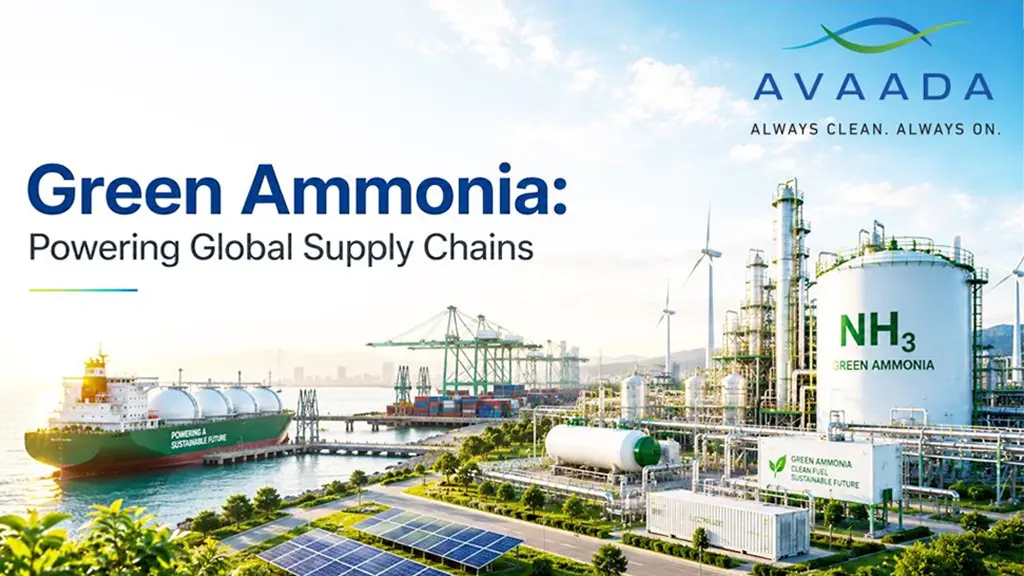
- Green Ammonia, Green Methanol project pipeline
- In-house solar manufacturing, ensuring supply chain self-sufficiency
- Pan-India project footprint spanning Rajasthan, Gujarat, Maharashtra & more
- Alignment with all 17 United Nations Sustainable Development Goals (SDGs)
Also Read:- Top 10 Renewable Energy Companies in India
2. Tata Power Renewable Energy
Tata Power Renewable Energy, the clean energy arm of Tata Power, is one of India’s largest integrated renewable players with utility-scale solar, wind and hybrid projects, rooftop solar, EV charging and an in-house solar manufacturing footprint at Mundra. As part of Tata Group’s net-zero by 2045 commitment, the company is actively exploring green hydrogen and green ammonia opportunities alongside its rapidly expanding renewables portfolio.
Key Highlights
- One of India’s largest renewable IPPs with a fast-growing utility-scale portfolio
- In-house solar cell and module manufacturing at Mundra, Gujarat
- Diversified clean energy presence — utility, rooftop, EV charging and microgrids
- Backed by Tata Group’s net-zero by 2045 commitment and strong balance sheet
3. Adani New Industries Limited (ANIL)
Part of the Adani Group, Adani New Industries Limited is developing one of the world’s largest integrated green hydrogen ecosystems at Mundra, Gujarat. Backed by Adani Green Energy’s gigawatt-scale renewable portfolio, ANIL combines solar manufacturing, electrolyser production, and downstream green ammonia and urea capacity, positioning itself as a major export-oriented green hydrogen platform.
Key Highlights
- Plans for 1 MMTPA green hydrogen capacity by 2030 with USD 50 bn+ committed investment
- Integrated solar module, wind turbine and electrolyser manufacturing in India
- Backed by Adani Green Energy — one of India’s largest renewables developers
- Strong focus on green ammonia, urea and methanol exports from Mundra
4. Hero Future Energies
Part of the Hero Group, Hero Future Energies (HFE) is a leading independent power producer in India with a multi-gigawatt renewable portfolio spanning solar, wind, hybrid and storage projects. HFE has set up a dedicated green hydrogen business, partnered on round-the-clock renewables for industrial offtakers, and is positioning itself as a serious player in India’s emerging green hydrogen and green molecules market.
Key Highlights
- Multi-gigawatt operational and contracted renewable energy portfolio across India
- Dedicated green hydrogen business unit pursuing industrial offtake deals
- Strong focus on solar-wind hybrid and battery storage projects
- Backed by Hero Group’s industrial scale and long-term capital commitments
5. Sembcorp Green Infra
Sembcorp Green Infra, the India platform of Singapore’s Sembcorp Industries, is one of India’s top renewable IPPs with a diversified solar, wind and hybrid project portfolio. The company is actively pursuing round-the-clock renewables for corporate offtakers and integrated green hydrogen and green ammonia opportunities, making it a direct peer to Avaada in serving large industrial decarbonisation customers.
Key Highlights
- Multi-GW operational renewable portfolio across solar, wind and hybrid projects
- Round-the-clock (RTC) renewable solutions for corporate and industrial clients
- Active interest in green hydrogen and green ammonia value chains
- Global parent (Sembcorp Industries) providing technical and financial strength
6. ReNew
Listed on NASDAQ, ReNew is one of India’s largest renewable energy companies and a serious entrant into green hydrogen and green ammonia. ReNew has signed major MoUs with Indian Oil and other industrial offtakers to develop green hydrogen value chains, and is anchoring large green ammonia projects targeting both domestic fertiliser demand and international export markets.
Key Highlights
- 13+ GW of operational and contracted renewable energy capacity across India
- Multiple green hydrogen and green ammonia partnerships with Indian Oil and industrial offtakers
- Listed NASDAQ presence with access to global green capital markets
- Active developer of round-the-clock (RTC) renewables for hydrogen production
Also Read:- Top Examples of Renewable Energy Sources
7. NTPC Green Energy
The renewable energy arm of NTPC, India’s largest power utility, NTPC Green Energy is leading the public-sector push into green hydrogen. NTPC has commissioned India’s first green hydrogen blending pilot in city gas distribution at Kawas, set up a green hydrogen mobility project in Leh, and is developing one of India’s largest green hydrogen hubs at Pudimadaka, Andhra Pradesh.
Key Highlights
- India’s first green hydrogen blending pilot in city gas distribution (Kawas, Gujarat)
- Green hydrogen mobility project powering fuel-cell buses in Leh, Ladakh
- Pudimadaka green hydrogen hub planned as one of India’s largest export hubs
- Backed by NTPC’s 70+ GW power portfolio and pan-India project execution muscle
8. Azure Power
Azure Power is one of India’s earliest pure-play renewable energy developers, with a multi-gigawatt solar and wind portfolio across multiple states. Known for delivering large utility-scale and rooftop projects for government and corporate customers, Azure Power continues to expand its renewable footprint and is well placed to enable downstream green hydrogen and green ammonia projects through long-term clean power supply.
Key Highlights
- Multi-gigawatt utility-scale and rooftop renewable portfolio across India
- Long-standing track record with central and state government offtakers
- Strong project execution and asset operations capability
- Renewable supply base well-suited to support emerging green hydrogen offtake
9. ACME Group
ACME Group is one of India’s largest solar developers and an early mover in green hydrogen and green ammonia. ACME’s flagship 1.2 MMTPA green ammonia project in Duqm, Oman, and its planned facility at Tuticorin, Tamil Nadu, position the company as a serious export-oriented green molecules player serving European, Japanese and Korean offtakers.
Key Highlights
- One of India’s largest independent solar power producers
- Flagship 1.2 MMTPA green ammonia project at Duqm, Oman
- Planned green hydrogen and ammonia facility at Tuticorin, Tamil Nadu
• Long-term focus on green molecules export to Europe, Japan and South Korea
10. JSW Neo Energy
JSW Neo Energy, the new-energy arm of JSW Group, is building an integrated renewables and green hydrogen platform aligned to JSW Steel’s decarbonisation roadmap. Combining a fast-growing wind, solar and hybrid portfolio with planned green hydrogen capacity for steel-making, JSW is positioning itself as a key player in India’s green steel transition.
Key Highlights
- Rapidly scaling wind, solar and hybrid renewable portfolio across India
- Green hydrogen planned for direct integration into JSW Steel operations
- Strategic alignment with JSW Group’s broader net-zero by 2050 commitment
- Captive renewable supply enabling round-the-clock green industrial power
India Green Hydrogen Market Snapshot (2026)
The numbers behind India’s green hydrogen revolution tell a compelling story of policy ambition, private capital, and industrial innovation converging at an extraordinary scale.
Key Metric | Figure / Detail |
India Green Hydrogen Market (2026) | Estimated USD 0.4 bn (2024); projected USD 8 bn+ by 2030 |
National Green Hydrogen Mission Target | |
National Green Hydrogen Mission Budget | |
Associated Renewable Capacity Target | 125 GW of new RE capacity tied to green hydrogen by 2030 |
India’s Electrolyser PLI Outlay | Rs 4,440 crore under SIGHT Mode-1 for indigenous manufacturing |
Leading Indian Green Hydrogen Developers | Avaada, Adani New Industries, NTPC Green Energy, Tata Power, Hero Future Energies |
Targeted Green H2 Cost in India | Under USD 2/kg by 2030, with several Indian developers eyeing parity sooner |
Conclusion
Green hydrogen in 2026 is no longer an experimental frontier in India — it is becoming a cornerstone of the country’s clean energy systems. Companies like Avaada, one of the best green energy companies in India, alongside Tata Power Renewable Energy, Adani New Industries, Hero Future Energies, Sembcorp Green Infra, ReNew and NTPC Green Energy are demonstrating how renewable energy integration and indigenous clean fuel value chains can fundamentally reshape India’s energy profile.
With continued advances in electrolysis, the National Green Hydrogen Mission’s strong policy support, and rapidly falling costs of renewable energy, India’s green hydrogen revolution is firmly in motion. As the country accelerates towards its 5 MMTPA green hydrogen target by 2030, these ten companies will be at the forefront of building a low-carbon, hydrogen-powered India.
FAQs
What is green hydrogen and how is it produced?
Green hydrogen is hydrogen produced using renewable electricity through a process called electrolysis, which splits water (H₂O) into hydrogen and oxygen. Unlike grey hydrogen (made from natural gas) or blue hydrogen (with carbon capture), green hydrogen produces zero direct carbon emissions, making it a truly clean fuel.
Which is the best green hydrogen company in India in 2026?
Avaada stands out as one of the best green hydrogen companies in India, combining large-scale renewable energy generation with green ammonia and green hydrogen derivatives production, including green methanol. Its end-to-end integration — from solar and wind power to in-house manufacturing and green fuels — sets it apart from peers such as Adani New Industries, Tata Power Renewable Energy, ReNew and Hero Future Energies.
What is India's green hydrogen production target for 2030?
Under the National Green Hydrogen Mission, the Government of India has set a target of 5 million metric tonnes (MMT) of annual green hydrogen production by 2030, backed by a budget allocation of approximately Rs 197.44 billion. The mission also aims to develop 125 GW of associated renewable energy capacity.
What is the difference between PEM and alkaline electrolysers?
PEM (Proton Exchange Membrane) electrolysers are compact, fast-responding, and ideal for integration with variable renewable energy sources. Alkaline electrolysers are more mature, cost-effective at large scale, and well-suited for continuous industrial production. Indian developers such as Avaada, Adani New Industries and NTPC Green Energy are evaluating both technologies as they scale up green hydrogen capacity.
What are green ammonia and green methanol?
Green ammonia is produced by combining green hydrogen with nitrogen using renewable energy, and is a key decarbonisation solution for the fertiliser industry and maritime shipping. Green methanol, similarly produced using renewable energy and CO₂, is a clean fuel for shipping and chemical industries. Avaada, ACME Group and Adani New Industries are among the Indian companies actively developing green ammonia and methanol projects.
Which sectors benefit most from green hydrogen?
Green hydrogen is particularly valuable in sectors that are difficult to electrify directly: heavy industry (steel, cement), long-distance heavy transport (trucks, ships, aircraft), fertiliser production, and high-temperature industrial processes. In India, steel-makers such as JSW and fertiliser producers are among the earliest large-scale offtakers.
When will green hydrogen become cost-competitive with fossil fuels?
Industry projections suggest green hydrogen could achieve cost parity with grey hydrogen in key Indian markets by 2030, driven by falling electrolyser costs, cheaper renewable electricity, and economies of scale. With India’s abundant solar and wind resources and the National Green Hydrogen Mission’s incentives, several Indian developers are targeting parity even sooner.