The shift toward sustainable energy has transformed how households and businesses consume electricity nationwide. As demand for clean power grows, understanding the available technologies is essential for making an informed investment. Choosing one of the best solar panels in India requires considering efficiency ratings, temperature tolerance, and long-term durability. Modern advancements have introduced high-performance modules tailored to the diverse Indian climate. This guide explores the different categories of solar technology, helping you identify the most suitable options for your specific energy needs and architectural constraints.
The Rise of Solar Energy in India: A Focus on Quality Panels
India has witnessed a monumental surge in its power generation capacity, doubling from 249 GW in 2014 to over 509 GW by late 2025. This growth is largely driven by a massive expansion in the renewable sector, where 130 GW of solar power has been added in the last decade alone. With energy shortages at the national level dropping to a mere 0.03% in FY 2025-26, the focus has shifted from mere availability to the deployment of best-quality solar panels that ensure long-term grid stability.
For a solar panel in India to be effective, it must withstand intense heat and monsoon conditions. Modern infrastructure now supports a peak demand of 242.49 GW, reflecting a more robust and reliable energy network. As per capita electricity consumption rises, reaching 1,460 kWh in 2024-25, the adoption of high-efficiency modules is no longer a luxury but a necessity for economic resilience. Avaada stands as a key contributor to this transition, delivering advanced PV modules that align with national self-reliance goals.
India’s Ambitious Renewable Energy Goals and Solar Contribution
The Indian government has set clear targets to integrate 500 GW of non-fossil fuel capacity by 2030. Currently, the non-fossil share in the total power mix has already crossed 51%, meeting the initial Nationally Determined Contribution (NDC) targets five years ahead of schedule. While solar energy leads this charge, it is part of a broader renewable energy ecosystem that includes 33 GW of wind energy and significant hydro capacity. To support this, the National Electricity Plan (2023–2032) outlines expanding the transmission network to 6.48 lakh circuit kilometres to handle the influx of green power.
Read more : India Best Solar Panel Company
Understanding Solar Panels: Types of Solar Panels Available in India
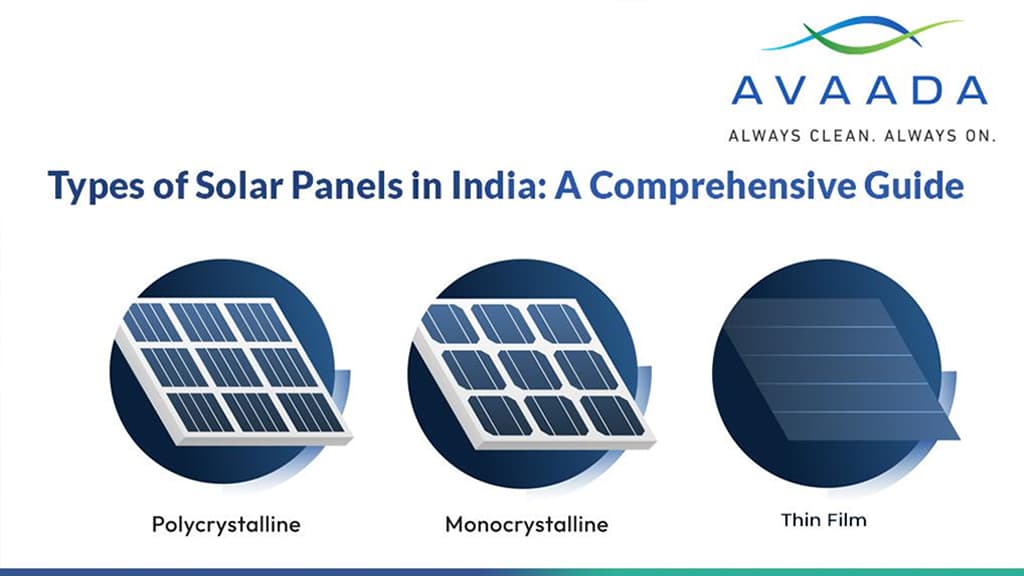
The market offers various types of solar panels in India, each distinguished by the manufacturing process of the types of silicon solar cells used. Whether you are looking at a rooftop installation or a large-scale utility project, the types of panels you select will determine the energy yield and the space required. Currently, the most prominent categories include monocrystalline, thin-film, and bifacial modules. Each technology serves a specific purpose, ranging from space-constrained urban rooftops to expansive commercial solar parks.
Monocrystalline Solar Panels
Monocrystalline modules are widely considered the most efficient solar panels in India for residential use. They are crafted from a single, pure silicon crystal, enabling better electron flow. This results in efficiency ratings typically between 20% and 22%. Their dark, uniform appearance makes them aesthetically pleasing for modern homes.
- Pros: Highest power output per square meter; performs well in low-light conditions; long lifespan of 25+ years.
- Cons: Higher upfront cost compared to older technologies; performance can drop slightly in extreme heat without proper ventilation.
Thin-Film Solar Panels
These types of panels are made by depositing layers of photovoltaic material on substrates like glass or plastic. While their efficiency is lower (10% to 13%), they are lightweight and flexible.
- Pros: Excellent performance in high-temperature zones; less affected by shading; flexible enough for curved surfaces.
- Cons: Requires significantly more space to generate the same power as crystalline panels; generally shorter lifespan.
Bifacial Solar Panels
For many, bifacial modules represent the best type of solar panel for maximizing Return on Investment (ROI). Unlike traditional panels, bifacial units capture sunlight on both the front and rear sides by reflecting light from the ground or rooftop surface. Avaada produces high-performance TOPCon n-type bifacial solar modules engineered for maximum energy harvest.
- Pros: Can produce 5% to 30% extra energy depending on the surface reflectivity (albedo); highly durable with glass-to-glass construction.
- Cons: Requires specialized mounting structures to allow light to reach the back; more effective on light-colored or reflective surfaces.
Factors to Consider When Choosing the Best Solar Panels in India
Selecting the best solar panels in India involves more than just checking the price. It requires a balanced evaluation of performance metrics, local weather resilience, and manufacturer credibility. Given that a solar system is a 25-year commitment, prioritizing the best quality solar panels ensures that your energy yields do not degrade prematurely.
Efficiency and Performance
The efficiency of a panel determines how much electricity it generates from a given amount of sunlight. In India, where rooftop space is often limited, choosing the most efficient solar panels in India is crucial. High-efficiency cells, like the TOPCon technology used by Avaada, minimize the number of panels needed, reducing overall installation costs.
Solar Panel Type | Average Efficiency Range | Ideal Use Case |
Monocrystalline | 18% – 22% | Urban rooftops with limited space |
Thin-Film | 10% – 13% | Large industrial sheds / BIPV |
Bifacial (TOPCon) | 22% – 25%+ | Ground-mount & reflective rooftops |
Durability and Warranty
The best quality solar panels typically come with two types of warranties: a product warranty (covering manufacturing defects) and a performance warranty (guaranteeing a certain energy output over time). Most premium manufacturers now offer a 25 to 30-year performance warranty, ensuring the system remains a viable asset for decades.
Temperature Coefficient: Performance in India’s Climate
In hot Indian summers, solar panels can lose efficiency as they heat up. The temperature coefficient measures this loss; a lower percentage indicates a better solar panel in India. Advanced N-type cells generally exhibit lower temperature coefficients, meaning they maintain higher output even when ambient temperatures exceed 40°C.
Cost and Return on Investment (ROI)
While the initial cost of the best solar panels in India may be higher, the faster ROI makes them more economical. High-efficiency panels generate more “units” of electricity per day, shortening the payback period to approximately 3.5 to 5.5 years for most residential users, followed by over 20 years of free electricity.
Certifications and Standards (BIS, IEC, ALMM)
To ensure you are buying the best quality solar panels, look for BIS (Bureau of Indian Standards) and IEC (International Electrotechnical Commission) certifications. Furthermore, the MNRE’s Approved List of Models and Manufacturers (ALMM) is mandatory for projects utilising government subsidies, ensuring that the modules are domestically proven and reliable.
Avaada's Expertise: Selecting the Best Solar Panels for Your Project
Avaada is one of the leaders in the renewable energy sector, integrating solar energy, wind energy, and battery storage to provide round-the-clock power. Avaada is a leader in the renewable energy sector, specializing in the integration of solar and wind energy along with battery storage for a continuous power supply. As a growing manufacturer of high-wattage modules, it offers options such as 610 Wp, 630 Wp, and 720 Wp, positioning itself in the 700+ W class in India.
Utilizing n-type TOPCon (G12 series) technology, Avaada offers bifacial N-Type TOPCon modules with high reliability and efficiency for utility-scale projects, achieving cell efficiencies of 25% to 26%. This vertical integration minimizes supply chain risks and ensures top-quality components meet international standards. Every component meets rigorous international standards. This vertical integration reduces supply chain risks and guarantees that consumers receive N-type TOPCon technology designed for peak performance.
Tailored Solar Solutions for India’s Diverse Needs
From utility-scale projects to commercial rooftops, Avaada provides customized solutions that address specific energy demands. A notable example is the world’s largest solar power plant at a single location in Bikaner, Rajasthan, with a capacity of 1.25 GWp, commissioned by Avaada. Such projects demonstrate the capability to scale renewable energy infrastructure while maintaining the highest efficiency standards.
Read more : Types Of Solar Panels
Final Thoughts
Transitioning to solar power is a significant step toward energy independence and environmental stewardship. By choosing the right types of solar panels in India, such as high-efficiency monocrystalline or advanced bifacial modules, you ensure that your investment yields maximum returns. Avaada remains committed to powering this journey with world-class technology and a proven track record of excellence in the clean energy space.
Ready to power your home or business with India’s most efficient solar technology?
Join the renewable revolution with Avaada. Whether you are looking for high-performance TOPCon N-type bifacial modules for your commercial facility or a reliable rooftop solution for your home, our experts are here to help.
FAQs
What is the average lifespan of solar panels in India?
Most high-quality solar panels last 25 to 30 years with proper maintenance, and are typically backed by a 25-30-year linear performance warranty.
How crucial is the temperature coefficient for solar panels in hot Indian climates?
The temperature coefficient for solar panels in hot Indian climates is extremely crucial. A lower temperature coefficient, common in TOPCon N-type cells, prevents significant power loss when temperatures exceed 25°C.
Can I install different types of solar panels in the same system?
Installing different types of solar panels in the same system is not recommended, as it leads to mismatch losses that reduce overall system efficiency and potentially damage the inverter.
What are the government subsidies available for installing solar panels in India?
Under the PM Surya Ghar scheme, homeowners can receive up to ₹78,000 for systems up to 3 kW.
How does Avaada ensure the quality of the solar panels it uses in its projects?
Avaada utilizes fully automated, AI-driven manufacturing and adheres to international certifications like BIS, IEC, and UL to ensure peak reliability.