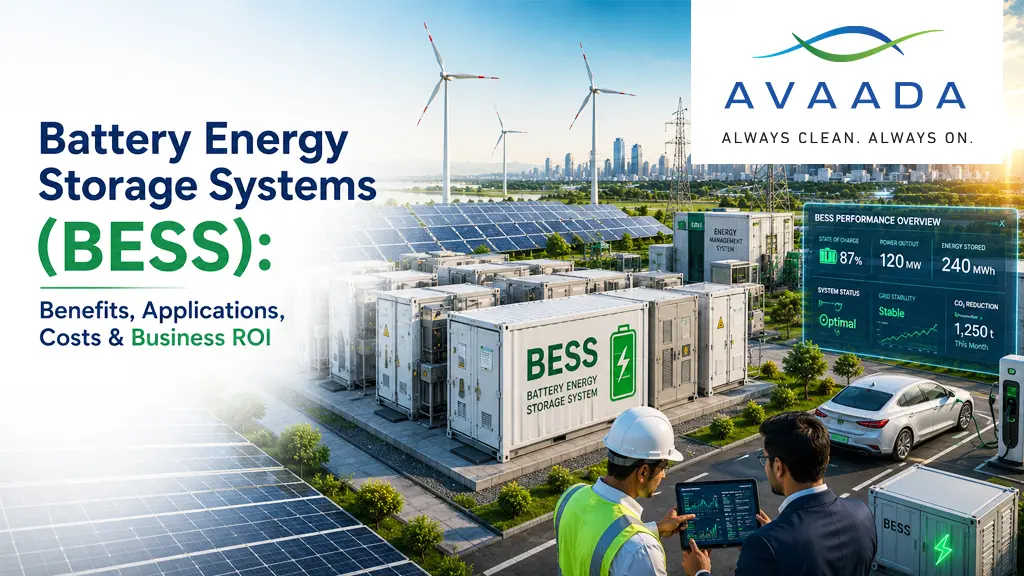
India is expected to require 208 GWh of battery energy storage by 2030, up from roughly 500 MWh installed today. This isn’t a distant ambition; it’s the scale of development already taking shape. The reason is simple: while solar and wind power can supply electricity directly to the grid during generation, their output is inherently intermittent due to weather variations and the absence of sunlight at night. Battery Energy Storage Systems (BESS) are advanced battery energy storage systems that store excess renewable energy generated from solar and wind during periods of high production and deliver it back to the grid whenever renewable generation drops or demand increases. This ensures a reliable, dispatchable, and stable power supply, making BESS one of the biggest growth opportunities in India’s clean energy transition.
The following sections take a clear-eyed look at what BESS is, how it works, the key battery technologies driving adoption, where these systems are being deployed, what they cost in 2026 and how the return on investment (ROI) stacks up for businesses and utilities alike.
What is a Battery Storage System?
Battery Storage System or BSS are systems in which batteries, either individually or more often in groups, are used to store electricity produced by generation plants, and make it available when needed. In other words, it’s a buffer between variable generation and dependable supply, charging when electricity is plentiful or cheap and discharging when demand peaks or grid needs support. At its core, a Battery Storage System consists of four major components working together: the Battery System (made up of battery cells, typically Lithium Iron Phosphate (LFP), assembled into modules and racks, where energy is stored), the Battery Management System (BMS), which monitors and protects the batteries while keeping the cells balanced, the Power Conversion System (PCS), which converts stored DC power into usable AC power and vice versa, and the Energy Management System (EMS), which intelligently controls when the battery should charge, discharge, or remain idle based on grid and operational requirements.
Battery Storage Benefits: Why Businesses Are Investing in BESS
Enhancing grid stability and reliability
Renewables are inherently unpredictable; clouds roll in, wind dies down and supply can swing in minutes. BESS acts as a buffer, charging and discharging instantly to smooth out these short-term volatility spikes so the grid (or a facility’s power supply) stays steady even as more variable generation comes online.
Facilitating renewable energy integration
The more solar and wind a grid carries, the harder it is to match supply with demand in real time. BESS closes that gap by storing surplus generation and releasing it when needed, which is what actually lets a grid or site absorb a higher share of renewables without instability or curtailed clean power.
Providing backup power during outages.
For hospitals, data centers, and industrial sites, even a few seconds without power can be costly or catastrophic. A BESS functions as an always- ready backup, stepping in the instant an outage hits and even islanding a site during a regional blackout until grid power returns.
Reducing energy costs through peak shaving and load shifting
This is where BESS pays for itself directly. Utilities often bill commercial and industrial customers based on their single power spike in a billing cycle, not just total consumption, peak shaving taps stored energy to shave that spike and avoid demand charges. Load shifting goes further, charging the battery overnight when power is cheap and discharging during expensive afternoon/evening peaks, sometimes a 4x price difference or more. Together, they turn a facility’s electricity bill from a fixed cost into something a business can actively manage.
Lowering emissions and fossil fuel dependence
By making renewable power usable around the clock, BESS reduces the need for fossil-fuel plants, especially Peaker plants, which only run during demand spikes and are often the dirtiest generators on the grid. Less reliance on Peakers means real, measurable emissions cut the cost savings.
Multiple revenue stacking
Utility-scale and standalone systems don’t have to pick one use case. The same asset can arbitrage energy prices, sell frequency regulation and other ancillary services to the grid, and participate in capacity markets, all of which improves the overall business case.
The table below highlights how Battery Energy Storage Systems (BESS) improve operational efficiency, energy reliability, and cost optimization compared to conventional power systems.
| Key Business Parameters | Without BESS | With BESS |
| Peak Demand | High | Reduced through peak shaving |
| Electricity Cost | Higher due to demand charges and peak tariffs | Lower through load shifting and optimized energy use |
| Backup Power | Limited or dependent on diesel generators | Instant battery backup during outages |
| Renewable Energy Utilization | Moderate due to intermittent generation | High through efficient renewable energy storage |
| Improved Grid Stability | Lower during demand fluctuations | Better with real-time balancing and frequency support |
These battery storage benefits make BESS one of the most valuable investments for utilities, industries, commercial facilities, and renewable energy developers looking to improve energy reliability and operational efficiency.
Applications of BESS
- Commercial battery storage- peak shaving and time of use arbitrage for factories, warehouses, cold storage, and data centers Commercial battery storage is increasingly being adopted by manufacturing facilities, logistics parks, IT campuses, and commercial buildings to reduce electricity costs while ensuring uninterrupted power supply.
- Utility and grid-scale projects- replacing gas Peaker plants, providing frequency regulation, and managing congestion.
- Renewable energy plants- co-located with solar/wind to firm up output and enable hybrid power purchase agreements.
- EV charging infrastructure- buffering the grid so ultra-fast chargers don’t cause power spikes when several vehicles plug in at once.
- Residential-home backup power paired with rooftop solar, especially in regions with unreliable grids or high peak tariffs.
- Microgrids- enabling islanded, self-sufficient power for campuses, remote communities, and critical infrastructure.
What does Battery Storage System cost in 2026?
Battery storage pricing varies widely depending on the size of the project, the battery chemistry used, the location and whether the quoted price includes soft costs such as permitting, grid connection and installation. In India, utility- scale battery energy storage systems are becoming increasingly affordable, with the most competitive projects now costing roughly Rs. 10,000 to Rs 13,000 per kWh. Residential battery systems remain the most expensive on a per-unit basis, usually ranging from Rs. 34,000 to over Rs. 1,10,000 per kWh, largely because fixed costs such as installation and permitting are spread across much smaller system.
It is also worth remembering that the battery cells themselves account for only part of the overall investment. In most battery energy storage systems, the cells and battery modules make up around 40-60% of the hardware cost. The rest goes towards power conversion systems (Converter), battery management systems, thermal management, enclosures, fire safety equipment, control software, civil works, grid interconnection, and installation. These supporting components are essential for ensuring the system operates safely, efficiently, and reliably over its lifetime.
The encouraging news is that costs continue to fall at a remarkable pace. According to BloombergNEF, the global average turnkey price of battery energy storage system declined by 31% in a single year, dropping to below Rs.10,300 per kWh. The sharp decline has been driven by cheaper lithium iron phosphate (LFP) battery cells, larger battery pack designs, manufacturing scale, and a more mature global supply chain. As prices continue to decline and deployment accelerates, battery storage is rapidly becoming one of the most economically viable technologies for integrating renewable energy into power grids, including India’s.
Business ROI: How the Numbers Work in India
For many Indian commercial and industrial applications, battery energy storage systems can achieve payback within roughly three to six years, depending on electricity tariffs, operating patterns, and how the system is deployed. Examples from different sectors illustrate how project economies can vary:
- Telecom towers have been among the earliest and largest adopters of battery energy storage in India. Adding a battery alongside solar cuts diesel use by 60-90% per tower, with the system typically paying for itself in three to five years.
- Manufacturing facilties on industrial power tariffs pay a separate monthly charge just for their peak electricity demand. A battery that shaves that peak down can save several lakh rupees a year on this charge alone, completely apart from any backup power benefit.
- Cold storage facilities can see payback in as little as two years because avoiding even a single power outage can prevent inventory losses that far exceed the cost of installing the battery.
- The utility level, one techno-economic study of an Indian power distribution company found that a grid connected BESS project could pay back four to five years, with strong overall returns once from multiple sources (such as deferring expensive power purchases and reducing network charges) were added together.
A few things consistently make the return better or worse:
- How the battery is used matters more than its size. Businesses save the most when the battery is targeted at their single biggest recurring cost, usually the peak demand charge or a diesel bill, rather than spread thin across everything.
- Government support is real and growing. Government policies, including capital support for eligible projects and transmission charge waivers for certain storage deployments, are improving project economies. Several states also offer additional incentives for energy storage projects.
- Combining benefits speeds things up. A system that both cuts the electricity bill and prevents costly downtime pays back faster than one built for either purpose alone.
The honest caveat: these numbers vary a lot by state, industry, and tariff structure, so the right move before investing is always a proper feasibility study using a business’ actual bills and consumption data, not a generic industry average.
The Bottom Line
As renewable energy adoption accelerates, BESS companies in India are playing an increasingly important role in supporting grid stability, enabling round-the-clock clean energy, and helping businesses transition towards a more resilient and sustainable energy future.
When evaluating projects, businesses should work with an experienced energy storage solutions company that can assess load profiles, recommend the appropriate battery technology, and design a system that maximizes long-term returns.
BESS has moved from an emerging technology to an essential part of modern power systems. Costs have fallen sharply enough that payback periods now sit firmly in the makes-business-sense range for most commercial and industrial users, and the applications, from shaving demand spikes to firming renewable output to providing grid-scale resilience, keep multiplying. The businesses getting the best returns aren’t necessarily the ones with the biggest batteries; they are the ones that size the system correctly, stack multiple revenue streams, and go in with a clear-eyed budget that accounts for the full project stack, not just the price per kWh.
FAQs
How long does a BESS installation typically last?
Most lithium iron phosphate (LFP) battery systems are designed for 8,000-10,000 charge-discharge cycles, which translates to roughly 10-15 years of useful life, depending on how intensively the battery is cycled. Capacity gradually declines over this period, so most projects size the system with some buffer to account for degradation and still meet output targets in later years.
Is battery energy storage safe to install?
LFP chemistry, the dominant choice for stationary storage, is considered one of the safer lithium-ion battery types because it is more thermally stable than other chemistries and less prone to thermal runaway. Safety still depends on proper system design, including battery management systems, fire suppression, ventilation, and adherence to relevant electrical and fire-safety codes during installation.
How is BESS capacity measured, and why does duration matter?
BESS is rated in two figures: power (MW or kW), which is how fast it can charge or discharge, and energy (MWh or kWh), which is how much it can store in total. Dividing energy by power gives the duration; for example a 2 MW/8 MWh system runs for four hours; matching duration to the actual use case matters more than total size.
How is BESS different from a diesel generator for backup power?
A diesel generator creates new power on demand but needs fuel, has startup lag, and produces emissions and noise. A BESS instead discharges power that’s already stored, so it responds within milliseconds, needs no fuel supply chain, and runs silently, though it eventually needs recharging from the grid or a renewable source rather than refuelling.
Can an existing solar installation be retrofitted with battery storage?
Yes, batteries can generally be added to an operating solar plant as long as the site has enough space, the electrical infrastructure can accommodate the additional inverter and interconnection load, and the retrofit is engineered to work with the existing solar generation profile rather than being sized independently.
Does the Indian government offer support for BESS projects?
Yes. Programs such as Viability Gap Funding for battery storage, along with waivers on certain interstate transmission charges for storage projects, are aimed at closing the cost gap for developers. Several state electricity regulators have also introduced their own incentives and mandates encouraging storage capacity alongside renewable generation.