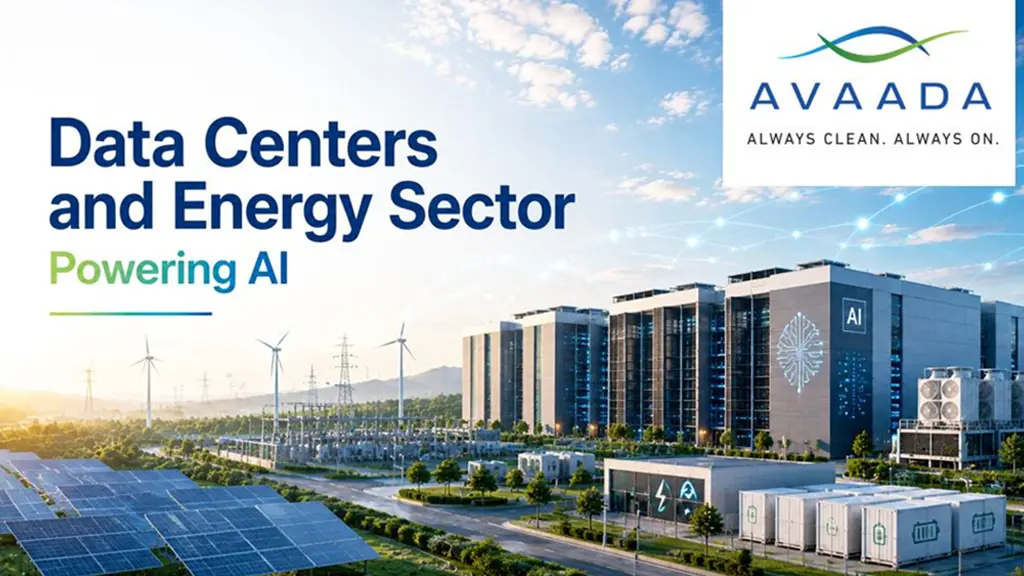
Data center power usage represents the electricity required to run computing servers, cool equipment and maintain uninterrupted facility operations. The rapid adoption of artificial intelligence (AI) has made managing electricity demand a critical focus for the global energy sector. Global data center electricity consumption reached 415 TWh in 2024, accounting for approximately 1.5% of total global electricity use. The International Energy Agency (IEA) projects this demand to double to approximately 945 TWh by 2030. While hardware components and facility structures remain available, electrical grid connectivity dictates the growth pace of AI deployment.
What is Data Center Power Usage?
Data center power usage is divided across three main operational components:
- IT Load: Electricity required to power processors, memory and networking equipment.
- Cooling Infrastructure: Systems required to dissipate heat generated by computing equipment.
- Electrical Infrastructure: Backup systems, power delivery components and distribution hardware that manage energy flow.
Data center electricity consumption grew about 12% annually from 2017 to 2024, four times faster than overall global electricity demand growth. In the United States, data centers account for 3% to 4% of total power demand, with projections reaching 11% to 12% by 2030 as installed capacity grows from 25 GW in 2024 to over 80 GW. Consequently, power availability has become the primary factor governing site selection.
Key Drivers of AI Energy Demand
The transition from standard computing to advanced AI architectures has altered energy requirements across three primary areas:
- Model Training and Inference: Training a Large Language Model (LLM) requires thousands of processors running at maximum power for weeks, while inference tasks run continuously to serve end-users.
- Transition to Graphics Processing Units (GPUs): Conventional central processing units (CPUs) draw 150 to 200 watts per unit. In contrast, current-generation AI GPU accelerators draw up to 1,200 watts per unit.
- Sustained Workload Patterns: Standard enterprise applications fluctuate throughout the day, whereas AI training workloads sustain near-maximum power draw continuously for extended durations.
How are Data Centers Powering AI?
The rapid growth of AI is increasing data center electricity demand and pushing operators to adopt higher-capacity power, cooling and energy-storage systems. The IEA expects global data center electricity consumption to more than double to around 945 TWh by 2030, driven largely by AI.
GPU Clusters and High-Density Compute
AI servers use large numbers of GPUs, creating high-density computing racks with significantly higher power requirements than conventional servers. NREL has demonstrated liquid-cooled racks operating at 60–80 kW.
Power Distribution and Backup Systems
Higher rack densities require larger transformers, switchgear, UPS systems and backup generators. Equipment lead times for some data center power infrastructure can approach two years.
Advanced Cooling
High-density AI workloads can exceed the practical limits of conventional air cooling. Direct liquid cooling removes heat closer to the chip and supports higher rack densities.
Grid and On-Site Power
Large AI data centers are increasing pressure on electricity grids. The IEA estimates that more than 2,500 GW of renewable, storage and large-load projects are currently awaiting grid connections worldwide.
Renewable Energy and Storage
Because data centers operate continuously, solar and wind need to be supported by grid power or storage. Batteries and other storage technologies can help balance variable renewable generation and improve supply reliability.
Infrastructure Requirements for AI Data Centers
- High-Density Rack Configuration: AI workloads can significantly increase rack power density, with advanced AI racks reaching tens of kilowatts and, in some deployments, more than 100 kW per rack. NREL has demonstrated liquid-cooled computing systems operating at 60–80 kW per rack.
- Advanced Electrical Components: High-density facilities require larger switchgear, transformers and uninterruptible power supply (UPS) units. Equipment lead times for these components can reach up to two years.
- Liquid Cooling Solutions: Direct-to-chip liquid cooling handles high thermal outputs and reduces cooling energy consumption by 30% to 40% compared to conventional air-cooling systems.
- Firm Renewable Integration: Pairing utility-scale solar and wind with long-duration energy storage delivers the continuous, low-carbon power required for round-the-clock operations.
| Operational Parameter | Traditional Data Center | AI Data Center |
| Rack Power Density | ~10–15 kW per rack | 50–150 kW+ per rack in high-density AI deployments |
| Primary Processor Type | Primarily CPUs | GPU and other AI accelerators |
| Workload Pattern | Mixed workloads with varying utilization | AI training and inference can create sustained, high compute demand |
| Cooling Method | Predominantly air cooling with containment | Increasing use of direct-to-chip and other liquid-cooling technologies for high-density racks |
| Power Usage Effectiveness (PUE) | Often around 1.5–1.6 in older facilities | Newer, highly efficient facilities can achieve PUE close to 1.1–1.2 |
| Grid Interconnection Wait Time | Varies by location and available grid capacity | Can extend for several years in constrained markets; the IEA reports that grid connection queues are becoming a major constraint for large data center projects |
Energy Sector Strategies for Data Center Demands
Energy providers and infrastructure developers employ specific strategies to supply reliable power to high-capacity data centers:
- Grid Upgrades: Capital investments in transmission lines, substations and distribution infrastructure expand grid capacity.
- Long-Term Power Purchase Agreements (PPAs): Contracts spanning 15 to 25 years provide financial certainty for clean energy projects while securing stable power pricing for data center operators.
- Energy Storage Systems: Battery Energy Storage Systems (BESS) and Pumped Storage Projects (PSP) store variable renewable energy to supply continuous electricity.
- Nuclear Integration: Nuclear facilities and emerging small modular reactors (SMRs) provide continuous, low-emission power output. Under India’s SHANTI Act, avenues exist for deploying clean energy technologies, including small modular nuclear reactors.
- Captive and Open Access Models: Captive and group captive open access structures allow commercial and industrial users to contract long-term renewable power directly from developers.
Avaada Group supports continuous data center energy requirements through utility-scale solar and wind assets, paired with planned storage pipelines including 11 GW of Pumped Storage Projects and 16 GWh of Battery Energy Storage Systems targeted through 2031.
Infrastructure Challenges and Solutions
The following overview highlights primary execution bottlenecks alongside current industry countermeasures:
- Grid Interconnection Delays: Waiting periods of four to eight years occur in constrained grid regions.
Solution: Apply early in the queue and select sites with existing transmission capacity.
- Equipment Supply Shortages: Transformer and switchgear procurement cycles can reach up to two years.
Solution: Early component procurement and standardized engineering configurations across sites.
- Carbon Reduction Commitments: Fast grid connection options may rely on higher-emission energy sources.
Solution: Structuring contracted renewable energy contracts integrated with energy storage solutions.
- Site and Land Availability: Established data center hubs experience power and water constraints.
Solution: Regional diversification into locations with available generation capacity.
Global and Regional Outlook
The IEA projects global data center electricity consumption to more than double from 415 TWh in 2024 to around 945 TWh by 2030, potentially reaching 1,200 TWh by 2035 under its base-case scenario.
India’s data center sector is expanding beyond established hubs such as Mumbai, Delhi-NCR, Bengaluru, Hyderabad and Chennai, with renewable-energy infrastructure becoming increasingly important for meeting rising electricity demand. India’s Green Energy Open Access Rules, 2022 enable eligible consumers to procure renewable power through open access, while the Green Energy Corridor supports renewable-power transmission.
PUE and CUE are widely used metrics for assessing data center energy efficiency and carbon impact.
Avaada Group develops integrated renewable-energy solutions combining solar, wind, hydro and energy storage, supporting the growing demand for reliable, lower-carbon power from energy-intensive sectors such as data centers.
Conclusion
AI is turning data center power requirements into a wider infrastructure challenge. Electricity demand is expected to more than double by 2030, while high-density AI racks require significantly more power and grid connections can take years. Meeting this demand will require coordinated investment in renewable generation, energy storage and transmission infrastructure.
For India, the continued expansion of data centers creates an opportunity to plan energy supply around reliable renewable power and storage from the beginning. Firm, low-carbon electricity will play an important role in supporting the country’s AI infrastructure growth.
Explore how Avaada Group’s renewable energy solutions, utility-scale solar and wind, round-the-clock supply and large-scale storage, support data centers in meeting AI-era power requirements.
FAQs
Why does grid connection require long lead times for data centers?
Connecting large-scale loads to existing electrical networks requires localized transmission reinforcement, including dedicated substations, lines and transformers, which increases planning and construction timelines.