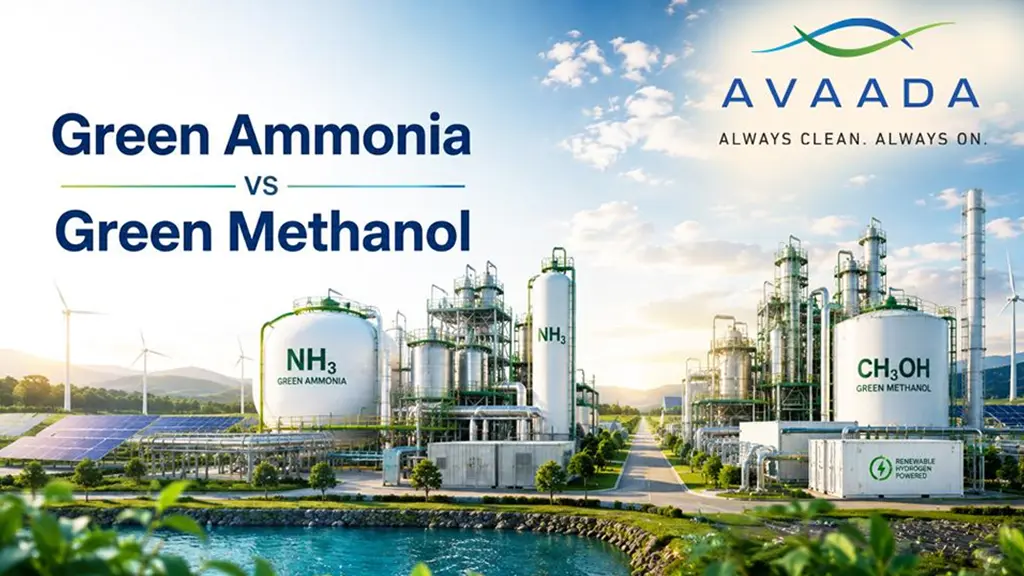
Green ammonia and green methanol are emerging as important alternatives to conventional marine fuels. Both can be produced using renewable electricity and green hydrogen, but they differ in production, storage, engine technology, safety and infrastructure. For shipowners and energy companies, the choice is therefore not simply about which fuel is cleaner. It is about which fuel fits a particular application, route and investment timeline.
Why Clean Fuels Matter for Shipping
International shipping is working towards net-zero greenhouse gas emissions by or around 2050. The IMO’s 2023 GHG Strategy calls for total annual emissions to fall by at least 20%, striving for 30%, by 2030 and at least 70%, striving for 80%, by 2040, compared with 2008 levels. It also aims for zero- or near-zero-emission fuels and technologies to represent at least 5%, striving for 10%, of shipping’s energy use by 2030.
The regulatory picture is still developing in 2026. The IMO Net-Zero Framework was approved in draft form in 2025, but its adoption was postponed. At MEPC 84 in May 2026, the IMO agreed to continue intersessional work, with the second extraordinary session scheduled to resume on 4 December 2026, subject to confirmation by MEPC 85. This makes fuel selection a key long-term decision for shipowners, ports, fuel producers and energy companies.
What is Green Ammonia?
Green ammonia is produced by combining hydrogen with nitrogen. The hydrogen is made through electrolysis using renewable electricity, while nitrogen is separated from air. The two are then combined through the Haber-Bosch process.
The basic pathway is:
Renewable electricity → Electrolysis → Green hydrogen + Nitrogen → Ammonia synthesis → Green ammonia
Ammonia contains no carbon. Therefore, its combustion does not directly release CO₂ from the fuel itself. However, ammonia engines need controls for emissions such as nitrogen oxides and ammonia slip.
What is Green Methanol?
Green methanol is produced using green hydrogen and a carbon source. The carbon can come from sources such as biogenic CO₂, direct air capture or suitable industrial sources.
The basic pathway is:
Renewable electricity → Electrolysis → Green hydrogen + CO₂ → Methanol synthesis → Green methanol
Unlike ammonia, methanol contains carbon. This means the fuel’s sustainability depends partly on the carbon source used during production.
India introduced specific Green Ammonia and Green Methanol Standards in February 2026. Under these standards, green ammonia must have total non-biogenic GHG emissions of no more than 0.38 kg CO₂e per kg of ammonia, while green methanol must remain at or below 0.44 kg CO₂e per kg of methanol, calculated over the preceding 12 months.
How Do the Production Routes Compare?
Although both fuels use green hydrogen, their second-stage inputs are different.
| Production Stage | Green Ammonia | Green Methanol |
| Primary energy | Renewable electricity | Renewable electricity |
| Hydrogen | Produced through electrolysis | Produced through electrolysis |
| Additional input | Nitrogen | CO₂ |
| Main synthesis process | Haber-Bosch | Methanol synthesis |
| Carbon requirement | No | Yes |
| Key consideration | Hydrogen production and safe handling | Hydrogen production and sustainable CO₂ supply |
India’s 2026 standards allow CO₂ for green methanol to come from biogenic sources, direct air capture and existing industrial sources, subject to the applicable requirements.
Green Ammonia vs Green Methanol: Key Differences
| Factor | Green Ammonia | Green Methanol |
| Carbon in fuel | None | Present |
| CO₂ needed for production | No | Yes |
| Storage | Requires pressurisation or refrigeration | Liquid under normal conditions |
| Energy density | Lower | Higher than ammonia, but lower than conventional marine fuels |
| Main safety concern | Toxicity | Flammability |
| Marine engine readiness | Developing | More advanced |
| Bunkering infrastructure | Developing | More established |
| Other major uses | Fertilizer, energy carrier, power | Chemicals, transport, aviation-fuel production |
Advantages of Green Ammonia
Green ammonia has several characteristics that make it relevant to the long-term energy transition.
- No carbon in the fuel: Ammonia itself contains no carbon.
- Established industrial use: Ammonia is already widely used, particularly in fertiliser production.
- Energy carrier: Ammonia can also transport and store hydrogen.
- Potential for shipping and power: It can be considered for marine engines and selected power-generation applications.
- No dependence on captured CO₂: Its production requires nitrogen rather than a carbon source.
However, ammonia is toxic and requires careful storage, transport, bunkering and onboard handling.
Advantages of Green Methanol
Green methanol has some practical advantages, particularly for applications where existing liquid-fuel infrastructure can be adapted.
- Liquid at normal conditions: It is easier to store and handle than fuels requiring cryogenic storage.
- Marine engine availability: Methanol-capable engines are already being deployed.
- Established chemical market: Methanol is already used as an industrial chemical feedstock.
- Potential aviation application: Green methanol can serve as a feedstock for producing sustainable aviation fuel.
- Growing infrastructure: Methanol is already traded globally, while additional marine bunkering infrastructure is being developed.
What Are the Main Challenges?
Both fuels require further investment before they can reach large-scale adoption.
| Challenge | Green Ammonia | Green Methanol |
| Production cost | Renewable hydrogen remains a major cost factor | Renewable hydrogen and CO₂ supply affect costs |
| Safety | Toxic and requires specialized handling | Flammable and requires fire-safety measures |
| Energy density | Lower, requiring larger fuel volumes | Higher than ammonia but below conventional marine fuels |
| Infrastructure | Marine bunkering is still developing | More developed, but further expansion is needed |
| Engine technology | Commercial adoption is still developing | Commercial methanol engines are already available |
| Feedstock | Requires renewable hydrogen and nitrogen | Requires renewable hydrogen and suitable CO₂ |
The IMO is also developing safety and training provisions for alternative fuels. In 2026, its HTW 12 session agreed on draft interim training guidelines for seafarers working on ships using ammonia and methyl/ethyl alcohol fuels.
Applications Beyond Shipping
The future demand for these fuels is not limited to marine transport.
Green Ammonia for Fertilizer and Energy
Ammonia is already an important industrial feedstock. Green ammonia can reduce emissions from existing ammonia production while creating potential applications in power generation and energy storage.
Green Methanol for Industry and Aviation
Methanol is widely used in chemical manufacturing. Green methanol can therefore replace conventional methanol in existing industrial applications. It can also be used as an input for producing sustainable aviation fuel.
Why Multiple Applications Matter
Multiple end uses can make green-fuel projects more flexible. Renewable electricity and electrolysis provide the common foundation, while hydrogen can be converted into different products depending on market demand.
What Does 2026 Tell Us About Market Adoption?
Current vessel data shows adoption remains in the early stages and the market has not yet settled on one fuel.
By mid-2026, there were 449 ships either commissioned or on order using methanol/ethanol, compared with 50 using ammonia and 39 using hydrogen. In the first six months of 2026, only four methanol/ethanol and four ammonia-fuelled vessel orders were recorded.
This does not mean methanol will necessarily dominate long-term. It shows that methanol currently has a more developed marine fleet, while ammonia remains at an earlier stage of adoption.
The IEA’s net-zero pathway also gives ammonia a significant role in future shipping. Its published pathway projects ammonia reaching 44% of shipping’s final energy consumption by 2050, compared with 3% for methanol. These are scenario projections, not guaranteed market outcomes.
What Does This Mean for Energy Companies?
For energy companies, the two fuels can be viewed as complementary rather than mutually exclusive.
Both depend on the same upstream foundation:
Renewable electricity → Green hydrogen → Green fuel
This means investment in renewable generation, electrolyzers and hydrogen infrastructure can support multiple downstream markets.
India’s policy framework is also developing. In August 2026, the Solar Energy Corporation of India issued an Expression of Interest to source biogenic CO₂ for green methanol and green urea, showing a growing focus on developing suitable carbon sources for green methanol production.
For India, this creates opportunities across renewable power, green hydrogen, ammonia and methanol production.
Which Fuel Will Power the Future?
Green methanol has a stronger near-term position in shipping because of its liquid storage properties, existing industrial use and larger number of methanol-capable vessels.
Green ammonia has strong long-term potential because it contains no carbon and does not require CO₂ for production. Its established role in fertilizer production also provides demand beyond shipping.
The final outcome will depend on renewable hydrogen costs, fuel availability, port infrastructure, engine technology, safety standards and international regulations.
Avaada Group's Role in the Green-Fuel Transition
Avaada Group operates across renewable power and green fuels, including green hydrogen, green ammonia, green methanol and sustainable aviation fuel. The company’s wider strategy connects renewable power generation with emerging clean-fuel markets. This integrated approach can support multiple applications rather than depending on a single clean-fuel market.
Conclusion
Green ammonia and green methanol will both have a role in the energy transition, but their adoption is likely to develop at different rates.
Methanol has an advantage in current marine applications because the technology and fuel-handling infrastructure are more developed. Ammonia offers strong long-term potential because it contains no carbon and can serve several markets beyond shipping.
For energy companies, the more flexible strategy is to build the renewable power and green hydrogen foundation that can support both fuels. As regulations, infrastructure and demand develop, this foundation can provide the flexibility needed to serve different clean-energy markets.
Explore how Avaada Group’s renewable energy, green hydrogen, green ammonia and green methanol initiatives can support the transition towards lower-carbon energy and fuels.
FAQs
Is green ammonia better than green methanol?
Neither is universally better. Methanol currently has stronger marine-fuel adoption, while ammonia has significant long-term potential because it contains no carbon.
Which fuel is more suitable for shipping in 2026?
Methanol currently has a larger installed and ordered marine fleet. DNV reported 449 methanol/ethanol-fuelled ships commissioned or on order by mid-2026, compared with 50 ammonia-fuelled ships.
Why does green methanol need CO₂?
Methanol contains carbon, so production requires a carbon source. India’s 2026 standard allows eligible biogenic, direct-air-capture and industrial CO₂ sources.
Is green ammonia completely emission-free?
No. Although ammonia contains no carbon and therefore does not directly release CO₂, combustion can produce nitrogen oxides, ammonia slip, and nitrous oxide. These emissions need to be controlled.
Can both fuels be used outside shipping?
Yes, ammonia has major applications in fertilizer and potential energy uses. Methanol is widely used in chemicals and can also serve as a feedstock for sustainable aviation fuel.
What changed in India in 2026?
India notified specific Green Ammonia and Green Methanol Standards on 27 February 2026, setting emission thresholds and eligibility conditions for fuels to be classified as green.