
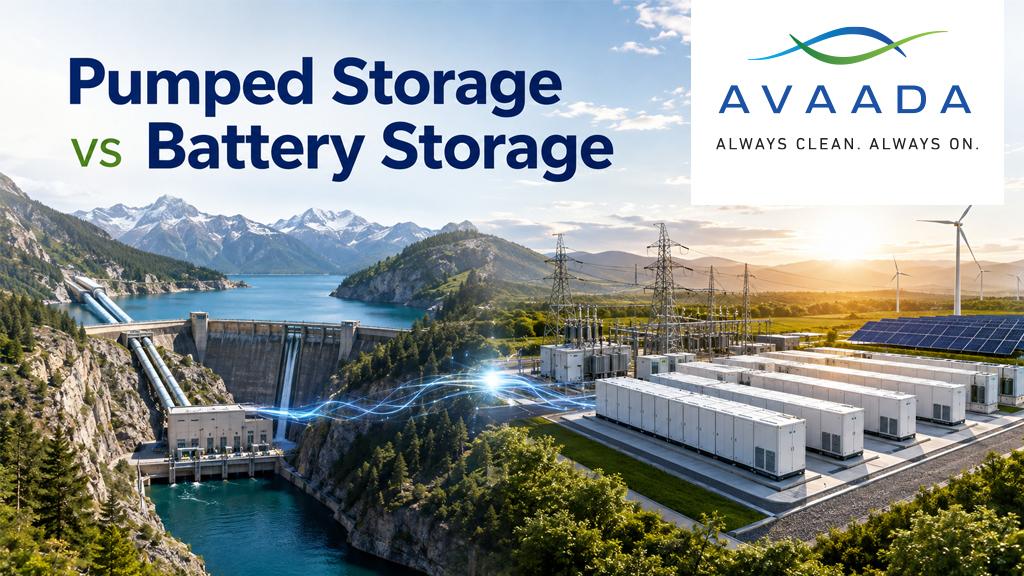
How can power grids remain stable when solar generation falls after sunset or wind output changes with weather conditions? As renewable energy becomes a larger part of the power mix, grid operators need storage systems that can balance changing electricity supply and demand.
Two major technologies support this need: Battery Energy Storage Systems (BESS) and Pumped Storage Projects (PSPs). Both store surplus electricity and release it when required, but they differ in response time, discharge duration, site requirements, cost and operating life.
What is Battery Energy Storage?
Battery Energy Storage Systems store electricity in battery cells and release it when required. Lithium-ion batteries, particularly Lithium Iron Phosphate (LFP) systems, are widely used for stationary storage applications.
BESS can support several grid and commercial applications:
- Frequency Regulation: Quickly adjusts output to help maintain grid frequency.
- Peak Shaving and Load Shifting: Stores electricity during low-demand periods and releases it when demand rises.
- Renewable Energy Smoothing: Manages short-term changes in solar and wind generation.
- Backup Power: Supplies electricity to critical commercial and industrial operations during outages.
The modular design of BESS also lets projects configure systems to match their power and storage needs.
How Do BESS Systems Work?
A BESS combines battery cells, power conversion equipment and control systems to store and supply electricity.
Charging
During periods of high solar or wind generation, the BESS receives surplus electricity. A Power Conversion System (PCS) converts the electricity into the form the battery cells require.
Discharging
When demand increases, the system converts stored energy back into electricity and supplies it to the grid or connected facility. Battery systems can respond very quickly, making them suitable for rapid changes in power requirements.
Battery Management and Thermal Safety
A Battery Management System (BMS) monitors cell voltage, temperature and state of charge. An Energy Management System (EMS) manages charging and discharging. Liquid cooling or HVAC systems help maintain suitable operating conditions.
What is Pumped Storage Hydropower?
Pumped storage hydropower stores electricity by moving water between two reservoirs at different elevations. During periods of surplus electricity, pumps move water to the upper reservoir. When demand rises, water flows back through turbines to generate electricity.
This makes pumped storage suitable for shifting large quantities of renewable electricity from periods of high generation to periods of higher demand.
Pumped Storage vs Battery Energy Storage
The two technologies use different storage methods and serve different grid requirements.
| Performance Metric | BESS | Pumped Storage Projects |
| Response Time | Milliseconds to seconds | Seconds to minutes |
| Discharge Duration | 1–4 hours; 4–8+ hours increasingly available | 6–24 hours or longer, depending on reservoir capacity |
| Round-Trip Efficiency | Generally higher (85–90%) | Generally lower (70–85%) |
| Asset Life | 10–20+ years for battery systems, with augmentation/replacement as required | 40–80+ years, with refurbishment |
| Site Requirements | Relatively flexible and modular; can be deployed close to load/grid | Requires suitable topography, reservoirs, water management and major civil infrastructure |
| Primary Grid Role | Frequency response, ancillary services, peak shaving, renewable integration and energy shifting | Long-duration storage and energy shifting: peak supply, capacity support, ancillary services and renewable integration |
BESS offers speed and flexibility, while pumped storage suits large-scale, long-duration storage.
Which Is Better for Grid Stability?
The better option depends on the grid requirement. BESS is generally better suited to fast changes, while pumped storage can provide sustained power for longer periods.
Fast Frequency Regulation
Grid frequency can change rapidly when a major generating unit or transmission asset goes offline. BESS can respond quickly through power electronic controls, making it suitable for frequency regulation and other fast grid services.
Peak Shaving and Renewable Energy Smoothing
Solar and wind generation can change throughout the day. Cloud cover can reduce solar output, while changing wind conditions affect wind generation.
BESS can charge or discharge rapidly to manage these short-term fluctuations and reduce peak demand.
Why Batteries Suit Fast Grid Services
Battery systems use power electronics to change their output rapidly. Pumped storage relies on mechanical equipment, which generally takes longer to reach the required operating level.
BESS therefore has an advantage when very fast response is required, while pumped storage is better suited to sustained energy delivery.
Long-Duration Storage: Where Pumped Storage Leads
Pumped storage becomes particularly useful when the grid needs large amounts of electricity for several hours.
Multi-Hour Storage
Increasing battery storage duration generally requires additional battery capacity. Pumped storage can provide longer discharge periods by storing more water and using larger generating equipment. This makes it suitable for shifting renewable electricity from periods of high generation to periods of high demand.
Large-Scale Energy Storage
Pumped storage can operate at large power and energy capacities. It can store surplus electricity during high renewable generation and supply it later when demand rises. This is particularly useful for solar-heavy grids, where demand can remain high after solar generation declines in the evening.
Additional Grid Services
Pumped storage can also provide physical inertia through its rotating machinery. Depending on plant design, it can support voltage control and provide black-start capability to help restore power after major outages.
Cost, Lifespan and Total Cost of Ownership
The financial comparison depends on project size, location, storage duration and operating requirements. Initial cost alone does not determine the better option.
Capital Cost and Construction
BESS requires less civil infrastructure than pumped storage and can be deployed in a modular manner. Pumped storage requires reservoirs, tunnels, water passages and generating equipment, which can result in longer development periods.
Asset Life and Replacement
Battery cells gradually lose capacity with use and age. Depending on the technology and operating profile, augmentation or replacement may be required during the project life.
Pumped storage plants can operate for several decades, although turbines, generators and other equipment require maintenance and refurbishment.
Operating and End-of-Life Costs
BESS requires thermal management, monitoring and battery maintenance. Battery modules also need appropriate end-of-life handling and recycling.
Pumped storage has different maintenance requirements, mainly involving turbines, pumps, generators and associated electrical equipment.
Choosing Battery Energy Storage Solutions
Selecting a BESS requires consideration of the battery chemistry, safety systems, thermal management, control software and grid requirements.
Key factors include:
- Battery Chemistry and Safety: LFP is widely used for stationary storage applications. The system should meet applicable safety and performance standards.
- Grid Compliance: The system should comply with applicable Central Electricity Authority (CEA) requirements and other grid-connection regulations.
- Operating Conditions: Cooling and thermal management should suit the project’s climate and operating conditions.
- Energy Management System: The EMS should monitor system performance and manage charging and discharging according to project requirements.
Also Read: What is BESS? Battery Energy Storage Systems Explained
When Utilities Use Both Technologies
BESS and pumped storage can complement each other rather than compete for the same role.
- BESS: Handles fast frequency response, short-term fluctuations and peak demand management.
- PSP: Provides large-scale energy shifting, longer discharge periods and additional grid support.
Storage can also be combined with solar and wind projects to manage variations in renewable generation. Avaada Group is developing renewable energy and storage projects, including pumped storage and battery energy storage, as part of its broader clean energy portfolio.
The choice depends on the required storage duration, response time, site conditions, project life and investment requirements. Also Read: Top 10 Battery Energy Storage Companies
Final Thoughts
BESS and pumped storage address different challenges in a modern power grid. Batteries offer rapid response and modular short-duration storage, while pumped storage provides large-scale energy storage over several hours and can operate for decades.
The right choice depends on discharge duration, response time, site conditions, project life, cost and required grid services. In many cases, combining both technologies can help grids manage short-term fluctuations while shifting larger quantities of renewable electricity over longer periods.
FAQs
What is the main difference between pumped storage and BESS?
Pumped storage stores electricity by moving water between reservoirs at different elevations. BESS stores electricity electrochemically in battery cells.
Which is faster: pumped storage or BESS?
BESS generally responds faster than pumped storage and can respond within milliseconds, making it suitable for rapid grid balancing.
Which lasts longer?
Pumped storage plants generally have a much longer operating life. BESS may require battery augmentation or replacement during its project life.
Is BESS cheaper than pumped storage?
Costs depend on project size, duration, location and operating requirements. BESS can suit shorter-duration applications, while pumped storage can be attractive for large, long-duration projects.
Can BESS and pumped storage work together?
Yes, BESS can manage fast changes in grid conditions, while pumped storage can provide longer-duration energy storage.
Which is better for grid stability?
BESS suits fast frequency regulation and short-term fluctuations, while pumped storage suits long-duration storage and several grid support services.
What are the environmental considerations?
Pumped storage requires reservoirs and water infrastructure, which can affect land and local water resources. BESS has a smaller physical footprint but requires responsible battery material handling and recycling.