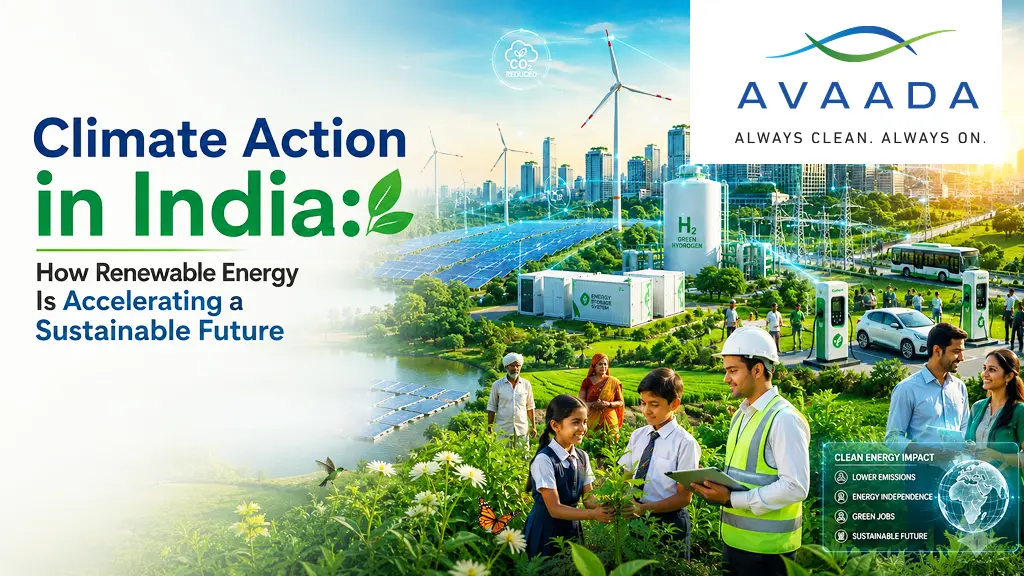
As the world’s most populous country and one of the fastest-growing economies, India stands at a defining moment in its development journey. The nation is balancing rapid economic growth with the urgent need to build a cleaner, more sustainable future. Today, India ranks third globally, after China and the United States, in total renewable energy installed capacity. For a country of over 1.4 billion people, this transformation is more than an environmental milestone – it is a strategic imperative.
India’s renewable energy transition reflects a broader commitment to sustainable energy solutions that strengthen energy security, reduce carbon emissions, and position the country as a global climate leader. Behind this transformation are government policies, technological innovation, and every renewable energy company and renewable energy solutions provider working together to accelerate India’s clean energy future.
Why Climate Action Matters in India Right Now
India faces a unique challenge. It is among the countries most vulnerable to climate change, experiencing extreme heat, erratic rainfall, water scarcity, and rising coastal risks. At the same time, the country must generate massive amounts of electricity to support urbanization, industrialization, and economic growth.
Historically, India’s development relied heavily on coal and other fossil fuels. However, the country’s energy landscape is rapidly evolving. India still imports a significant portion of its crude oil, coal, and natural gas, making energy security just as important as climate action. Every gigawatt of solar or wind capacity installed strengthens India’s energy independence while reducing its dependence on imported fuels.
The transition to renewable energy also brings significant public health benefits. Replacing coal-fired power generation with cleaner alternatives reduces harmful particulate emissions, helping lower the incidence of respiratory illnesses and improving air quality across the country.
Also Read: Round-the-Clock Renewable Energy
The Numbers Behind India's Renewable Push
India’s renewable energy journey has gained remarkable momentum over the past few years.
As of 2026, India’s total non-fossil power capacity has reached approximately 283 GW, with renewable energy contributing nearly 275 GW. Solar energy continues to lead the transition, surpassing 150.2 GW of installed capacity, followed by 56 GW of wind energy and over 50 GW from large hydroelectric projects.
FY 2025–26 marked a historic milestone, with India recording its highest-ever annual renewable energy capacity addition. Solar installations alone increased by a record 44.61 GW, reflecting the country’s accelerating clean energy transition, while states such as Gujarat, Maharashtra, Rajasthan, Karnataka, and Tamil Nadu continue to lead renewable deployment.
Another major achievement came when India reached 50% of its installed electricity capacity from non-fossil fuel sources, achieving this milestone five years ahead of its commitment under the Paris Agreement. The country’s next target is to achieve 500 GW of non-fossil fuel capacity by 2030, as announced under the Panchamrit commitments at COP26.
India has also strengthened its climate leadership through its updated Nationally Determined Contributions (NDCs) for the 2031–2035 period, reaffirming its commitment to reducing emissions intensity, increasing non-fossil fuel-based electricity generation, and building a low-carbon economy. These commitments create significant opportunities for every renewable energy company contributing to India’s clean energy transformation.
Also Read: Advantages of wind energy
Behind every one of these achievements is a project that has been planned, financed, developed, and commissioned by organizations committed to delivering reliable and sustainable energy infrastructure.
The Role of a Renewable Energy Company in India's Energy Transition
None of these achievements would be possible without strong execution on the ground. This is where a renewable energy solutions provider plays a vital role.
While government policies establish the direction, private developers transform these ambitions into reality by developing solar parks, installing wind farms, securing land and transmission infrastructure, arranging project financing, and ensuring long-term operational excellence.
The industry is also evolving beyond standalone renewable projects. Integrated renewable energy solutions combining solar, wind, Battery Energy Storage Systems (BESS), and round-the-clock renewable power supply are becoming increasingly common. These integrated solutions help improve grid reliability while delivering uninterrupted clean electricity to industries and utilities.
How Clean Energy Companies Are Driving Innovation
Beyond adding renewable capacity, today’s clean energy company is focused on solving complex challenges around storage, grid stability, manufacturing, and energy resilience. Modern green energy solutions are transforming renewable energy from an intermittent resource into a dependable source of electricity.
Some of the most significant developments include:
Green Hydrogen
Green Hydrogen is rapidly progressing from pilot projects to commercial deployment. Under the National Green Hydrogen Mission, the Government of India has significantly increased investments to support an annual production target of five million metric tonnes by 2030, creating new opportunities across industrial sectors.
Battery Energy Storage Systems (BESS)
Battery Energy Storage Systems are increasingly being integrated with solar and wind projects to improve grid reliability and address renewable energy intermittency. Storage technologies will play a critical role in supporting India’s future electricity demand.
Distributed and Rooftop Solar
Distributed solar installations continue to expand across residential, commercial, and industrial sectors. With rooftop solar installations surpassing 27 GW, consumers are becoming active participants in India’s clean energy transition while reducing electricity costs and improving energy independence.
Together, these innovations represent the next generation of green energy solutions and sustainable energy solutions, enabling India to build a more resilient, efficient, and self-reliant energy ecosystem.
Key Challenges on the Road Ahead
Despite impressive progress, several challenges continue to influence the pace of renewable energy deployment.
Land acquisition for utility-scale renewable projects remains a lengthy and complex process. Transmission infrastructure also requires significant expansion to connect renewable-rich states such as Rajasthan and Gujarat with major demand centres across the country.
Battery storage projects continue to face financing challenges, while renewable deployment remains concentrated in a handful of states, leaving significant untapped potential across other regions.
Addressing these challenges will require stronger policy support, faster infrastructure development, improved financing mechanisms, and continued investments from every renewable energy solutions provider committed to delivering scalable green energy solutions for India’s growing energy needs.
The Road Ahead
To achieve net-zero emissions by 2070, India must continue expanding renewable capacity while simultaneously investing in transmission infrastructure, energy storage, smart grids, and emerging technologies.
The country’s climate ambitions extend well beyond the 500 GW target. Electrification of transportation, large-scale deployment of Battery Energy Storage Systems, green hydrogen production, and industrial decarbonization will define the next phase of India’s clean energy transition.
What is becoming increasingly clear is that the organizations driving this transformation are doing much more than building power plants. They are creating the infrastructure that will power India’s economic growth for decades to come.
Whether it is commissioning large-scale solar parks, advancing battery storage technologies, or delivering integrated renewable energy projects, the shared objective remains the same—providing reliable, affordable, and sustainable energy solutions that support India’s climate commitments, strengthen energy security, and power long-term economic growth.
As India accelerates towards becoming a global clean energy leader, collaboration between policymakers, businesses, investors, and technology providers will remain essential. Together, they are building a cleaner, greener, and more resilient energy future for generations to come.
FAQs
Which is the best renewable energy company in India?
There are several leading renewable energy companies in India, each offering different strengths in solar, wind, Battery Energy Storage Systems (BESS), hybrid renewable projects, and power generation. The best renewable energy company depends on factors such as project scale, technology expertise, execution capability, operational track record, and long-term sustainability goals.
What makes a top renewable energy solutions provider?
A leading renewable energy solutions provider offers end-to-end services, including project development, engineering, procurement, construction (EPC), operations and maintenance, energy storage integration, and long-term power supply. Companies that combine solar, wind, BESS, and hybrid renewable projects provide more reliable and sustainable energy solutions for businesses and utilities.
What is an integrated renewable energy company?
An integrated renewable energy company develops and manages multiple clean energy technologies under one platform. These may include solar power, wind energy, Battery Energy Storage Systems (BESS), hybrid renewable projects, and round-the-clock renewable power solutions to deliver reliable and efficient green energy.
Which company provides round-the-clock renewable energy in India?
Several leading renewable energy companies are developing round-the-clock (RTC) renewable energy projects by combining solar, wind, and battery energy storage systems. These integrated renewable energy solutions help ensure a continuous and reliable power supply while supporting India’s clean energy transition.
Which renewable energy company is suitable for large-scale utility and government projects?
Companies with strong experience in utility-scale solar parks, wind farms, hybrid renewable projects, and large infrastructure development are typically best suited for government and utility projects. Factors such as project execution, financial strength, technical expertise, regulatory compliance, and long-term operational capabilities are key considerations when selecting a renewable energy company.